(a) A Particle on a Smooth Horizontal Circle
Let a particle of mass m, constrained to move on a smooth horizontal circle of radius a, be given
an initial velocity V , and let it be resisted by the air with a force proportional to the square of its
velocity.
Here we have one degree of freedom. Let us take as our coordinate the angle 𝜃 which the particle
has described about the center of its path in the time t.
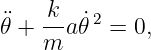
Our differential equation is
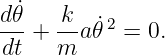
which reduces to
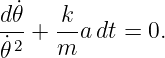
or
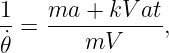
Separating the variables,
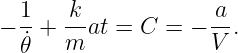
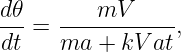
Integrating,
Hence
and
The problem of the motion is completely solved.
(b) The Pressure of the Constraining Curve
If, however, we are interested in R, the pressure of the constraining curve, we must
proceed somewhat differently. We have only to replace the constraint by a force R directed
toward the center of the path. There are now two degrees of freedom, and we shall
take 𝜃 and the radius vector r as our coordinates and form two differential equations of
motion.
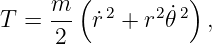
Thus
To these we may add
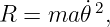
Whence
as before, and
(c) The Constraining Circle Rough
Let us now suppose that the constraining circle is rough. Here, since the friction is μR (the
coefficient of friction multiplied by the normal pressure), R will be needed, and we must replace
the constraint by R as before.
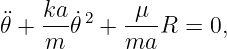
We have now
and
Whence
as before, and
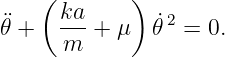
or
Replacing ka∕m in (1) by ka∕m + μ, we have
Examples
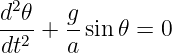
- Obtain the familiar equation
for the simple pendulum.
- Find the Tension of the string in the simple pendulum.
Answer.
- Obtain the equations of the spherical pendulum in terms of the spherical coordinates
𝜃 and ϕ.
Answer.
Source
William Elwood Byerly, An Introduction to the Use of Generalized Coördinates in mechanics and
Physics, Ginn and Company, 1916. Chapter I, “Introduction.”
The 1916 source work is in the public domain in the United States.

![[parent]](https://images.physicslibrary.org/images/uparrow.png)


![( )
m m kV t
𝜃 = ka-log [m + kV t] + C = ka-log 1 + -m-- . (1)](https://images.physicslibrary.org/cache/objects/1064/make4ht/ExampleOfDynamicsOfAParticleConstrainedMotion8x.png)









![[ ( ) ]
1 ka V t
𝜃 = ka-----log 1 + m--+ μ a-- . (1)
---+ μ
m](https://images.physicslibrary.org/cache/objects/1064/make4ht/ExampleOfDynamicsOfAParticleConstrainedMotion22x.png)
![[ ( )2]
d𝜃-
R = m g cos𝜃 + a dt .](https://images.physicslibrary.org/cache/objects/1064/make4ht/ExampleOfDynamicsOfAParticleConstrainedMotion24x.png)
