
|
|
|
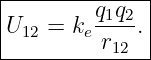
|||||||
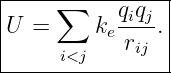
For N charges, add the energy of every distinct unordered pair:
This excludes each ideal point charge’s divergent self-energy. Positive pair products increase energy relative to infinite separation. Opposite-sign pairs contribute negative energy.
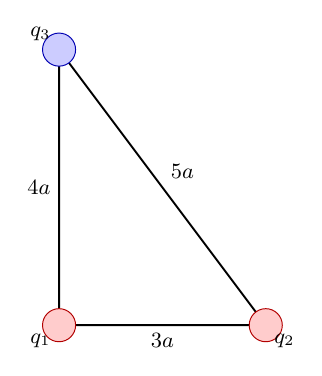
Figure 1. A three-charge triangle. Three pair distances enter the total energy, each exactly once.
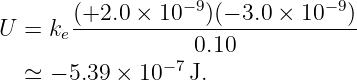
2 Worked example 1: two charges and a sign checkBring q1 = +2.0 nC and q2 = −3.0 nC to separation r = 0.10 m. Then
The negative result means the pair has lower electrostatic interaction energy than when infinitely separated. The electric force can do positive work while the negative charge approaches the positive charge, so a quasistatic external agent must remove the released energy.
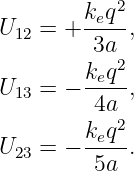
3 Worked example 2: assembly of three chargesAt the vertices of a right triangle with sides 3a, 4a, and 5a, place charges q1 = +q, q2 = +q, q3 = −q. Let r12 = 3a, r13 = 4a, and r23 = 5a. The three pair interactions are
Add with a common denominator 60a:
An independent assembly-order check: bring q1 first for zero pair energy, q2 next at cost U12, and q3 last at cost q3(V 1 + V 2) = U13 + U23. The same total results.
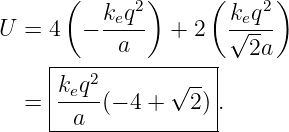
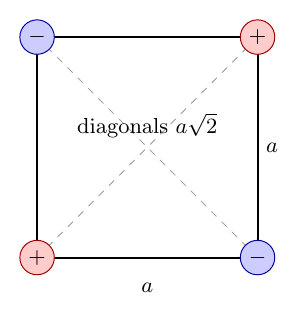
4 Worked example 3: four alternating charges on a squarePut +q,−q, +q,−q successively around a square of side a. Four edges connect opposite charges and
contribute −keq2∕a each. Two diagonals connect like charges and have length a
The configuration is negative in energy despite having net zero charge. Net charge by itself does not determine configuration energy.
Figure 2. Alternating-sign charges on a square. Four opposite-sign edge pairs and two like-sign diagonal pairs contribute to the assembly energy.
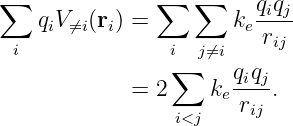
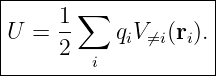
5 Worked example 4: the double-counting factorLet V ≠i(ri) denote the potential at charge i from all the other charges. Compute
Every unordered pair appears twice, once as (i,j) and once as (j,i). Hence
The 1∕2 is necessary in this all-charge formulation, but not when adding the new pair interactions one by one during assembly.
6 Worked example 5: interaction between distant dipolesConsider two fixed dipoles separated by R = RR, with moments p1 and p2 and R much larger than their charge separations. The field produced by dipole 1 at dipole 2 is
The energy of dipole 2 in this approximately uniform external field is U12 = −p2 ⋅ E1, so
For aligned parallel moments along the separation direction, U = −2kep1p2∕R3. For aligned parallel moments transverse to that direction, U = +kep1p2∕R3. Orientation affects energy even when each dipole is neutral.
7 Energy constraints in capacitance experimentsEnergy calculations for charges assembled without a power source must be distinguished from experiments with a battery maintaining fixed voltage. For a linear capacitor, UC = Q2∕(2C) = CV 2∕2. If V is externally held fixed while C changes, the battery transfers charge and performs work, so differentiating UC alone as though the capacitor were isolated can give the wrong mechanical-force sign. ES05E5 develops the appropriate combined energy accounting.
8 Exercises and complete solutionsExercise 1. Two equal positive charges q lie distance a apart. Find the pair energy. Solution. U = keq2∕a > 0, since the charges repel and external work is needed to assemble them quasistatically. Exercise 2. Three equal charges q occupy an equilateral triangle of side a. What is U? Solution. There are Exercise 3. The square in Example 3 is expanded from side a to 2a with the same charges. How does its interaction energy change? Solution. Every pair distance doubles and U ∝ 1∕a at fixed geometry, so U(2a) = U(a)∕2. The energy becomes less negative. Exercise 4. Two dipoles have p1 = px, p2 = py, and R = x. What is the leading interaction energy? Solution. p1 ⋅ p2 = 0, and p2 ⋅R = 0, so the leading dipole-dipole interaction energy is zero. Higher multipoles may still contribute to a finite pair of charge distributions.
References
"Electrostatic Assembly Energy of Point Charges" is owned by bloftin.
This object's parent. Cross-references: external work, voltage, power, net charge, square, positive charge, negative charge, force, kinetic energy, electric potential, energy, charges, work There is 1 reference to this object. This is version 1 of Electrostatic Assembly Energy of Point Charges, born on 2026-11-28. Object id is 1630, canonical name is ElectrostaticAssemblyEnergyOfPointCharges. Accessed 2 times total. Classification:
|
|
|
|
Pending Errata and AddendaNone.
|
DiscussionNo messages.
|
Interact |


 , contributing
+
 ) each. Thus


 = 3 distinct pairs, all at distance