Celestial Mechanics: Gravitational Potential and Potential Energy
CM01 described gravity as a force and as a gravitational field. The next step is to reformulate the
same physics in terms of work and potential. This viewpoint is essential because celestial mechanics
repeatedly uses energy to classify orbits, derive escape conditions, analyze turning points, and
understand bound versus unbound motion.
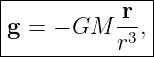
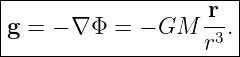
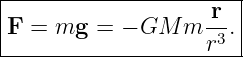
For a point mass M, CM01 gave The Gravitational Field
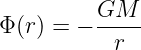
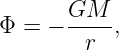
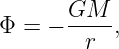
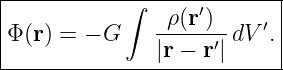
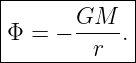
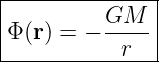
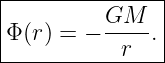
CM02 will derive the scalar gravitational potential
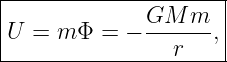
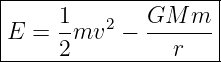
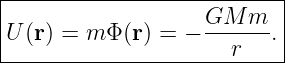
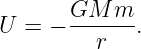
and the potential energy of a mass m,
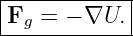
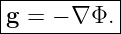
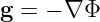
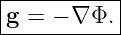
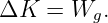
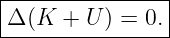
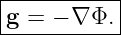
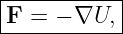
The connection among force, field, potential, and work will then be summarized by
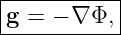
and
These are not new laws added to Newtonian gravity. They are alternative mathematical
descriptions of the same conservative interaction [1, 2, 3, 4].
1 Work done by a force
For a constant force, introductory mechanics often writes work as
Gravity in celestial mechanics is not constant. Its magnitude changes with separation, so the
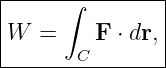
correct expression is the line integral
where C is the path followed by the particle.
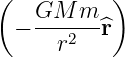
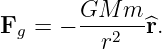
For gravity produced by a point mass M at the origin,
Suppose the particle moves radially from r1 to r2. Then
Therefore
| Wg | = ∫
r1r2
Fg ⋅ dr | (11)
|
| = ∫
r1r2
 ⋅ ⋅ | (12)
|
| = −GMm∫
r1r2
 . . | (13) |
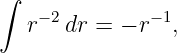
Since
we obtain
| Wg | = −GMm![[ ]
1-
− r](https://images.physicslibrary.org/cache/objects/1251/make4ht/CelestialMechanicsGravitationalPotentialAndPotentialEnergy14x.png) r1r2 r1r2
| (15)
|
| = GMm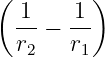 . . | (16) |
Thus
This sign contains the physics.
If the mass moves outward, then
so
and therefore
Gravity opposes the outward motion and does negative work.
If the mass falls inward, then r2 < r1 and
Gravity then does positive work on the particle.
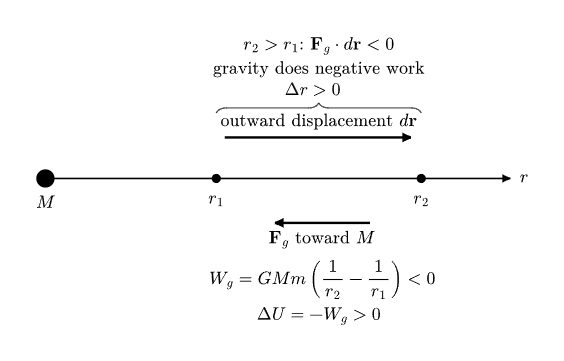
Figure. When a mass is displaced outward while gravity points inward, Fg ⋅ dr < 0.
Gravity does negative work and gravitational potential energy increases.
2 Conservative forces and potential energy
A force is called conservative when the work done between two points depends only on the
endpoints, not on the particular path between them.
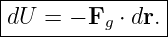
For a conservative force, one defines potential energy U by
For gravity,
Using the point-mass work result,
| U2 − U1 | = −GMm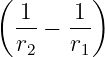 | (24)
|
| = GMm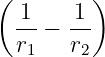 . . | (25) |
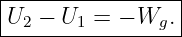
Therefore
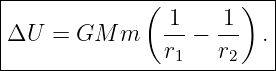
Potential energy increases when a mass is moved outward against gravity and decreases when the
mass falls inward.
3 Only differences in potential energy are physically required
The equations of motion depend on forces, and forces depend on spatial derivatives of potential
energy. Adding any constant C to U leaves the force unchanged:
Then
Thus the zero of potential energy is a convention.
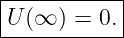
For isolated gravitational systems, the most useful convention is
This choice is especially convenient in celestial mechanics because it cleanly distinguishes
finite-separation bound states from the limiting state of complete separation.
4 Deriving the point-mass potential energy
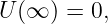
Take the initial point to be at infinity and the final point to be at radius r:
With U(∞) = 0,
| U(r) − U(∞) | = GMm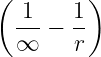 | (31)
|
| = − . . | (32) |
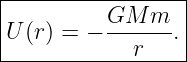
Therefore
This negative sign is a direct consequence of the chosen zero at infinity.
At any finite separation,
As the masses are separated farther and farther,
As they move closer together,
becomes more negative.
5 Why negative gravitational potential energy is physically sensible
Imagine two masses initially separated infinitely far apart and at rest. Under the convention
they begin with zero gravitational potential energy.
Now allow them to fall toward one another. Gravity does positive work, increasing kinetic energy.
Conservation of energy requires a corresponding decrease in potential energy. Therefore the
finite-separation state must have
Conversely, separating the masses back to infinity requires positive external work. That work raises
U from a negative value to zero.
The negative value therefore encodes the energy that must be supplied to completely separate an
attractive gravitational system.
6 The gravitational potential Φ
Potential energy depends on both the source mass M and the test mass m:
Just as CM01 separated gravitational field from force, it is useful to separate the source-generated
potential from the test mass.
Define gravitational potential by
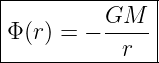
For a point mass,
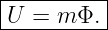
Then the potential energy of any test mass is simply
The gravitational potential belongs to the gravitational field generated by the source distribution.
Potential energy belongs to the interaction between that field and a particular mass placed within
it.
This distinction parallels the relation
The two pairs are therefore
and
7 Units of gravitational potential
Since
its SI units are
Using
we obtain
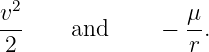
These are the same dimensions as speed squared. This becomes important later because orbital
energy per unit mass naturally contains terms such as
8 The shape of the point-mass potential
The function
approaches zero from below as r becomes large.
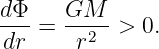
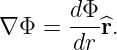
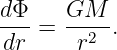
Its derivative is
Thus Φ increases as one moves outward. Moving inward takes the particle toward increasingly
negative potential.
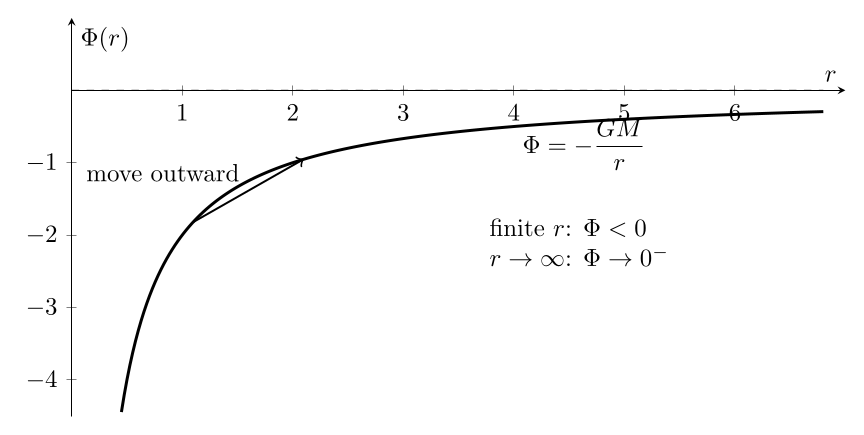
Figure. With the conventional zero Φ(∞) = 0, the point-mass gravitational potential is
negative at every finite radius and approaches zero from below as r →∞.
9 Differential relation between work and potential energy
For an infinitesimal displacement,
For a conservative force,
Therefore
A scalar field U(r) changes under an infinitesimal displacement according to
Equating the two expressions gives
Because this must hold for arbitrary infinitesimal displacements,
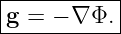
This is the fundamental relation between a conservative force and its potential energy.
10 From gravitational potential to gravitational field
Use
and
Then
| mg | = −∇(mΦ) | (61)
|
| = −m∇Φ. | (62) |
Cancel the test mass:
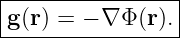
This is one of the most important relations in gravitational physics.
The field points in the direction in which gravitational potential decreases most rapidly.
11 Checking g = −∇Φ for a point mass
For spherical symmetry,
so
With
we have
Therefore
| g | = −∇Φ | (68)
|
| = − r. r. | (69) |
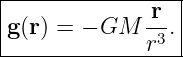
Hence
which is exactly the gravitational field obtained directly from Newton’s law in CM01.
The potential description therefore reproduces the original force law.
12 Equipotential surfaces
An equipotential surface is a surface on which
For a point mass,
so constant potential means constant radius. The equipotential surfaces are therefore spheres
centered on the mass.
Along an equipotential surface,
But
Therefore a displacement tangent to an equipotential surface is perpendicular to ∇Φ and hence
also perpendicular to g.
Thus
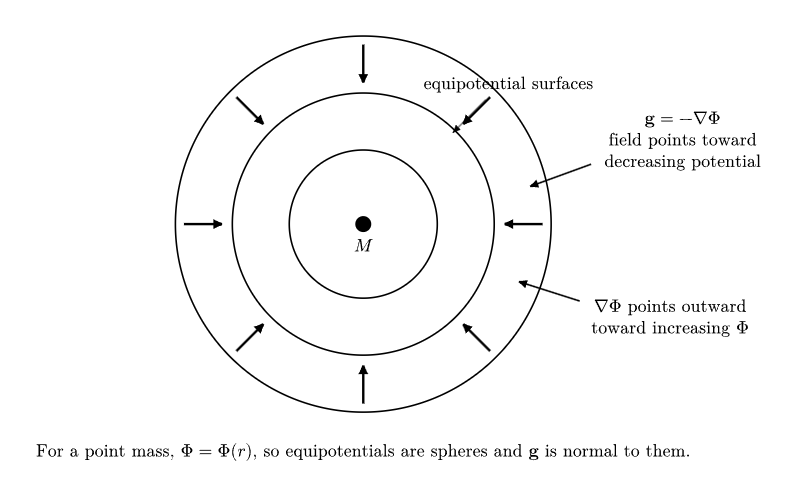
Figure. For a point mass, the equipotential surfaces are concentric spheres. The gradient
∇Φ points toward increasing potential, while the gravitational field g = −∇Φ points
inward toward decreasing potential.
13 Work written directly in terms of potential
Because
we have
Since
then
Equivalently,
For a point mass,
| Wg | = −m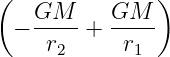 | (81)
|
| = GMm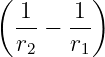 , , | (82) |
which agrees with the direct force integral.
14 Path independence
Once
has been established, the path independence of gravitational work follows immediately.
For any path from point 1 to point 2,
| Wg | = m∫
12g ⋅ dr | (84)
|
| = −m∫
12∇Φ ⋅ dr | (85)
|
| = −m(Φ2 − Φ1). | (86) |
Only the endpoints appear in the final result.
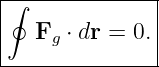
Therefore the work around any closed path is zero:
This is the operational statement that Newtonian gravity is conservative away from singular point
sources.
15 Potential from several point masses
Gravitational fields obey superposition. Because gradients are linear, gravitational potentials do as
well.
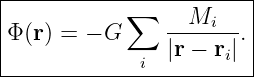
Suppose masses Mi are located at positions ri. The potential at field point r is
Then
Potential is often easier to superpose than force because it is a scalar. One adds numbers
rather than vectors, and takes the gradient only after the total scalar potential has been
assembled.
This becomes extremely useful in multi-body celestial mechanics and in gravitational modeling of
extended bodies.
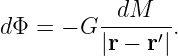
16 Potential of a continuous mass distribution
Let a mass density be
An infinitesimal source element has mass
Its contribution to the potential at r is
Integrating over the source gives
The field is then obtained from
This scalar-potential formulation is one of the gateways from elementary celestial mechanics to
geophysics, stellar structure, galactic dynamics, and numerical gravity models.
17 Mechanical energy conservation
The work-energy theorem states
If gravity is the only force doing work,
But
Therefore
so
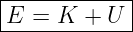
Hence the total mechanical energy
is constant for motion under time-independent Newtonian gravity alone.
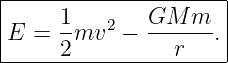
For a test mass m moving in the field of a fixed point mass M,
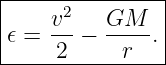
Dividing by m gives the specific mechanical energy
This equation will become central later when the course classifies circular, elliptic, parabolic, and
hyperbolic trajectories.
18 Example 1: Earth’s gravitational potential at the surface
Using
and
Earth’s surface gravitational potential is approximately
| Φ(RE) | = − | (105)
|
| ≈−6.26 × 10⁷ J/kg. | (106) |
Therefore
This number says that, under the point-mass/spherical-Earth approximation, approximately
62.6 MJ of energy per kilogram would be required to raise matter from Earth’s surface to rest at
infinite distance.
It does not mean that a launch vehicle must literally supply exactly that amount as usable
propulsion energy; real launch problems include kinetic-energy requirements, atmosphere, finite
burn trajectories, losses, Earth rotation, and other effects. Here the number is purely the
gravitational potential-energy difference.
19 The near-surface approximation and mgh
Introductory mechanics often uses
This is not a different gravitational theory. It is the small-height approximation to the exact
Newtonian potential.
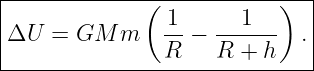
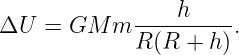
Suppose an object of mass m is raised from radius R to radius R + h. The exact potential-energy
change is
| ΔU | = U(R + h) − U(R) | (109)
|
| = − + +  | (110)
|
| = GMm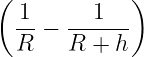 . . | (111) |
Thus
Combine the fractions:
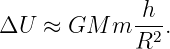
If
then
so
At the surface,
Therefore
The familiar constant-g expression is therefore the first-order local approximation to the exact
inverse-radius potential.
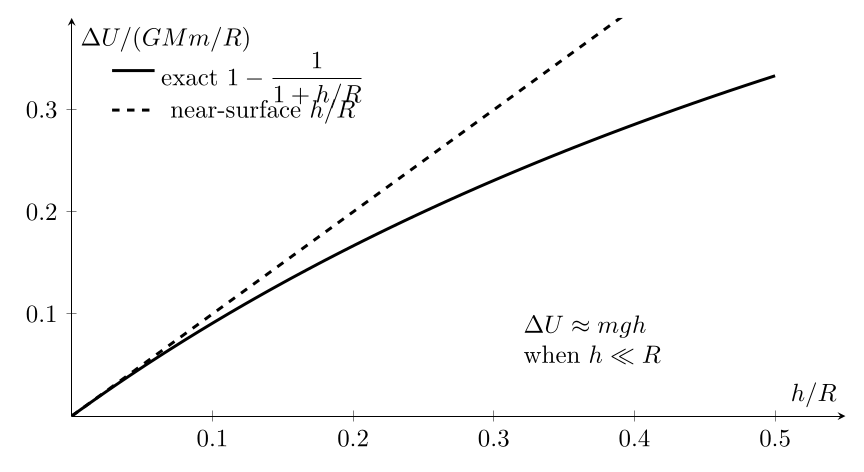
Figure. The exact Newtonian potential-energy increase approaches the straight-line mgh
approximation when the height h is small compared with the body’s radius R.
20 Example 2: raising one kilogram to 400 km altitude
Take
and
For m = 1 kg, the exact increase is
| ΔU | = GME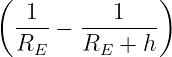 | (122)
|
| ≈ 3.70 × 10⁶ J. | (123) |
Thus
Using constant surface gravity instead gives
| ΔUmgh | ≈ (9.82)(4.00 × 10⁵) | (125)
|
| ≈ 3.93 × 10⁶ J/kg. | (126) |
The constant-g estimate is about 6% high because Earth’s gravitational field weakens appreciably
over a 400 km rise.
This example shows exactly when celestial-mechanics gravity must replace the local constant-g
approximation.
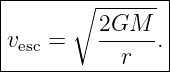
21 Preview: escape speed from gravitational potential
Potential energy gives a short derivation of escape speed.
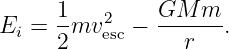
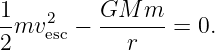
Suppose a particle starts at radius r with speed vesc and just barely reaches infinity with zero final
speed. Then
Initially,
At infinity,
so
Therefore
Cancel m and solve:
At Earth’s surface this gives approximately
The cancellation of the test mass is another expression of the equivalence between gravitational
field and acceleration in Newtonian mechanics.
A more complete interpretation of this result belongs later in the orbital-energy lessons, where
zero, negative, and positive specific energies will be connected to parabolic, elliptic, and hyperbolic
motion.
22 Spherically symmetric bodies and the point-mass exterior potential
A major result developed more fully in later gravity examples is Newton’s shell theorem. For a
spherically symmetric body of total mass M, the gravitational field outside the body is the same as
if all mass were concentrated at the center:
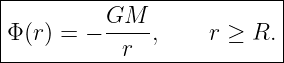
With the convention Φ(∞) = 0, the exterior potential is therefore
This is why point-mass formulas work so well for planets and stars when we are outside a nearly
spherical source.
Inside an extended body, however, the potential generally depends on the internal mass
distribution. The simple exterior expression cannot automatically be continued through the
interior.
23 Potential versus field: which description should we use?
The field formulation is
The potential is a scalar, while the field is a vector.
Potential is often advantageous when:
- adding contributions from many sources;
- using energy conservation;
- finding equilibrium points;
- exploiting symmetry;
- deriving orbital turning points;
- constructing effective potentials;
- solving gravitational boundary-value problems.
The field is often advantageous when:
- computing instantaneous acceleration;
- integrating equations of motion directly;
- determining local force direction;
- propagating trajectories numerically.
Celestial mechanics routinely moves between the two descriptions.
24 A compact hierarchy of gravitational quantities
For a point source mass M, the sequence is
followed by
A test mass m then has
and
The work done by gravity between two locations is
This compact network of relations is worth learning as a connected structure rather than as four
independent formulas.
25 Common mistakes
- Forgetting that the zero of gravitational potential is conventional. The standard
isolated-system choice is Φ(∞) = 0.
- Treating negative potential energy as an error. With zero at infinity, attractive
point-mass gravity gives negative U at finite separation.
- Confusing potential Φ with potential energy U. They are related by U = mΦ.
- Confusing field g with force F. They are related by F = mg.
- Missing the minus sign in g = −∇Φ. Gravity points toward decreasing potential.
- Using mgh over distances that are not small compared with the source radius.
- Assuming that Φ = −GM∕r is valid everywhere inside an extended body. It is exact
outside a spherically symmetric body but the interior potential depends on the mass
distribution.
- Forgetting that gravitational work is positive during inward fall and negative during
outward motion.
- Using only the magnitude GM∕r2 when a vector field direction is required.
26 What CM02 adds to the series
CM01 introduced gravity through force and field. CM02 adds the scalar potential description and
the energy viewpoint.
The central derivation chain is
Dividing by the test mass gives
Differentiating recovers the field:
The energy equation
now provides the bridge to orbital mechanics. The next lessons can use this framework to examine
gravitational potentials of spherical bodies and then move into Newton’s orbital equation of motion
and central-force dynamics.
References
[1] Herbert Goldstein, Charles Poole, and John Safko, Classical Mechanics, 3rd ed.,
Addison-Wesley, 2001.
[2] John R. Taylor, Classical Mechanics, University Science Books, 2005.
[3] J. M. A. Danby, Fundamentals of Celestial Mechanics, 2nd ed., Willmann-Bell, 1988.
[4] Bradley W. Carroll and Dale A. Ostlie, An Introduction to Modern Astrophysics, 2nd
ed., Pearson Addison-Wesley, 2007.
[5] Roger R. Bate, Donald D. Mueller, and Jerry E. White, Fundamentals of
Astrodynamics, Dover reprint of the 1971 edition.




















![J
[Φ] = ---.
kg](https://images.physicslibrary.org/cache/objects/1251/make4ht/CelestialMechanicsGravitationalPotentialAndPotentialEnergy46x.png)

![|------------|
|[Φ ] = m2 ∕s2.
--------------](https://images.physicslibrary.org/cache/objects/1251/make4ht/CelestialMechanicsGravitationalPotentialAndPotentialEnergy48x.png)