Trigonometric Identities: A Reference and Derivation Roadmap
Trigonometric identities are equalities between trigonometric expressions that hold at every
angle for which both sides are defined. They are essential in algebra, calculus, geometry,
differential equations, waves, oscillations, Fourier analysis, Electromagnetism, and orbital
mechanics.
This article is a parent reference: it assembles the principal identities into related families, explains
when each family is useful, gives short verification examples, and identifies the derivations to be
developed in independent PhysicsLibrary companion articles. Those future companion entries will
derive the formulas from first principles, including the unit circle, rotation matrices, and complex
exponentials.
The accompanying calculus entries INT01: Trigonometric Substitution for Integration and
INT01E1: Worked Problems and Solutions emphasize how these identities remove quadratic
radicals in integrals.
1 What qualifies as an identity?
An identity is not simply an equation that happens to hold at one angle. For example,
holds for all real x, whereas
holds only at particular angles and is an equation to solve.
An identity may still have domain restrictions. The relation
holds only when cos x≠0. The restriction is necessary because both tan x and sec x are undefined
when cos x = 0.
Unless stated otherwise, angles are measured in radians and k denotes any integer. All identities
involving ratios or square roots are interpreted on their common real domains.
2 The unit-circle foundation
A point at angle 𝜃 on the unit circle has coordinates
Since this point lies on x2 + y2 = 1,
This geometric equation is the foundation of the Pythagorean identities.
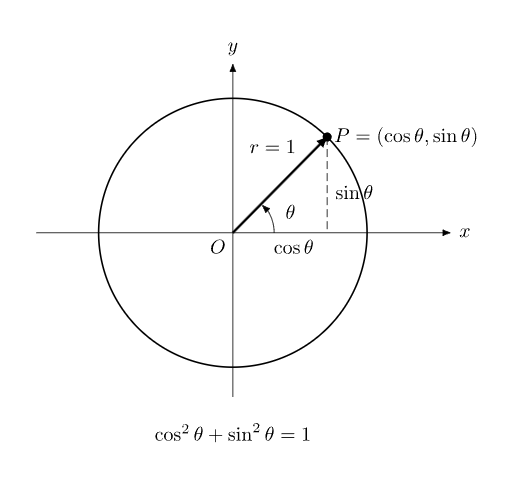
Figure 1. The unit circle defines sine as the vertical coordinate and cosine as the horizontal
coordinate. The radius has length one, so the Pythagorean theorem immediately relates their
squares.
The six standard functions are
| sin 𝜃 | = y, | cos 𝜃 | = x, | (6)
|
| tan 𝜃 | =  , | cot 𝜃 | =  , | (7)
|
| sec 𝜃 | =  , | csc 𝜃 | =  , | (8) |
where each quotient requires a nonzero denominator.
3 Common exact-angle values
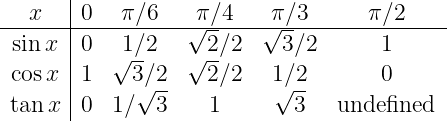
The most-used first-quadrant values provide quick independent checks on proposed
identities:
These are evaluations rather than identities; the preceding unit-circle relations explain why they
are consistent.
4 Family 1: Reciprocal and quotient identities
4.1 Reciprocal identities
| csc x | =  , | sin x | =  , | (10)
|
| sec x | =  , | cos x | =  , | (11)
|
| cot x | =  , | tan x | =  . | (12) |
The last pair is restricted to angles at which the indicated expressions are defined. In particular
cot x = cos x∕ sin x is defined at angles where sin x≠0, even though 1∕ tan x requires tan x to be
both defined and nonzero. These two written forms are equal on their common domain; they do
not have identical domains as standalone expressions.
4.2 Quotient identities
| tan x | =  , | (13)
|
| cot x | =  . | (14) |
For example, wherever sin x cos x≠0,
The multiplication by one is valid because every canceled factor is nonzero.
5 Family 2: Pythagorean identities
The three most frequently used forms are
| sin 2x + cos 2x | = 1, | (16)
|
| 1 + tan 2x | = sec 2x, | (17)
|
| 1 + cot 2x | = csc 2x. | (18) |
Useful rearrangements include
| sin 2x | = 1 − cos 2x, | (19)
|
| cos 2x | = 1 − sin 2x, | (20)
|
| sec 2x − 1 | = tan 2x, | (21)
|
| csc 2x − 1 | = cot 2x. | (22) |
A representative derivation is to divide sin 2x + cos 2x = 1 by cos 2x, assuming cos x≠0:
 +  | =  , | (23)
|
| tan 2x + 1 | = sec 2x. | (24) |
These identities are particularly useful in integration because they turn expressions such as
1 + tan 2𝜃 into a perfect square of a secant.
6 Family 3: Even, odd, periodic, and cofunction identities
6.1 Even and odd functions
| sin(−x) | = − sin x, | cos(−x) | = cos x, | (25)
|
| tan(−x) | = − tan x, | cot(−x) | = − cot x, | (26)
|
| csc(−x) | = − csc x, | sec(−x) | = sec x. | (27) |
Sine is odd and cosine is even. Their reciprocals have the same parity, and their quotients inherit
the appropriate parity.
6.2 Periodicity
| sin(x + 2πk) | = sin x, | (28)
|
| cos(x + 2πk) | = cos x, | (29)
|
| sec(x + 2πk) | = sec x, | (30)
|
| csc(x + 2πk) | = csc x, | (31)
|
| tan(x + πk) | = tan x, | (32)
|
| cot(x + πk) | = cot x. | (33) |
For tangent and cotangent, π is a period, while sine and cosine have fundamental period
2π.
6.3 Reflection and cofunction identities
| sin(π − x) | = sin x, | (34)
|
| cos(π − x) | = − cos x, | (35)
|
sin  | = cos x, | (36)
|
cos  | = sin x, | (37)
|
tan  | = cot x, | (38) |
with the usual restrictions for quotients. An equivalent cofunction form is sec(π∕2 − x) = csc x on
the common domain.
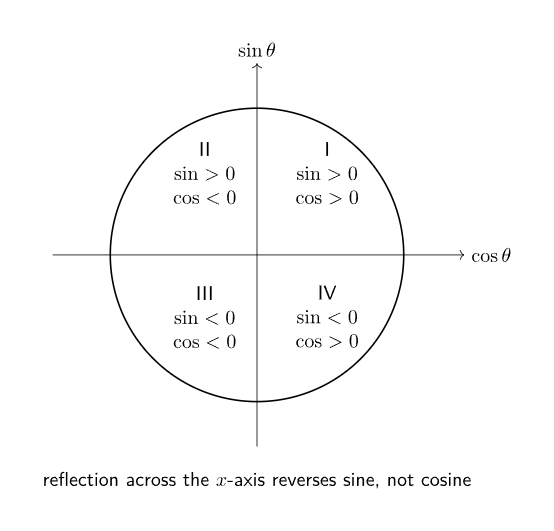
Figure 2. The signs of sine and cosine follow from the signs of the unit-circle coordinates.
Symmetry across the axes explains the even, odd, and reflection identities.
7 Family 4: Angle addition and subtraction
7.1 Sine and cosine
| sin(a + b) | = sin a cos b + cos a sin b, | (39)
|
| sin(a − b) | = sin a cos b − cos a sin b, | (40)
|
| cos(a + b) | = cos a cos b − sin a sin b, | (41)
|
| cos(a − b) | = cos a cos b + sin a sin b. | (42) |
The minus sign in the cosine sum is a frequent source of mistakes. A quick check is a = b = π∕2:
the cosine sum must give cos π = −1.
7.2 Tangent
| tan(a + b) | = 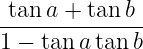 , | (43)
|
| tan(a − b) | = 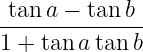 . | (44) |
These quotient formulas require all displayed tangents and denominators to be defined and the
denominators to be nonzero. The underlying sine and cosine sum formulas remain valid at all real
angles.
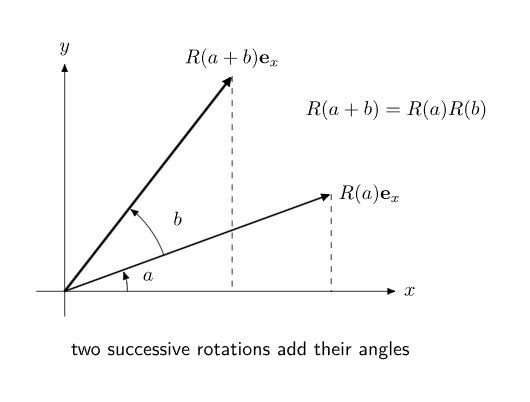
Figure 3. Successive plane rotations by a and b result in a rotation by a + b. Multiplying the two
rotation matrices produces the sine and cosine addition identities.
8 Family 5: Double-angle and triple-angle identities
Set a = b = x in the angle-addition formulas:
| sin 2x | = 2 sin x cos x, | (45)
|
| cos 2x | = cos 2x − sin 2x, | (46)
|
| = 1 − 2 sin 2x, | (47)
|
| = 2 cos 2x − 1. | (48) |
The last two cosine versions follow by using sin 2x + cos 2x = 1.
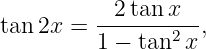
For tangent,
on its stated quotient domain.
Repeated addition gives the triple-angle relations
| sin 3x | = 3 sin x − 4 sin 3x, | (50)
|
| cos 3x | = 4 cos 3x − 3 cos x, | (51)
|
| tan 3x | =  , t = tan x, | (52) |
where the tangent expression requires the displayed denominator and tangent values to
exist.
These identities are especially useful for expressing nonlinear powers of sinusoids as sums of
different harmonics.
9 Family 6: Half-angle identities
Replace x by x∕2 in the cosine double-angle identities:
sin 2 | =  , | (53)
|
cos 2 | =  . | (54) |
Taking square roots requires a sign decision:
sin  | = ±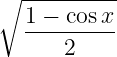 , | (55)
|
cos  | = ±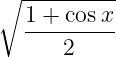 . | (56) |
Select the sign from the quadrant of x∕2, not the quadrant of x.
Two useful half-angle tangent forms are
tan  | =  , | (57)
|
tan  | =  . | (58) |
They are equal wherever both ratios are defined, but their written denominators differ and
therefore require separate domain checks.
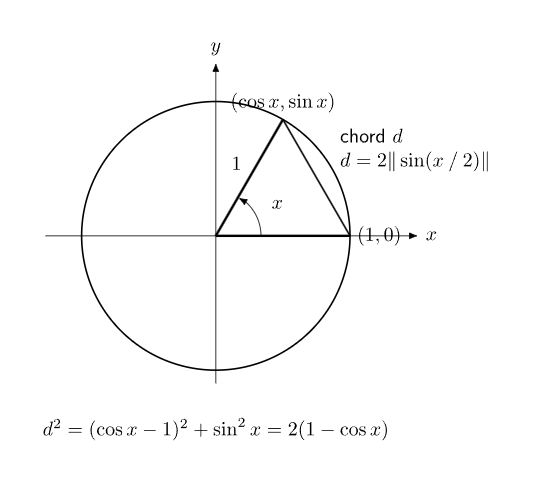
Figure 4. A chord from (1,0) to (cosx,sinx) has length 2|sin(x∕2)|. This geometric relation leads
to the half-angle square identity; the absolute value explains why signed square roots need care.
10 Family 7: Product-to-sum identities
Product-to-sum identities replace a product of two trigonometric functions by a sum or difference
at combined frequencies:
| 2 sin a sin b | = cos(a − b) − cos(a + b), | (59)
|
| 2 cos a cos b | = cos(a − b) + cos(a + b), | (60)
|
| 2 sin a cos b | = sin(a + b) + sin(a − b), | (61)
|
| 2 cos a sin b | = sin(a + b) − sin(a − b). | (62) |
For example, adding the two cosine addition formulas gives
| cos(a + b) + cos(a − b) | = 2 cos a cos b, | (63)
|
| cos a cos b | = 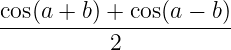 . | (64) |
This family is fundamental in Fourier orthogonality and nonlinear wave calculations: products
generate frequencies at ω1 + ω2 and |ω1 − ω2|.
11 Family 8: Sum-to-product identities
The inverse transformations are
| sin a + sin b | = 2 sin  cos  , | (65)
|
| sin a − sin b | = 2 cos  sin  , | (66)
|
| cos a + cos b | = 2 cos  cos  , | (67)
|
| cos a − cos b | = −2 sin  sin  . | (68) |
These identities are useful for combining oscillations and identifying beat envelopes. In
particular,
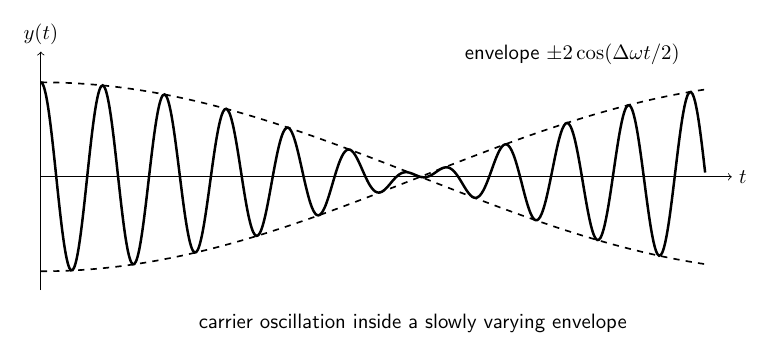
Figure 5. Two nearby cosine frequencies add to produce a rapidly oscillating carrier and a slowly
varying signed amplitude. The observable envelope is the magnitude of that signed amplitude.
12 Family 9: Power-reduction identities
Double-angle identities can reduce even powers to lower-degree harmonics:
| sin 2x | = 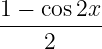 , | (70)
|
| cos 2x | = 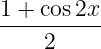 , | (71)
|
| sin x cos x | =  sin 2x, | (72)
|
| sin 2x cos 2x | = 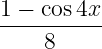 . | (73) |
Triple-angle identities similarly give
| sin 3x | = 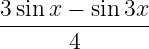 , | (74)
|
| cos 3x | = 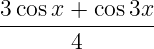 . | (75) |
Higher integer powers can be reduced repeatedly by this family or by product-to-sum identities. An
integration example is
| ∫
sin 2xdx | =  ∫
(1 − cos 2x) dx, | (76)
|
| =  −  + C. | (77) |
13 Family 10: Tangent half-angle substitution
A single new variable
turns sine and cosine into rational functions of t:
| sin x | =  , | (79)
|
| cos x | =  , | (80)
|
| tan x | =  , | (81)
|
| dx | =  dt. | (82) |
The tangent equation requires t≠ ± 1. A branch of x = 2 arctan t should be chosen on a
continuous interval; crossing an excluded point x = (2k + 1)π requires a new interval or
chart.
This is also called the Weierstrass substitution. It converts many rational combinations of sin x and
cos x into rational integrals. It is related to, but distinct from, the x = a tan 𝜃 substitution used for
 in INT01.
14 Family 11: Amplitude-phase identities
For real constants A and B,
where
and, when R > 0,
Thus ϕ may be chosen as atan2(B,A), rather than a one-argument arctangent that loses quadrant
information. If A = B = 0, then R = 0 and the phase is arbitrary.
An equivalent cosine representation is
with cos δ = B∕R and sin δ = A∕R for R > 0.
The identity is useful for combining sinusoidal forces, displacements, phasors, and alternating-current
signals into a single amplitude and phase.
15 Family 12: Inverse-trigonometric relationships
Inverse functions require restricted principal branches:
| arcsin | : [−1, 1]→[−π∕2,π∕2], | (87)
|
| arccos | : [−1, 1]→[0,π], | (88)
|
| arctan | : ℝ→(−π∕2,π∕2). | (89) |
For −1 ≤ z ≤ 1,
| sin(arcsin z) | = z, | (90)
|
| cos(arccos z) | = z, | (91)
|
| cos(arcsin z) | =  , | (92)
|
| sin(arccos z) | =  . | (93) |
For any real z,
| tan(arctan z) | = z, | (94)
|
| sin(arctan z) | =  , | (95)
|
| cos(arctan z) | =  . | (96) |
However arcsin(sin x) = x is not true for arbitrary real x; it is true for x ∈ [−π∕2,π∕2]. Similar
qualifications apply to arccos(cos x) and arctan(tan x).
16 A further derivational viewpoint: Euler’s formula
One compact explanation of several trigonometric families is
Complex conjugation gives
| cos x | =  , | (98)
|
| sin x | =  . | (99) |
The exponential law
produces angle-addition formulas by equating real and imaginary parts. Raising eix to integer
powers gives De Moivre’s relation
for integer n. This is a useful alternative to multiple-angle proofs from geometry. Euler’s formula is
explained and justified in TRIG12.
17 How to choose an identity
- To remove tan 2x or sec 2x, try a Pythagorean identity.
- To combine different angles a and b, try addition or subtraction.
- To integrate powers sin 2x or cos 2x, try power reduction.
- To replace products of sinusoids with harmonics, use product-to-sum.
- To expose slow modulation from nearby frequencies, use sum-to-product.
- To combine A sin x + B cos x, use amplitude-phase form.
- To rationalize expressions in sine and cosine, try t = tan(x∕2).
- For inverse trig, check the principal branch before simplifying.
- For substitutions involving square roots, distinguish
 = | cos x| from cos x.
18 Worked example 1: Simplifying a quotient
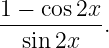
Simplify
Use the double-angle formulas:
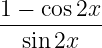 | = 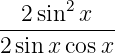 , | (103)
|
| =  , | (104)
|
| = tan x. | (105) |
This holds where the original quotient is defined: sin 2x≠0. Canceling a factor at a forbidden point
would extend the expression incorrectly.
19 Worked example 2: A trigonometric equation
Solve
Since 2 sin 2x − 1 = − cos 2x,
| cos 2x | = 0, | (107)
|
| 2x | =  + kπ, | (108)
|
| x | =  +  . | (109) |
The identity reduces a quadratic trigonometric equation to a standard cosine equation.
20 Worked example 3: Trigonometric substitution in an integral
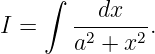
For a > 0,
Set x = a tan 𝜃, so
Then
| a2 + x2 | = a2(1 + tan 2𝜃), | (112)
|
| = a2 sec 2𝜃. | (113) |
Consequently,
| I | = ∫
 d𝜃, | (114)
|
| =  𝜃 + C, | (115)
|
| =  arctan  + C. | (116) |
This is the Pythagorean identity in direct service of INT01.
21 Worked example 4: Constant energy in simple harmonic motion
Let
for a mass m attached to a linear spring with k = mω2. Then
The mechanical energy is
| E | =  mv2 +  kx2, | (119)
|
| =  mA2ω2  , | (120)
|
| =  mA2ω2, | (121) |
where ψ = ωt + ϕ. The identity shows energy does not change with time in this ideal, undamped
oscillator.
22 Worked example 5: Beats and nearby frequencies
For two equal-amplitude signals,
Sum-to-product gives
The rapidly oscillating cosine has mean frequency (f1 + f2)∕2. The magnitude of the slower
amplitude factor repeats at the beat frequency
The signed factor cos(π(f1 − f2)t) has a different sign every half beat cycle; taking its magnitude
correctly identifies the observable envelope.
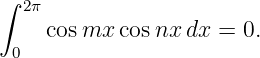
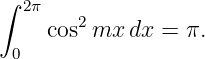
23 Worked example 6: Fourier orthogonality
For positive integers m,n,
Integrate over a full 2π interval. If m≠n, both frequencies are nonzero integers, hence
If m = n ≥ 1, the difference term is cos 0 = 1, so
This is one route to the orthogonality behind the PhysicsLibrary Fourier series articles.
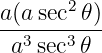
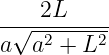
24 Worked example 7: A finite line-charge integral
The radial field component of a finite uniform line charge contains an integral of the
form
Set x = a tan 𝜃. Then
| (a2 + x2)3∕2 | = (a2 sec 2𝜃)3∕2, | (129)
|
| = a3| sec 𝜃|3. | (130) |
Because a > 0 and x = a tan 𝜃 can be taken with −π∕2 < 𝜃 < π∕2, the secant is positive there.
Therefore
| I | = ∫
 d𝜃, | (131)
|
| =  ∫
cos 𝜃 d𝜃. | (132) |
The definite limits transform to 𝜃± = ± arctan(L∕a), hence
| I | =   𝜃−𝜃+
, | (133)
|
| =  . | (134) |
This example shows why domain selection matters when simplifying a three-halves power. Further
examples appear in INT01E1.
25 Common mistakes and domain warnings
- An identity equates expressions only where both sides are defined.
- sin(a + b) does not equal sin a + sin b.
- cos(a + b) contains a minus sign before sin a sin b.
- Squaring discards signs:
 = | sin x|.
- The half-angle square-root signs depend on the quadrant of x∕2.
- arcsin(sin x) is not generally x outside its principal range.
- When canceling sin x or cos x, exclude their zeros.
- Distinguish sin 2x = (sin x)2 from sin(x2).
- In the tangent addition identity, check the denominator.
- Frequency mixing introduces sum and difference frequencies; do not confuse the signed
envelope with its magnitude.
26 Planned derivation companion series
The following are planned entry IDs, not claims that those pages have already been published.
Each companion can be attached to this parent and linked back to the identity family summarized
here.
- TRIG01: Unit Circle, Reciprocal, Quotient, and Pythagorean Identities.
Derive sin 2x+cos 2x = 1 from geometry; derive the tangent and cotangent Pythagorean
identities by division and track domains.
- TRIG02: Symmetry, periodicity, Reflection, and Cofunction Identities. Use
unit-circle coordinate reflection and rotation by quarter- and half-turns.
- TRIG03: Sine and Cosine Angle Addition from Rotations. Derive the rotation
matrix, multiply successive rotations, and recover addition and subtraction formulas
with their signs.
- TRIG04: Tangent Addition and Multiple-Angle Identities. Derive the tangent
quotient, double-angle and triple-angle formulas and explain denominator restrictions.
- TRIG05: Half-Angle Identities and Sign Choices. Derive squared half-angle
formulas, reconstruct the sign by quadrant, and examine the half-angle chord geometry.
- TRIG06: Product-to-Sum Identities. Add and subtract angle-addition equations,
then connect the results to Fourier orthogonality.
- TRIG07: Sum-to-Product Identities and Beats. Use the variable changes a =
(u + v)∕2, b = (u − v)∕2 and apply the results to wave interference.
- TRIG08: Power Reduction and Integration. Derive quadratic, cubic, and
fourth-power reductions and solve selected integrals without prematurely invoking a
substitution.
- TRIG09: Tangent Half-Angle and Rationalization. Derive the Weierstrass
substitution, the differential dx, and the necessary interval restrictions.
- TRIG10: Amplitude-Phase Identity and Phasors. Derive A sin x + B cos x =
R sin(x + ϕ) and explain atan2 and the zero-amplitude case.
- TRIG11: Inverse Trigonometric Identities and Branches. Use inverse-function
ranges and reference triangles to establish identities without dropping signs or
extending domains.
- TRIG12: Euler’s Formula, De Moivre, and a Unified Derivation. Use complex
exponentials to recover addition, multiple-angle, product-to-sum, and harmonic
relations.
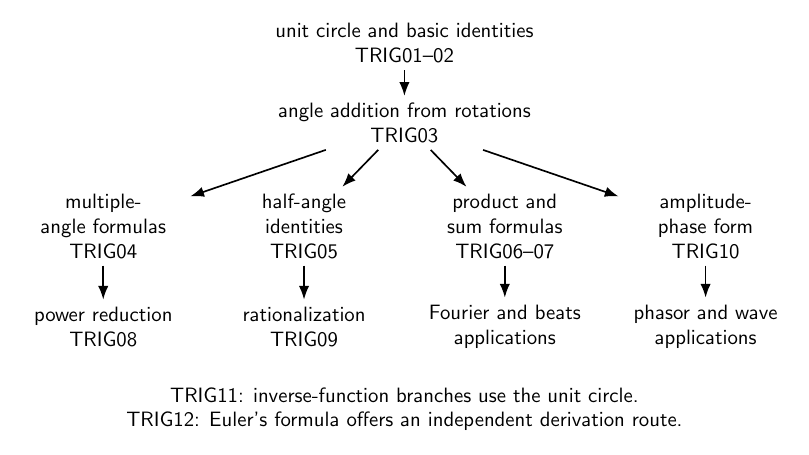
Figure 6. Recommended proof dependencies. The unit circle provides basic functions and signs;
rotation geometry supplies angle addition; addition generates multiple-angle, half-angle,
product-to-sum and sum-to-product identities; complex exponentials give an independent unifying
route.
27 Suggested use in a PhysicsLibrary course
Read the parent as a map of the subject. Then use a companion when a proof is required, or
consult the appropriate family while solving a calculus or physics problem. For example:
- Before INT01, review TRIG01 and TRIG05.
- During INT01E1, consult TRIG04 and TRIG08.
- Before the Fourier-series sequence, study TRIG06 and TRIG07.
- Before phasors or oscillations, study TRIG03 and TRIG10.
- For complex representation of waves, study TRIG12.
The identities are not independent memorization exercises. A small number of geometric or
algebraic principles generate most of the table. A derivation-first approach therefore reduces
memorization and improves error checking.
References and further reading
References
[1] OpenStax, Calculus Volume 2, Techniques of Integration, Trigonometric Substitution.
[2] J. Stewart, Calculus: Early Transcendentals, sections on trigonometric identities and
integration techniques.
[3] M. Spivak, Calculus, chapters on trigonometry, complex numbers, and elementary
integration.
[4] PhysicsLibrary, INT01, Trigonometric Substitution for Integration.
[5] PhysicsLibrary, INT01E1, Trigonometric Substitution: Worked Problems and
Solutions.