Physics Library
 An open source physics library
Encyclopedia | Forums | Docs | Random |  
Login
create new user
Username:
Password:
forget your password?
Main Menu
Sections

Meta

Talkback

Downloads

Information
[parent] resultant force example (Example)

Resultant Forces with Vectors

In physics, the resultant force is the single force that represents the combined effect of multiple forces acting on an object. Forces are vector quantities, characterized by both magnitude and direction. To find the resultant force, we add the individual force vectors using vector addition.

Example: Two Forces Acting on an Object

Consider an object subjected to two forces:

  • ⃗
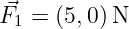
F1 = 5 N  at  ∘
0 (along the positive x  -axis).
  • ⃗F2 = 3 N  at   ∘
60 from the positive x  -axis.

We aim to find the resultant force F⃗R  = F⃗1 + F⃗2   .

Step 1: Resolve Forces into Components

Express each force in terms of its x  - and y  -components:

  • For ⃗F1   :
                 ∘                       ∘
F1x = 5 cos(0 ) = 5N,   F1y = 5 sin (0 ) = 0 N.

    So, ⃗F1 = (5,0)N  .

  • For ⃗
F2   :
                                                             √ --
F   = 3 cos(60∘) = 3 ⋅ 0.5 = 1.5 N,  F  =  3sin(60∘) = 3 ⋅--3-≈ 2.598 N.
  2x                                  2y                   2

    So, ⃗F  ≈ (1.5,2.598 )N
 2  .

Step 2: Sum the Components

The components of the resultant force F⃗R  = (FRx, FRy)  are:

FRx  = F1x + F2x = 5 + 1.5 = 6.5N,

FRy  = F1y + F2y = 0 + 2.598 ≈ 2.598 N.

Thus, ⃗FR ≈ (6.5,2.598)N  .

Step 3: Calculate Magnitude and Direction

The magnitude of F⃗
  R  is:

       ∘ -----------
 ⃗         2     2    √ ---2--------2   √ ------------  √ ---
|FR | =   F Rx + FRy =   6.5 +  2.598  =    42.25 + 6.75 ≈   49 ≈  7N.

The direction (angle 𝜃  relative to the positive x  -axis) is:

          (     )         (       )
        −1  FRy         −1  2.598         −1           ∘
𝜃 = tan     F---  =  tan    -6.5--  ≈ tan   (0.4 ) ≈ 21.8 .
              Rx

Thus, the resultant force is approximately 7 N  at 21.8∘ from the positive x  -axis.

Diagram of Forces

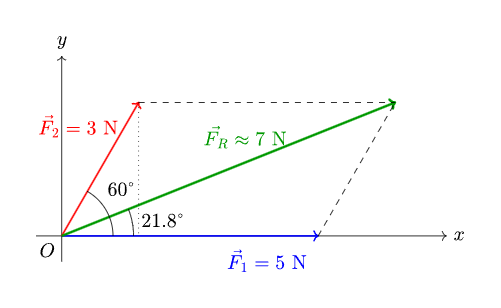
The following diagram illustrates the two forces and their resultant:
PIC

Figure 1. Vector addition of F1 and F2 showing the resultant force FR.

This example was generated by Grok, an AI developed by xAI, on June 6, 2025.


"resultant force example" is owned by bloftin.
(view preamble)
View style:

This object's parent.

Cross-references: diagram, vector addition, magnitude, vector, force, resultant force

This is version 20 of resultant force example, born on 2025-05-30, modified 2026-09-07.
Object id is 1008, canonical name is ResultantForceExample.
Accessed 2088 times total.

Classification:
Physics Classification45.50.Dd (General motion)
Pending Errata and Addenda
None.
Discussion
Style: Expand: Order:

No messages.

Interact
rate | post | correct | update request | add example | add (any)