|
|
|
|||||||
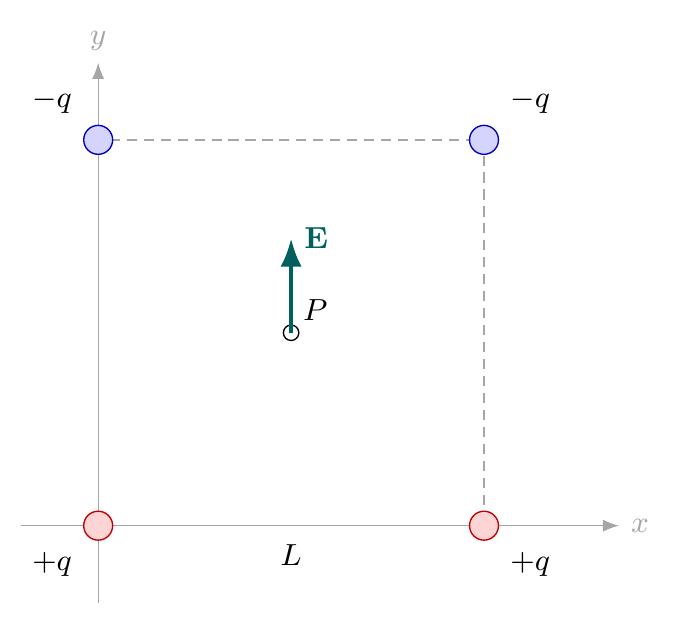
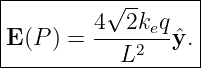
This is an example of pairwise cancellation: before evaluating any decimal, we can prove that Ex = 0. Notice that the four charges have net charge zero, but the field at the center is not zero. 2 2. Worked example 2: distinguish charge cancellation from field cancellationReplace all four corner charges by +q. The geometrical distance of every source from the center is unchanged. However, each field contribution has an equal and opposite counterpart from the diagonally opposite corner. For instance, the fields from (0, 0) and (L,L) cancel; so do the other diagonal pair. Thus E(P) = 0, even though the total charge is +4q and certainly not zero. The lesson is that net charge and field at a particular observation point are different quantities. A zero field at one point does not imply a neutral source distribution, and neutrality does not imply a zero field at arbitrary points. 3 3. Worked example 3: a positive test charge at the centerReturn to the original two positive, two negative square and place a sufficiently small test charge qt at the center. The force is Ft = qtE(P), so
For a negative probe it points downward, opposite the field. Take q = 2.00 nC, qt = −1.00 nC and L = 0.200 m. Then |E|≃ 2.54 × 10³ N/C and F t ≃−2.54 yμN. The sign check should precede this numerical substitution. 4 4. Worked example 4: reverse one corner chargeChange only the upper right source at (L,L) from −q to +q. This changes its charge by Δq = +2q.
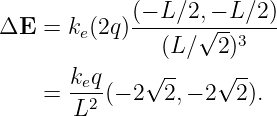
Because the field depends linearly on source charge, we need not recompute all four original
contributions: add the single perturbation field from Δq. The displacement from the upper right
source to the center is R = (−L∕2,−L∕2), with R = L∕
Add the original field from Equation (1):
Its magnitude is 4keq∕L2 and it points at 135∘ measured from +x. A charge reversal perturbation can therefore be handled with one correction rather than a complete new sum. 5 5. Worked example 5: two equal charges and an off axis pointPlace +q at (−a, 0) and (a, 0), and observe at (0,z) with z > 0. Both charge contributions have the same denominator, so
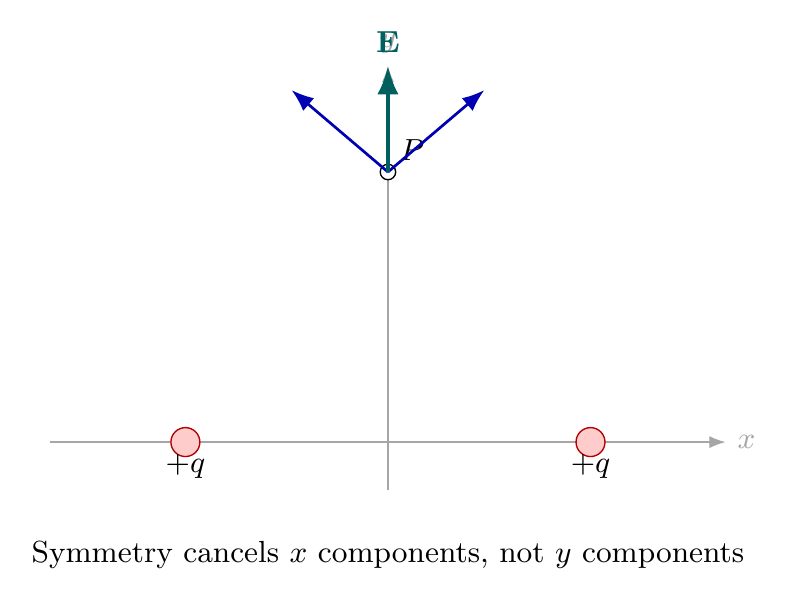
Adding yields E = 2keqz(a2 + z2)−3∕2y. This repeated geometry reinforces that reflection symmetry permits the horizontal cancellation only because both sources have equal charge magnitudes as well as mirrored positions.
Figure 2. Mirrored charges and an observation point on their perpendicular bisector. A symmetric geometry without a symmetric charge distribution would not give this cancellation.
6 6. Exercises
7 7. Solutions
8 8. Reliable superposition methodWrite one row per source: charge sign, source position, displacement vector, distance, and component contribution. Apply symmetry only after confirming equal signed magnitudes or the correct sign pairing. If one source changes, use the linearity of Coulomb’s law to compute the change to the field without redoing unaffected terms.
References
References
[1] P. Dourmashkin and collaborators, Electricity and Magnetism, MIT 8.02 course notes, chapters on Coulomb’s law and electric fields. [2] D. J. Griffiths, Introduction to Electrodynamics, 4th ed., Cambridge University Press, 2017, electrostatics chapters. [3] E. M. Purcell and D. J. Morin, Electricity and Magnetism, 3rd ed., Cambridge University Press, 2013. [4] PhysicsLibrary, ES01/EM05 articles and the earlier single example entries for the corresponding ES01E identifiers. "Mixed Two-Dimensional Charge Arrays and Symmetry Tests" is owned by bloftin.
This object's parent. Cross-references: Coulomb's law, vector, section, dimensions, equilibrium, positions, displacement, source charge, force, test charge, observation point, net charge, magnitude, negative charges, positive charges, square, vectors, charges, superposition This is version 1 of Mixed Two-Dimensional Charge Arrays and Symmetry Tests, born on 2026-11-27. Object id is 1606, canonical name is MixedTwoDimensionalChargeArraysAndSymmetryTests. Accessed 24 times total. Classification:
|
|
|
|
Pending Errata and AddendaNone.
|
DiscussionNo messages.
|
Interact |

 from the center. Each field
 ) =

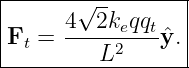
 , so