|
|
|
|||||||
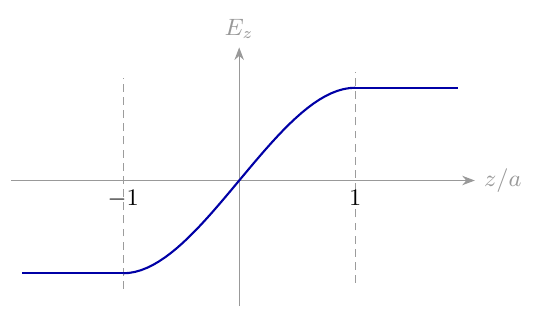
Outside the slab the enclosed charge stays fixed and the field is
The interior slope ρ0(1 −z2∕a2)∕𝜖 0 tends to zero at a, matching the constant exterior field’s slope. Both Ez and its first derivative are continuous. Check. The full slab contains charge per unit area 4ρ0a∕3. Half that divided by 𝜖0 gives the exterior magnitude.
3 Practice variationReplace the profile by ρ0z2∕a2 inside. Give the resulting field. Solution. The same integral gives Ez = ρ0z3∕(3a2𝜖 0) inside and exterior magnitude ρ0a∕(3𝜖0). The field is continuous, and its slope drops to zero at the boundary.
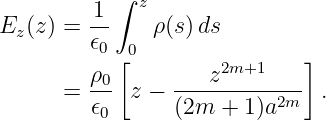
4 Scale the integral and check smoothnessThe planar volume charge density is signed charge per unit volume, here depending only on the normal coordinate. In the interior integral set t = s∕a, so ds = adt and the upper limit is z∕a. The primitive of 1 − t2 is t − t3∕3. Evaluating at both limits gives a[(z∕a) − (z∕a)3∕3]. For an exterior point the upper limit is instead 1. The same formula makes Ez continuous and its first derivative is zero at the outer edge. The interior second derivative is −2ρ0z∕(𝜖0a2), with one-sided value −2ρ0∕(𝜖0a) at the positive boundary. The exterior second derivative is zero.
5 Worked example 2: join the interior and exterior potentialUse V (0) = 0. The potential is even because Ez is odd. Integrating the positive-side field,
At a this gives −5ρ0a2∕(12𝜖 0). For z > a subtract the plateau field times z −a from that boundary value. Differentiating each expression recovers the original field, and the joined slopes agree. A zero at infinity is unsuitable for the nonzero exterior plateau.
6 Additional worked example 3: a family of smoothly graded slabsReplace the parabolic profile by the even family
The reflected charge profile is even, so the field is odd. For 0 < z < a use a centered Gaussian pillbox with area A. The two cap contributions total 2AEz(z) and the enclosed charge is 2A∫ 0zρ(s) ds, hence
Beyond the charged slab, the field reaches the constant plateau Ez(a) = ρ0a[2m∕(2m + 1)]∕𝜖0. For m = 1 this agrees with the parabolic example. For m →∞ the interior density tends toward ρ0 at every fixed |z| < a, reproducing the uniform slab away from its endpoints.
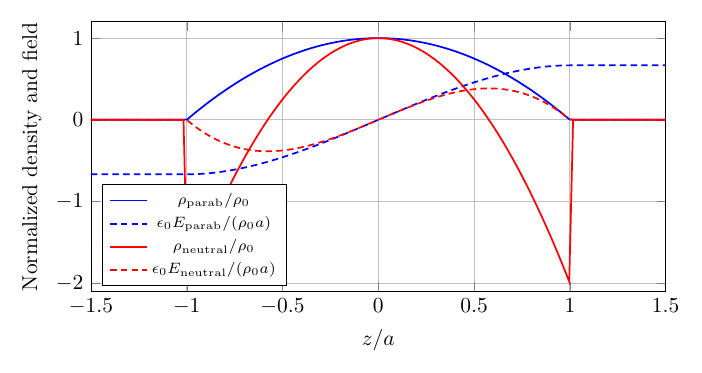
7 Additional worked example 4: a neutral slab with nonzero internal fieldA charge distribution need not have positive density everywhere. Let
and zero elsewhere, with ρ0 > 0. Near the center the density is positive; near the outer faces it is negative. By symmetry Ez(0) = 0, and
At z = a, Ez = 0. The net charge per unit area is indeed zero:
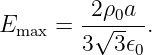
The field therefore vanishes for |z| > a, although it is not zero inside. The interior maximum occurs
where dEz∕dz = ρ(z)∕𝜖0 = 0, at z = a∕
This is a direct demonstration that zero total charge and zero exterior flux do not imply zero field at all interior points.
8 Additional worked example 5: infer density from a measured fieldSuppose a planar source is known to have Ez(z) = Cz −Dz3 in a region where the field has only a Normal component. The differential Gauss law becomes
The data determine local volume charge density only if planar symmetry and electrostatic conditions are justified. If the field becomes constant outside the material, the volume charge there is zero. Its continuity at a boundary rules out an ideal delta-function surface charge; a field jump would require one.
Figure 2. Normalized density and field for the parabolic and internally neutral slabs. The field is the signed integral of the density, not the density itself.
9 More practice with solutionsExercise 3. For m = 2 in Equation (4), what is the exterior field magnitude? Solution. Eext = 4ρ0a∕(5𝜖0), from 2m∕(2m + 1) = 4∕5. Exercise 4. For the neutral slab of Equation (6), find the potential change between z = 0 and z = a. Solution. V (a) − V (0) = −∫ 0aE z(z) dz = −(ρ0∕𝜖0)[a2∕2 − a2∕4] = −ρ 0a2∕(4𝜖 0).
10 ExercisesExercise 1. Find the ratio of field at a∕2 to the exterior plateau. Solution. The interior bracket at a∕2 is a(1∕2 − 1∕24) = 11a∕24. Divide by 2a∕3 to get 11∕16. Exercise 2. In the given variation ρ = ρ0z2∕a2, why does the slope jump while the field stays continuous? Solution. At a the integrated density is finite and continuous with respect to the integration limit. Its derivative is the local density divided by 𝜖0, which jumps from ρ0∕𝜖0 inside to zero outside.
References
References
"lectric Field of a Parabolic Charge Slab" is owned by bloftin.
This object's parent. Cross-references: planar symmetry, differential Gauss law, Normal, flux, net charge, Gaussian pillbox, formula, normal coordinate, volume, volume charge density, boundary, magnitude, unit, charge, enclosed charge This is version 1 of lectric Field of a Parabolic Charge Slab, born on 2026-11-27. Object id is 1621, canonical name is LectricFieldOfAParabolicChargeSlab. Accessed 14 times total. Classification:
|
|
|
|
Pending Errata and AddendaNone.
|
DiscussionNo messages.
|
Interact |

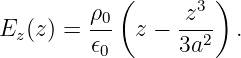






 . Substitution gives