Inclined-Plane Dynamics
An inclined plane is one of the most useful Newtonian dynamics models because it forces us to
separate geometry from physics. Gravity still points vertically downward, but the most convenient
axes are usually rotated so that one axis lies along the plane and the other is Normal to it. Once
that rotation is understood, a large class of problems becomes systematic rather than
diagram-specific.
This article develops inclined-plane dynamics from the geometry of the coordinate transformation
through Friction, applied forces, and connected bodies. The central lesson is that the familiar
terms mg sin 𝜃 and mg cos 𝜃 are not additional forces. They are components of the single
gravitational force mg in a rotated coordinate system.
1 Choose axes that match the constraint
For a block constrained to remain on a straight plane inclined by angle 𝜃 above the horizontal,
define
and
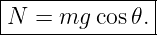
If the block remains in contact with the plane, its acceleration normal to the plane is usually
zero:
That makes the normal equation especially useful for finding the normal force.
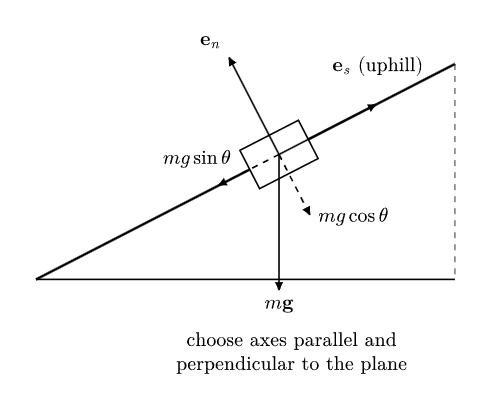
Figure 1. The natural axes for a block constrained to an incline are parallel and perpendicular to
the plane. The weight remains vertical; mg sin𝜃 and mg cos𝜃 are its components in the rotated
axes.
2 Deriving the gravitational components
Take ordinary horizontal and vertical unit vectors ex and ey. For a plane rising to the
right,
and
The gravitational force is
Its component along the plane is the dot product
while its normal component is
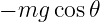
Therefore the magnitudes are
The signs depend on the chosen positive directions. With uphill and outward taken as positive,
both gravity components are negative.
3 The simplest case: a frictionless incline
Suppose gravity and the normal force are the only forces on the block. The normal equation
is
For continuous contact with a straight plane, an = 0, so
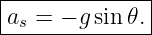
Along the plane, using uphill as positive,
Hence
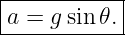
Equivalently, the acceleration magnitude down the plane is
The mass cancels. This is a consequence of both gravitational force and inertia being proportional
to mass.
4 Why the normal force is not always mg cos 𝜃
The result N = mg cos 𝜃 is valid only when no other force has a component normal to the plane
and the block has no normal acceleration.
Let an additional applied force F have components
The normal equation becomes
so
A force with an outward normal component reduces N. A force that presses the block into the
plane has Fn < 0 and increases N.
For example, a horizontal force F directed to the right has
Therefore
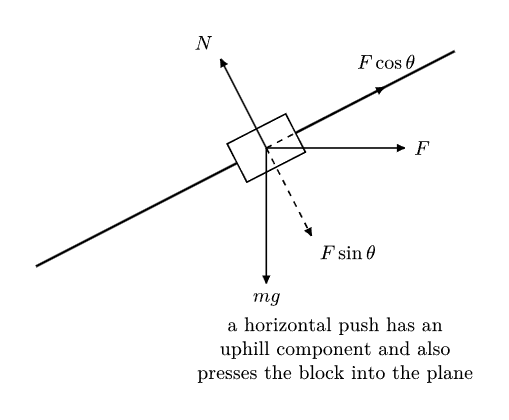
Figure 2. A horizontal force on a block on an incline generally has both a tangential and a normal
component. The normal component changes the contact force and therefore changes any friction
force that depends on N.
5 A general along-plane equation
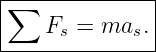
With uphill positive, Newton’s second law along the plane can be written in a compact
form:
For gravity, an applied tangential force Fs, and friction f,
where f is signed according to its actual direction.
This form is more reliable than memorizing a different equation for every diagram. Draw the
forces, project each force onto the chosen axis, assign signs, and then apply Newton’s second
law.
6 Static friction on an incline
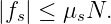
If a block is at rest, the friction force is whatever value is required by equilibrium, provided the
static limit is not exceeded.
With no other tangential force, equilibrium requires
up the plane. But static friction can supply at most
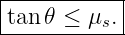
For the simple case N = mg cos 𝜃, equilibrium is possible when
or
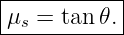
At impending downhill slip,
7 Friction direction comes from the tendency to slip
Gravity alone tends to make a block slide downhill, so friction points uphill. But this is not a
universal rule. If another force is strong enough to make the block tend to move uphill, static
friction points downhill.
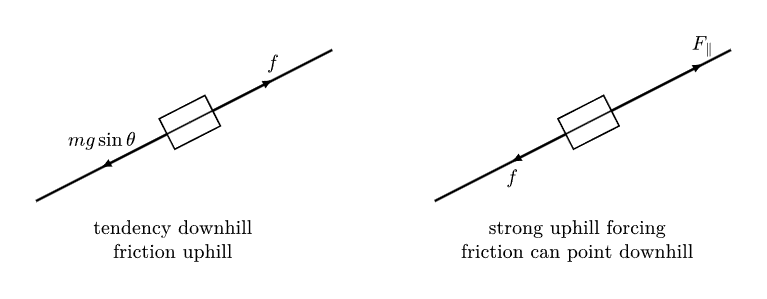
Figure 3. Static friction opposes the tendency for relative slip. It can point either uphill or
downhill depending on the other tangential forces.
A good procedure is to first solve the problem without assigning a friction direction by habit.
Determine the direction in which the block would tend to slip if friction were absent; static friction
opposes that tendency.
8 Kinetic friction and sliding motion
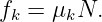
If the block slides, the elementary kinetic friction model is
If the block slides downhill and no other forces act along the plane, friction points uphill. With
downhill taken as positive,
so
If the block is instead sliding uphill, both gravity and kinetic friction point downhill. Taking uphill
as positive, the signed along-plane acceleration satisfies
Thus the acceleration is downhill with magnitude
Thus the same physical surface can produce different along-plane accelerations depending on the
direction of motion because kinetic friction reverses direction when the relative sliding
reverses.
9 Applied forces at arbitrary angles
Suppose an applied force of magnitude F makes an angle α above the plane. Its components
are
If Fn points outward, the normal force is
If the block slides uphill, friction points downhill and the tangential equation is
The dependence of N on the normal component of the applied force is essential. One should not
substitute N = mg cos 𝜃 automatically.
10 Connected bodies involving an incline
Inclined planes are often combined with the string and Pulley models of M02-05 and M02-06.
Consider a block m1 on a frictionless incline connected over an ideal fixed pulley to a hanging mass
m2.
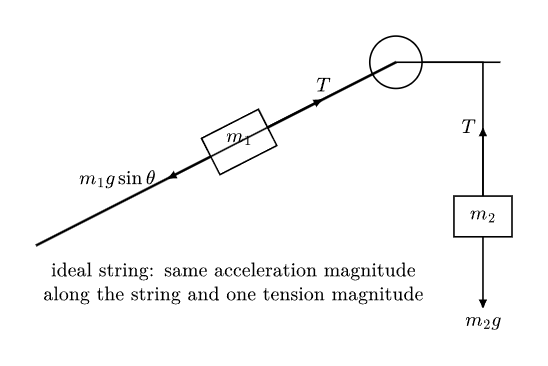
Figure 4. A block on an incline connected to a hanging mass. The ideal string imposes equal
acceleration magnitudes along the string and transmits one tension magnitude.
Assume m2 moves downward and m1 moves uphill. For m1,
For m2,
Adding eliminates the internal tension:
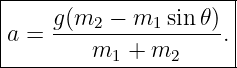
Therefore
The sign checks the assumed direction. If the expression is negative, the actual acceleration is
opposite the assumed direction.
Once a is known, the tension follows from either body’s equation, for example
For a rough incline, friction is included in the m1 equation with the direction determined by the
actual or impending motion.
11 Energy as a later cross-check
The force method is the focus here, but many incline results can later be checked with work and
energy. For a frictionless block descending a vertical height h, the loss of gravitational potential
energy becomes kinetic energy. For kinetic friction, the mechanical energy decreases by the friction
work.
The Newtonian component equations remain essential because they also determine quantities such
as normal force, tension, and instantaneous acceleration.
12 Common errors
- mg sin 𝜃 and mg cos 𝜃 are not extra forces. They are components of the single
Weight vector.
- N = mg cos 𝜃 is conditional. Other forces can have normal components and change
N.
- Static friction is not automatically μsN. Solve for the required friction first, then
compare with the limit.
- Friction direction is not always uphill. It opposes relative slip or the tendency to
slip.
- A negative acceleration is not an algebra failure. It means the acceleration
points opposite the chosen positive direction.
- Do not mix coordinate systems mid-equation. Resolve all forces consistently into
the same parallel and normal axes.
13 Worked example 1: frictionless block on an incline
A 5.00 kg block is released from rest on a frictionless 30.0∘ incline. Find the normal force and
acceleration.
The normal force is
The acceleration magnitude down the plane is
Thus
14 Worked example 2: rough incline, released from rest
An 8.00 kg block rests on a 25.0∘ incline with
Determine whether the block remains at rest. If it slides, find its acceleration.
For static equilibrium the required friction is
The normal force is
so the maximum available static friction is
Since 33.2 > 24.9, the block cannot remain at rest. It slides downhill. The kinetic acceleration
is
which gives
15 Worked example 3: horizontal push on an incline
A 10.0 kg block is on a frictionless 20.0∘ incline. A horizontal force of 50.0 N pushes to the
right, toward the uphill direction. Find the normal force and the acceleration along the
plane.
The applied force components are
and
Thus the normal force is
so
Along the plane,
Numerically,
Therefore
16 Worked example 4: incline connected to a hanging mass
A 6.00 kg block on a frictionless 30.0∘ incline is connected by a massless inextensible
string over an ideal pulley to a hanging 4.00 kg mass. Find the acceleration and string
tension.
Assume the 4.00 kg mass moves downward. The competing driving forces are
and
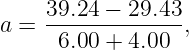
The system acceleration is
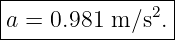
so
The positive result confirms the assumed direction: m2 accelerates downward and m1 accelerates
uphill.
Using the incline block equation,
therefore
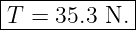
and
17 Practice problems
- A 3.00 kg block slides on a frictionless 40.0∘ incline. Find the normal force and the
acceleration magnitude.
- A block is at rest on a frictionless incline while held by a force parallel to the plane. If
m = 12.0 kg and 𝜃 = 18.0∘, find the required uphill force.
- A 7.00 kg block is on a 35.0∘ incline. A force of 60.0 N acts uphill parallel to the plane.
The surface is frictionless. Find the acceleration, including its direction.
- A block is released on a 22.0∘ incline with μ
s = 0.45. Determine whether it begins to
slide.
- A block slides downhill on a 28.0∘ incline with μ
k = 0.20. Find its acceleration.
- A block is launched uphill on a 28.0∘ incline with μ
k = 0.20. While it is still moving
uphill, find the magnitude and direction of its acceleration.
- A 10.0 kg block rests on a 20.0∘ incline. A horizontal force of 40.0 N pushes toward
the uphill direction. Find the normal force. Assume no normal acceleration.
- For the system in Problem 7, suppose the surface is frictionless. Find the along-plane
acceleration and state its direction.
- A 5.00 kg block on a frictionless 25.0∘ incline is connected over an ideal pulley to a
hanging 3.00 kg mass. Find the acceleration and identify which mass moves downward.
- A 4.00 kg block on a 30.0∘ incline is connected over an ideal pulley to a hanging 2.00
kg mass. The incline has μk = 0.10, and the block is known to be sliding uphill. Find
the acceleration magnitude and direction at that instant.
18 Answer check
-
-
- Taking uphill as positive,
so
- Static equilibrium requires tan 22.0∘ ≤ 0.45. Since tan 22.0∘ = 0.404, the block can remain at
rest.
-
- While the block moves uphill, both gravity and kinetic friction act downhill:
-
so
-
therefore
- Assume the hanging mass moves downward:
The result is positive, so the 3.00 kg mass moves downward.
- Take uphill motion of the incline block and downward motion of the hanging mass as
positive. Since the incline block is sliding uphill, friction acts downhill:
The right side evaluates to a negative acceleration,
Thus the acceleration is opposite the assumed positive direction: the incline block
accelerates downhill and the hanging mass accelerates upward, with magnitude
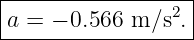
0.566 m∕s2.
19 Summary
For a plane inclined by 𝜃, choosing axes parallel and perpendicular to the surface converts the
weight into the components
along the uphill axis and
along the outward normal axis. The fundamental equations are still simply Newton’s second
law,
The expressions mg sin 𝜃 and mg cos 𝜃 come from geometry, not from new forces. The normal force
must be determined from the normal equation, friction must be assigned from the actual or
impending relative slip, and connected bodies must satisfy their string constraint. With those
principles in place, inclined-plane problems become a systematic application of vectors and
Newton’s laws.
References
[1] PhysicsLibrary, M02-01, Newton’s Laws of Motion.
[2] PhysicsLibrary, M02-02, Free Body Diagrams.
[3] PhysicsLibrary, M02-07, Friction.
[4] J. Moore et al., Mechanics Map, CC BY-SA 4.0.
[5] OpenStax, University Physics, Volume 1, sections on Newton’s laws, friction, and
inclined planes, CC BY 4.0.