Projectile Motion
Projectile motion is the motion of an object that has been given an initial velocity and then moves
under gravity. In the standard introductory model, air resistance is neglected, The Gravitational
Field is uniform, Earth is treated as locally flat, and the motion is described in an inertial frame
fixed near Earth’s surface. Under these assumptions the projectile has constant downward
acceleration
where g ≃ 9.81 m∕s2 near Earth’s surface.
The central idea is that two-dimensional projectile motion is a constant acceleration problem
whose horizontal and vertical components can be solved separately. The components share the
same time variable, so they combine to form one curved trajectory.

Figure 1. An initial velocity is resolved into horizontal and vertical components. In the ideal
projectile model the acceleration is constant and vertically downward.
1 The ideal projectile model
Choose the x axis horizontal and the y axis vertically upward. Let the projectile begin
at
with initial speed v0 at angle 𝜃0 above the horizontal. Then
Thus
and
In the ideal model,
These two equations contain the basic physics of ideal projectile motion.
2 Independent horizontal and vertical motion
Because the horizontal acceleration is zero,
and
The vertical component is ordinary one-dimensional constant acceleration motion:
and
The horizontal and vertical equations are independent except that they describe the same object at
the same time t.

Figure 2. The horizontal component has zero acceleration while the vertical component has
constant acceleration −g. Their common time parameter combines the two one-dimensional
motions into one two-dimensional trajectory.
3 Velocity during flight
At any time,
so
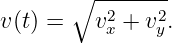
The speed is
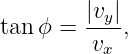
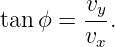
The instantaneous direction of motion may be described by an angle ϕ measured from the positive
horizontal direction:
At the apex of the trajectory,
but in general
Therefore the projectile is still moving at the top of its path. Its acceleration also remains −gey
there.
4 The trajectory is a parabola
The parametric equations are
and
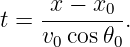
From the horizontal equation,
Substituting into the vertical equation gives
This is quadratic in x, so the ideal trajectory is a parabola.
The parabolic result depends on the assumptions of constant downward gravity and zero drag.
Real long range trajectories need not be parabolic.
5 Time to the apex
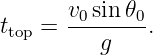
The projectile reaches its highest point when
Therefore
which gives
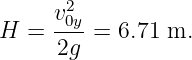
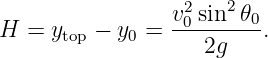
The maximum height above the launch point follows from the vertical no time equation
At the apex vy = 0, so
6 Same height launch and landing
If the projectile lands at the same vertical level from which it was launched, then
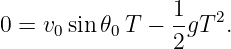
The vertical displacement equation becomes
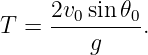
Besides the trivial root T = 0, the nonzero flight time is
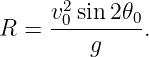
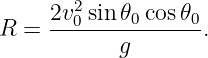
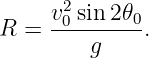
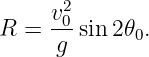
The horizontal range is
hence
Using
we obtain
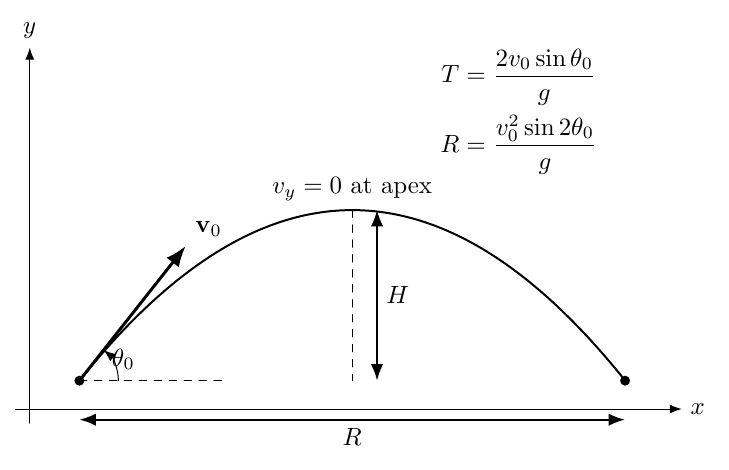
Figure 3. For launch and landing at the same height, the trajectory is symmetric in time. The
standard flight time and range formulas follow from the vertical and horizontal component
equations.
7 Maximum range and complementary angles
For fixed v0 and same height launch and landing,
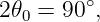
The maximum possible value of sin 2𝜃0 is one. Therefore the maximum ideal range occurs
when
or
Also,
Thus complementary launch angles 𝜃0 and 90∘− 𝜃
0 give the same ideal same height range. The
high angle trajectory has a longer flight time and greater maximum height.
These results are not generally true when launch and landing heights differ or when drag is
important.
8 Unequal launch and landing heights
If
one should usually avoid forcing the same height formulas onto the problem. Instead solve the
vertical equation directly:
Rearranging,
The quadratic formula gives
The physically relevant root depends on the problem. A positive root corresponding to the later
intersection with the landing height is normally selected.
Once the flight time is known,

Figure 4. For unequal launch and landing heights, solve the vertical quadratic for the physical
flight time and then use the horizontal motion to find range.
9 Horizontal launch as a special case
For a horizontal launch,
so
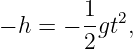
If the projectile falls through a vertical distance h,
which gives
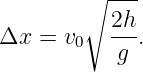
The horizontal distance is then
This example makes the component independence especially clear: the fall time depends only on
the vertical motion, while the horizontal speed determines how far the projectile travels during
that time.
10 Speed as a function of height
The component equations also give a useful relation between speed and vertical position.
Since
and
adding yields
Thus in the ideal model the speed at a given height depends only on that height and the initial
speed, not on whether the projectile is rising or falling. In particular, if the projectile later returns
to its launch height,
The velocity is not the same vector, because its vertical component has changed sign.
11 Choosing a sign convention
The common choice is +x horizontal in the launch direction and +y upward. Then
A different convention is allowed, but the signs in every equation must remain consistent. Many
projectile motion errors come from inserting g as a positive number while simultaneously treating
downward acceleration as if it were positive in an equation written for an upward positive
axis.
A reliable procedure is:
- draw the axes;
- resolve the initial velocity into components;
- write ax and ay with signs;
- solve the vertical and horizontal equations separately;
- use the common time to connect them;
- check whether the result is physically consistent.
12 Model limitations
The ideal model is extremely useful, but its assumptions must be stated. It neglects air resistance
and lift, treats g as constant, ignores Earth curvature and rotation, and assumes the local ground
frame is sufficiently inertial for the problem.
For a thrown ball over tens of meters these approximations may be excellent. For long range
artillery, rockets, atmospheric flight, or orbital trajectories they may fail badly. Those
problems require later topics such as drag, rotating frames, variable gravity, and orbital
mechanics.
13 Worked example 1: equal height launch
A projectile is launched from level ground with
at
Find the horizontal and vertical initial velocity components, time of flight, range, and maximum
height. Use g = 9.81 m∕s2.
The initial components are
and
Because launch and landing heights are equal,
The range is
The maximum height above launch is
14 Worked example 2: horizontal launch from a cliff
A ball leaves a horizontal cliff with speed
from a height
Find the flight time, horizontal range, impact speed, and impact angle below the horizontal.
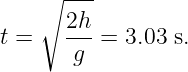
Because v0y = 0,
The range is
At impact,
and
Therefore
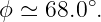
The impact angle below horizontal satisfies
so
15 Worked example 3: angled launch from an elevated point
A projectile is launched from a platform 8.0 m above the ground with speed
at
Find the time to hit the ground and the horizontal range.
The components are
and
Take ground level as y = 0. Then
Solving the quadratic and selecting the positive physical root gives
Therefore
The same height formula T = 2v0 sin 𝜃0∕g would be wrong here because the projectile lands below
its launch height.
16 Worked example 4: two angles for the same range
A projectile is launched and lands at the same height. Its launch speed is
and the required range is
Find the two possible launch angles in the ideal model.
Use
Then
The two angles between 0∘ and 180∘ having this sine are
and
Thus
or
The two angles are complementary, as expected. The low angle flight takes about 1.70 s, while the
high angle flight takes about 4.81 s.
17 Practice problems
- A projectile is launched at 16 m∕s at 30∘. Find v
0x and v0y.
- A projectile has v0x = 12 m∕s and v0y = 9 m∕s. Find its initial speed and launch
angle.
- A projectile is launched horizontally at 15 m∕s from a 20 m high platform. Find the
flight time and horizontal range.
- A projectile is launched from level ground at 22 m∕s and 40∘. Find the time to the
apex and maximum height.
- For the projectile in Problem 4, find the total same height flight time and range.
- A projectile is launched at 30 m∕s at 60∘. Find its horizontal and vertical velocity
components after 2.0 s.
- A projectile is launched from y0 = 5.0 m at 14 m∕s and 25∘. Write the horizontal and
vertical position functions using x0 = 0.
- A projectile launched from level ground has v0 = 20 m∕s. Find the ideal same height
range for 30∘ and for 60∘. Compare the results.
- A projectile is launched from level ground at 18 m∕s and 45∘. What is its speed at
the apex?
- A projectile is launched at 25 m∕s from a point 10 m above the landing level at 20∘.
Find the physical flight time and horizontal range.
- A projectile moves through a point 4.0 m above its launch height. If its initial speed
was 15 m∕s and drag is neglected, find its speed at that height.
- Explain why 45∘ does not necessarily maximize horizontal distance when the projectile
lands at a different height from the launch point.
18 Answer check
- v0x = 13.9 m∕s, v0y = 8.0 m∕s.
- v0 = 15.0 m∕s, 𝜃0 = 36.9∘.
- t = 2.02 s, R = 30.3 m.
- ttop = 1.44 s, H = 10.2 m.
- T = 2.88 s, R = 48.6 m.
- vx = 15.0 m∕s, vy = 6.36 m∕s.
- x(t) = 12.69t m, y(t) = 5.0 + 5.92t − 4.905t2 m.
- Both ranges are approximately 35.3 m.
- v = 18 cos 45∘ = 12.7 m∕s.
- t ≃ 2.54 s, R ≃ 59.8 m.
- v =
 ≃ 12.1 m∕s.
- Because the same height range formula R = v02 sin 2𝜃∕g no longer applies; the flight
time depends on the unequal vertical displacement.
19 Summary
Ideal projectile motion is constant acceleration motion in two dimensions. The horizontal
component has zero acceleration while the vertical component has acceleration −g. Resolving the
launch velocity into components gives
and
The parabolic trajectory, maximum height, time of flight, and range all follow from these
equations. Same height shortcuts are useful but should only be used when their assumptions are
satisfied. For unequal heights, the robust method is to solve the vertical equation for time and then
use the horizontal motion.
References
[1] PhysicsLibrary, “projectile motion,” existing encyclopedia entry, object 217.
[2] S. J. Ling, J. Sanny, and W. Moebs, University Physics, Volume 1, OpenStax, 2016,
sections on two-dimensional kinematics and projectile motion.
[3] University of California, Davis, Physics 9A course materials, introductory mechanics:
two-dimensional kinematics and projectile motion.
[4] J. R. Taylor, Classical Mechanics, University Science Books, 2005, introductory
Newtonian kinematics and motion in two dimensions.

![[parent]](https://images.physicslibrary.org/images/uparrow.png)
























![sin[2(90∘ − 𝜃 )] = sin(180∘ − 2𝜃 ) = sin 2𝜃 .
0 0 0](https://images.physicslibrary.org/cache/objects/1320/make4ht/GREProjectileMotion35x.png)