|
|
|
|||||||
and
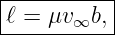
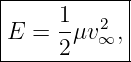
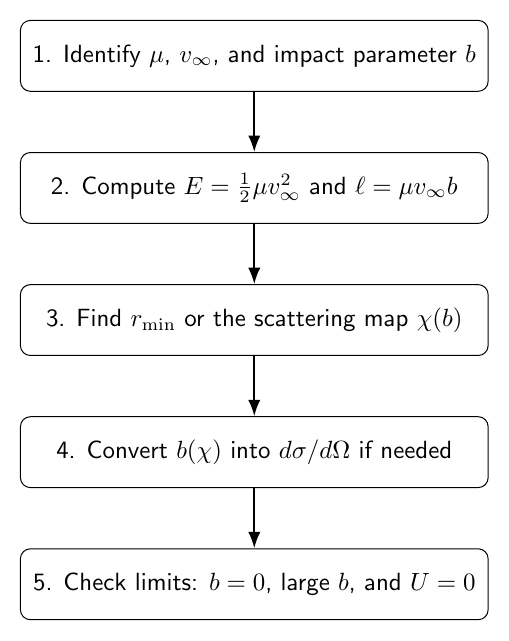
Figure 1. A compact strategy for classical scattering problems. Start from b and v∞, determine E and ℓ, find the turning point or deflection, and convert b(χ) into a cross section when needed.
1 High-value GRE facts
Part I: Original GRE-style problems
Problem 1: angular momentumA reduced particle has μ = 2m, incoming speed v, and impact parameter b. Its angular-momentum magnitude is
Problem 2: head-on collisionFor a head-on central-force scattering event,
Problem 3: no interactionIf U(r) = 0, then the distance of closest approach is
Problem 4: closest approachAt the distance of closest approach in a conservative central scattering problem,
Problem 5: geometric cross sectionAn event occurs whenever b ≤ b0. Its cross section is
Problem 6: annulus areaThe area associated with impact parameters between b and b + db is
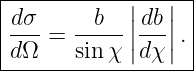
Problem 7: solid angleFor azimuthally symmetric scattering, the solid-angle element between χ and χ + dχ is
Problem 8: hard-sphere grazingFor hard-sphere scattering from radius a, a grazing trajectory has
Problem 9: hard-sphere differential cross sectionFor hard-sphere radius a,
equals
Problem 10: inverse-radius head-on turning pointFor repulsive potential U = k∕r and a head-on trajectory, the closest approach is
Problem 11: large impact parameterFor an ordinary short-range interaction, increasing b far beyond the interaction range generally makes the scattering angle
Problem 12: frame issueThe reduced-coordinate scattering calculation most naturally gives
Part II: Complete worked solutions
Solution 1Use
With μ = 2m,
Answer: (B).
Solution 2Head-on means the incoming asymptote passes through the force center:
Therefore ℓ = 0. Answer: (A).
Solution 3For U = 0, the turning-point equation gives
Thus
Answer: (C).
Solution 4Closest approach is a radial turning point, so
Answer: (A).
Solution 5The allowed incoming trajectories fill a disk of radius b0:
Answer: (C).
Solution 6The annulus area is circumference times width:
Answer: (B).
Solution 7For axial symmetry,
Answer: (C).
Solution 8A grazing trajectory just touches the sphere:
It experiences vanishing deflection:
Answer: (B).
Solution 9Hard-sphere geometry gives
Answer: (C).
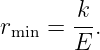
Solution 10For b = 0, energy conservation gives
Thus
Answer: (A).
Solution 11A large impact parameter keeps the trajectory far from a short-range interaction, so the deflection tends toward zero. Answer: (B).
Solution 12The reduced-coordinate problem is naturally a center-of-mass or relative-motion calculation. Laboratory particle angles require an additional frame transformation. Answer: (A).
2 GRE checklist
References
References
"GRE Physics Companion: Scattering Geometry and Impact Parameter" is owned by bloftin.
This object's parent. Cross-references: differential cross section, force, total linear momentum, scattering angle, distance of closest approach, magnitude, speed, particle, dimensions, energy, angular momentum, impact parameter, cross section, turning point, relations, scattering This is version 1 of GRE Physics Companion: Scattering Geometry and Impact Parameter, born on 2026-10-04. Object id is 1407, canonical name is GREPhysicsCompanionScatteringGeometryAndImpactParameter. Accessed 8 times total. Classification:
|
|
|
|
Pending Errata and AddendaNone.
|
DiscussionNo messages.
|
Interact |
![[parent]](https://images.physicslibrary.org/images/uparrow.png)