Physics Library
 An open source physics library
Encyclopedia | Forums | Docs | Random  

[parent] GRE Physics Companion: Effective Potential and Radial Motion in Central Gravity

(Example)

GRE Physics Companion: Effective Potential and Radial Motion in Central Gravity

For specific angular momentum

h,
(1)

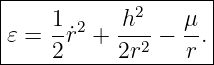
the radial energy equation is

|------------2-------|
|𝜀 = 1-˙r2 + h--−  μ-.|
-----2------2r2---r--|
(2)

PIC

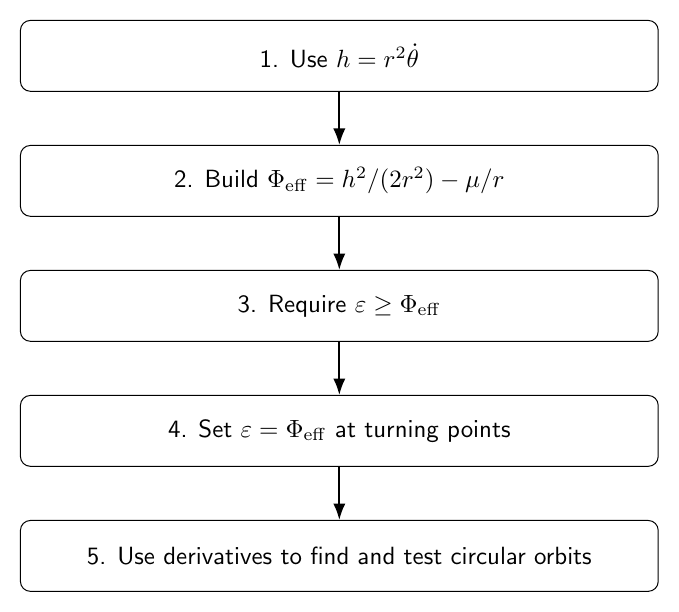
Figure 1. A compact effective-potential strategy: use conserved angular momentum, build Φeff, compare it with the energy level, locate turning points, and test circular-orbit stability.

1 High-value GRE facts

  1. Φeff = h2∕(2r2) − μ∕r.
  2. Allowed radial motion requires 𝜀 ≥ Φeff.
  3. radial turning points satisfy 𝜀 = Φeff.
  4. For h≠0, Φeff → +∞ as r → 0.
  5. Circular orbit: rc = h2∕μ.
  6. Circular specific energy: 𝜀c = −μ∕(2rc).
  7. The Newtonian circular orbit is a stable effective-potential minimum.
  8. At periapsis and apoapsis, ṙ = 0 but tangential speed is generally nonzero.
  9. For h = 0, the angular-momentum barrier disappears.
  10. The radial equation is r = h2∕r3 − μ∕r2.

Part I: Original GRE-style problems

Problem 1: effective potential

The specific effective potential for Newtonian gravity is

  1. h2∕(2r) − μ∕r2
  2. h2∕(2r2) − μ∕r
  3. h2∕r2 + μ∕r
  4. −μ∕r
  5. h∕r − μ∕r2

Problem 2: allowed region

Radial motion is allowed where

  1. 𝜀 < Φeff
  2. 𝜀 = Φeff only
  3. 𝜀 ≥ Φeff
  4. Φeff = 0
  5. h = 0

Problem 3: turning point

At a radial turning point,

  1. ṙ = 0
  2. 𝜃 = 0
  3. total speed must be zero
  4. angular momentum must vanish
  5. energy must vanish

Problem 4: circular radius

For fixed h, the circular-orbit radius is

  1. μ∕h2
  2. h∕μ
  3. h2∕μ
  4. μ2∕h
  5. 2h2∕μ

Problem 5: circular energy

At the circular-orbit radius,

𝜀c
(3)

is

  1. +μ∕(2rc)
  2. zero
  3. −μ∕(2rc)
  4. −μ∕rc
  5. +μ∕rc

Problem 6: stability

The Newtonian circular orbit is radially stable because at rc

  1. dΦeff∕dr≠0
  2. d2Φ eff∕dr2 < 0
  3. d2Φ eff∕dr2 > 0
  4. Φeff = 0
  5. h = 0

Problem 7: barrier

For nonzero h, as r → 0 the specific effective potential

  1. approaches −∞
  2. approaches zero
  3. approaches +∞
  4. remains constant
  5. oscillates

Problem 8: zero angular momentum

If h = 0, the effective potential becomes

  1. +μ∕r
  2. −μ∕r
  3. h2∕(2r2)
  4. zero
  5. −μ∕r2

Problem 9: radial acceleration

The radial equation can be written

  1. r = h2∕r3 − μ∕r2
  2. r = −h2∕r3 − μ∕r2
  3. r = h∕r2 − μ∕r
  4. r = μ∕r2
  5. r = 0

Problem 10: two bound turning points

For fixed nonzero h, a negative energy above the effective-potential minimum generally gives

  1. no turning radii
  2. one finite turning radius
  3. two finite turning radii
  4. infinitely many turning radii
  5. only r = 0

Problem 11: periapsis speed

At periapsis for nonzero angular momentum,

  1. total speed must vanish
  2. radial velocity vanishes but transverse speed remains
  3. angular momentum vanishes
  4. potential energy vanishes
  5. radial acceleration must vanish

Problem 12: small radial oscillation frequency

For a Newtonian circular orbit,

  2
ω r
(4)

for small radial oscillations is

  1. μ∕rc3
  2. μ∕rc2
  3. 2μ∕rc3
  4. h∕rc2
  5. zero

Part II: Complete worked solutions

Solution 1

Angular-momentum conservation converts the transverse kinetic energy into

h2∕ (2r2 ),
(5)

so

Φeff = h2 ∕(2r2) − μ ∕r.
(6)

Answer: (B).

Solution 2

Since

˙r2 = 2(𝜀 − Φ  ),
            eff
(7)

the right-hand side must be nonnegative. Answer: (C).

Solution 3

A radial turning point is defined by

˙r = 0.
(8)

For nonzero angular momentum, transverse motion can remain. Answer: (A).

Solution 4

Set

dΦe ff∕dr = 0.
(9)

This gives

h2 =  μrc
(10)

and therefore

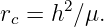
rc = h2 ∕μ.
(11)

Answer: (C).

Solution 5

At the circular minimum,

𝜀c = − μ∕ (2rc).
(12)

Answer: (C).

Solution 6

The second derivative is

 2      2||        3
d Φeff∕dr  rc = μ∕rc > 0.
(13)

The extremum is therefore a minimum. Answer: (C).

Solution 7

The positive term

h2∕(2r2)
(14)

dominates over

− μ∕r
(15)

at sufficiently small radius. Answer: (C).

Solution 8

When

h = 0,
(16)

the angular term disappears and only

− μ∕r
(17)

remains. Answer: (B).

Solution 9

Differentiating the effective potential gives

     2  3       2
¨r = h ∕r  − μ ∕r .
(18)

Answer: (A).

Solution 10

A horizontal negative-energy line above the minimum intersects the effective-potential curve twice. Answer: (C).

Solution 11

At periapsis,

˙r = 0,
(19)

but

v  = h∕r
 𝜃      p
(20)

is generally nonzero. Answer: (B).

Solution 12

The curvature of the effective potential at the circular minimum is

    3
μ∕r c.
(21)

Thus

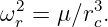
ω2 =  μ∕r3.
  r      c
(22)

Answer: (A).

2 GRE checklist

  1. Convert transverse kinetic energy using conserved angular momentum.
  2. Use the energy level to identify allowed radial regions.
  3. Set ṙ = 0 at turning points, not necessarily v = 0.
  4. Find circular orbits from dΦeff∕dr = 0.
  5. Test stability with the second derivative.
  6. Remember that the small-radius barrier disappears for h = 0.

References

References

[1]   PhysicsLibrary, M07-06, Effective Potential and Radial Motion in Central Gravity.

[2]   PhysicsLibrary, M07-05, Orbital Energy, Escape Speed, and Bound versus Unbound Motion.

[3]   J. R. Taylor, Classical Mechanics, University Science Books, 2005.


"GRE Physics Companion: Effective Potential and Radial Motion in Central Gravity" is owned by bloftin.
(view preamble)
View style:
Other names:  M07-06G
Keywords:  GRE physics, effective potential, central gravity, angular momentum, radial motion, turning points, circular orbit, stability

This object's parent.

Cross-references: kinetic energy, oscillations, acceleration, potential energy, radial velocity, effective potential, specific effective potential, radial equation, speed, radial turning points, turning points, angular momentum, energy, specific angular momentum

This is version 1 of GRE Physics Companion: Effective Potential and Radial Motion in Central Gravity, born on 2026-10-31.
Object id is 1560, canonical name is GREPhysicsCompanionEffectivePotentialAndRadialMotionInCentralGravity.
Accessed 7 times total.

Classification:
Physics Classification: 45.20.Dd (Newtonian mechanics)
 45.50.-j (Dynamics and kinematics of a particle and a system of particles)

Pending Errata and Addenda

None.

Discussion

No messages.

Interact