|
|
|
|||||||
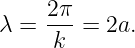
The traveling normal modes satisfy
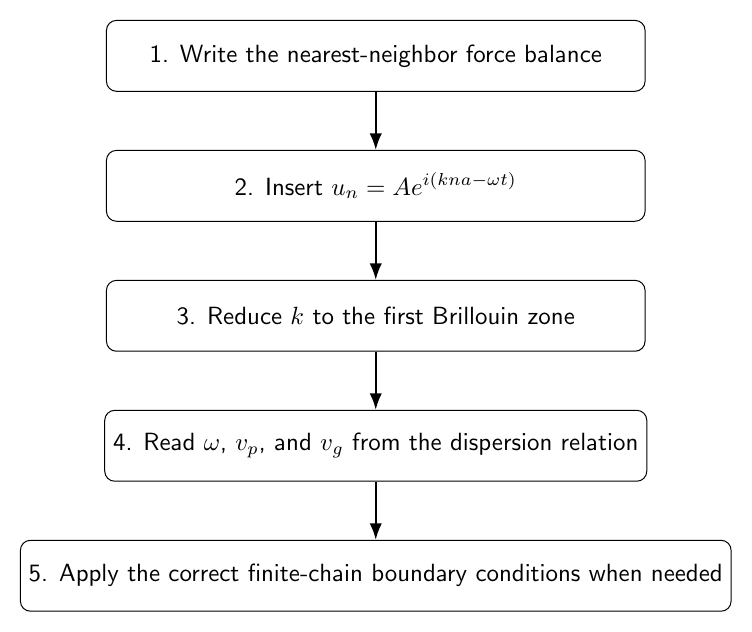
Figure 1. A compact oscillator-chain strategy: derive the discrete force balance, insert a lattice-wave ansatz, reduce wave numbers to the first Brillouin zone, then use the dispersion curve for frequency and propagation questions.
1 High-value GRE facts
Part I: Original GRE-style problems
Problem 1: lattice equationFor identical masses with nearest-neighbor springs,
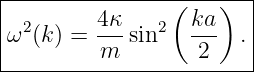
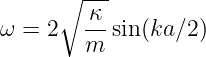
Problem 2: dispersion relationThe monatomic-chain dispersion relation is
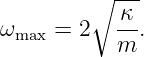
Problem 3: maximum frequencyThe maximum branch frequency is
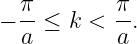
Problem 4: Brillouin-zone edgeThe positive edge of the first Brillouin zone is
Problem 5: zone-boundary patternAt
the displacement pattern is proportional to
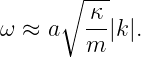
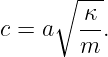
Problem 6: continuum speedIn the long-wavelength limit,
equals
Problem 7: group velocityFor
the group velocity is
Problem 8: group velocity at zone boundaryAt
is
Problem 9: periodic chain wave numbersFor a periodic chain of
sites,
is
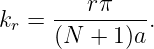
Problem 10: fixed-end frequenciesFor
moving masses between fixed ends,
is
Problem 11: numerical group velocityIf
then at
the group velocity is closest to
Problem 12: shortest distinct wavelengthThe shortest distinct wavelength of the monatomic lattice is
Part II: Complete worked solutions
Solution 1The two spring forces give the centered second difference:
Answer: (B).
Solution 2Substituting
gives
Answer: (B).
Solution 3The sine magnitude reaches one:
Answer: (B).
Solution 4One complete nonredundant interval is
The positive edge is
Answer: (C).
Solution 5At the zone boundary,
Answer: (C).
Solution 6For
Thus
Answer: (B).
Solution 7Differentiate
for positive
Then
Answer: (C).
Solution 8At
Therefore
Answer: (D).
Solution 9Periodic boundary conditions require
Therefore
Answer: (B).
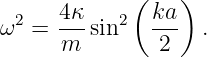
Solution 10For fixed ends,
Substitution into the infinite-chain dispersion relation gives
Answer: (A).
Solution 11First,
Then
Answer: (C).
Solution 12The zone boundary has
Thus
Answer: (C).
2 GRE checklist
References
References
"GRE Physics Companion: Discrete Oscillator Chains and Dispersion" is owned by bloftin.
This object's parent. Cross-references: scalar, quantization, phase velocity, phase factor, boundary, magnitude, periodic, group velocity, displacement, dispersion relation, phase, masses, zone-boundary mode, frequency, first Brillouin zone, force, normal modes This is version 1 of GRE Physics Companion: Discrete Oscillator Chains and Dispersion, born on 2026-10-18. Object id is 1499, canonical name is GREPhysicsCompanionDiscreteOscillatorChainsAndDispersion. Accessed 5 times total. Classification:
|
|
|
|
Pending Errata and AddendaNone.
|
DiscussionNo messages.
|
Interact |
![[parent]](https://images.physicslibrary.org/images/uparrow.png)


 .
.
 .
.





 sin[
sin[
 cos[
cos[ for every












![∘ --- [ ]
κ- ---rπ----
ωr = 2 m sin 2(N + 1) .](https://images.physicslibrary.org/cache/objects/1499/make4ht/GREPhysicsCompanionDiscreteOscillatorChainsAndDispersion45x.png)