|
|
|
|||||||
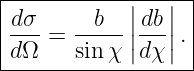
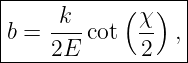
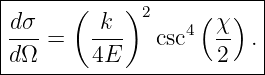
For repulsive Coulomb scattering,
so
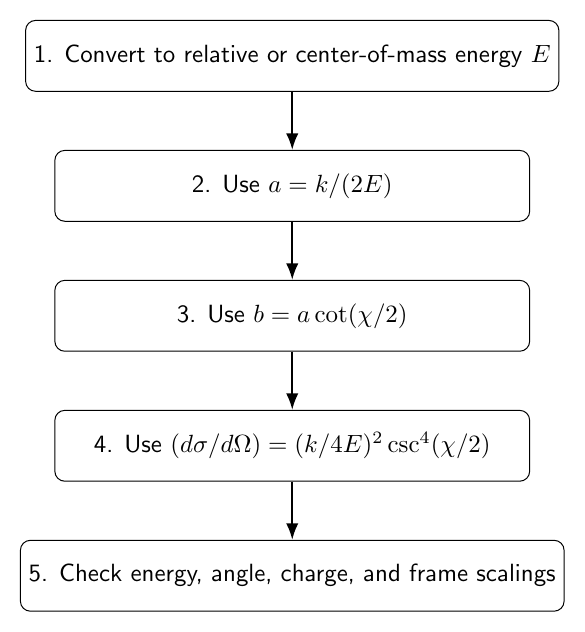
Figure 1. A compact Rutherford-scattering strategy: identify center of mass energy, use the Coulomb scattering function, then convert the impact-parameter map into a differential cross section.
1 High-value GRE facts
Part I: Original GRE-style problems
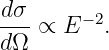
Problem 1: energy scalingAt fixed scattering angle, the projectile energy is doubled. The Rutherford differential cross section changes by a factor of
Problem 2: charge scalingAt fixed E and χ, one charge magnitude is doubled. The Rutherford differential cross section changes by a factor of
Problem 3: impact parameter at 90∘Define a = k∕(2E). For χ = 90∘, the Rutherford impact parameter is
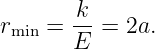
Problem 4: head-on closest approachFor repulsive Coulomb scattering, the head-on closest approach is
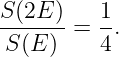
Problem 5: small-angle behaviorFor small χ, Rutherford scattering behaves approximately as
Problem 6: differential cross-section unitsThe customary units of dσ∕dΩ are
Problem 7: barn conversionOne barn equals
Problem 8: integrated angular cutThe cross section for Rutherford scattering through angles at least χ0 is
Problem 9: small angle and impact parameterFor repulsive Rutherford scattering, as b increases,
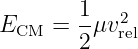
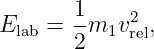
Problem 10: center of mass energyA projectile of mass m1 with lab kinetic energy Elab strikes a stationary target of mass m2. The relative kinetic energy is
Problem 11: pure Coulomb total cross sectionIf arbitrarily small nonzero scattering angles are counted for an unscreened Coulomb potential, the classical total cross section is
Problem 12: heavy target limitIf m2 ≫ m1, then for a stationary target
Part II: Complete worked solutions
Solution 1At fixed angle,
Therefore
Answer: (A).
Solution 2Since
and
doubling one charge multiplies the cross section by four. Answer: (E).
Solution 3
Answer: (C).
Solution 4For a head-on encounter,
Answer: (C).
Solution 5For small angle,
Therefore
Answer: (D).
Solution 6A differential cross section is an area per unit solid angle:
Answer: (D).
Solution 7By definition,
Answer: (D).
Solution 8All events with χ ≥ χ0 correspond to
Thus
Answer: (A).
Solution 9From
larger b corresponds to smaller χ. Answer: (B).
Solution 10Since
and
Answer: (C).
Solution 11As
Hence the ideal unscreened Coulomb integrated cross section diverges. Answer: (D).
Solution 12When
the reduced mass approaches m1, the center of mass energy approaches projectile lab energy, and the lab projectile angle approaches the center of mass angle. Answer: (B).
2 GRE checklist
References
References
[1] E. Rutherford, “The Scattering of α and β Particles by Matter and the Structure of the Atom,” Philosophical Magazine, Series 6, Vol. 21, 1911. [2] J. R. Taylor, Classical Mechanics, University Science Books, 2005. [3] H. Goldstein, C. Poole, and J. Safko, Classical Mechanics, 3rd ed., Addison-Wesley, 2002. "GRE Physics Companion: Differential Cross Sections and Rutherford Scattering" is owned by bloftin.
This object's parent. Cross-references: formula, solid, relative kinetic energy, kinetic energy, mass, units, magnitude, charge, Rutherford differential cross section, scattering angle, cross section, impact parameter, center of mass kinetic energy, Rutherford scattering, differential cross section, scattering function, energy, center of mass, scattering This is version 1 of GRE Physics Companion: Differential Cross Sections and Rutherford Scattering, born on 2026-10-04. Object id is 1409, canonical name is GREPhysicsCompanionDifferentialCrossSectionsAndRutherfordScattering. Accessed 10 times total. Classification:
|
|
|
|
Pending Errata and AddendaNone.
|
DiscussionNo messages.
|
Interact |
![[parent]](https://images.physicslibrary.org/images/uparrow.png)