GRE Physics Companion: Constant Acceleration Motion
This companion is designed for rapid review after completing M01-05. The emphasis is not on
re-deriving the equations, but on selecting the correct relation quickly, assigning signs consistently,
and recognizing common test traps.
1 Fast equation triage
For one-dimensional constant acceleration, keep the five variables
in view. Most problems give three or four of them and ask for another.
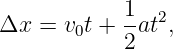
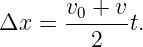
The four standard relations are
and
A fast strategy is to select the equation that contains the unknown and avoids the variable that is
not supplied.
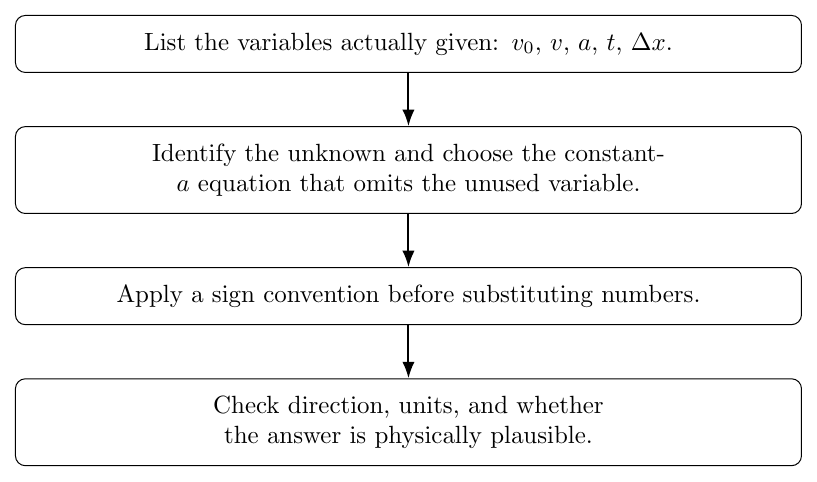
Figure 1. GRE-speed workflow: list the actual variables, choose an equation that omits the unused
one, set the sign convention, and then check units and physical sense.
2 Sign and free-fall traps
A sign belongs to a component, not to a physical word such as “speeding up” or “gravity.” Choose
the positive axis first.
With upward positive near Earth’s surface,
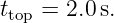
At the top of a vertical throw,
but
On the way downward, both vy and ay are negative, so the object is speeding up.
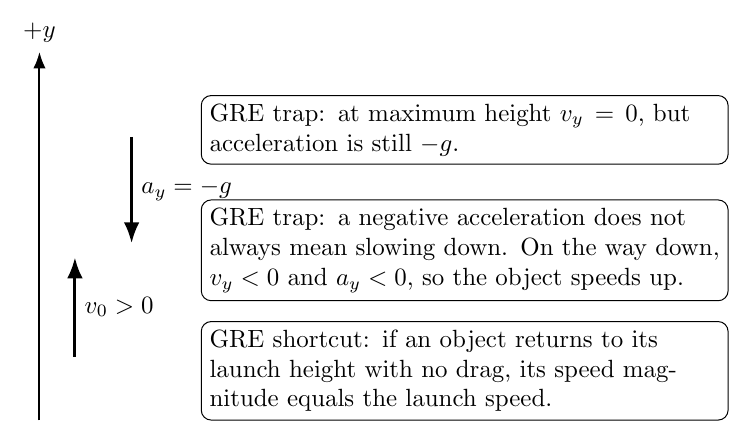
Figure 2. Three common constant acceleration test traps: zero velocity does not imply zero
acceleration, negative acceleration does not always mean slowing down, and return to the launch
height restores the launch-speed magnitude when drag is absent.
3 Worked GRE example 1: no-time equation
A CAR moving at 20 m∕s brakes uniformly and stops in 50 m. What is the acceleration?
Time is absent, so use
With v = 0,
Thus
The negative sign is expected because the positive direction was chosen along the initial
motion.
4 Worked GRE example 2: vertical launch
A ball is launched upward at 19.6 m∕s. Neglect drag and use g = 9.8 m∕s2. How long after launch
does it return to the launch height?
The time to the top follows from
so
The return time is twice this value:
A fast symmetry argument reaches the same result.
5 GRE-speed questions
M01-05G-Q01
A particle has v0 = 5 m∕s and a = 3 m∕s2. Its speed after 4 s is
(A) 8 m/s (B) 12 m/s (C) 17 m/s (D) 20 m/s (E) 25 m/s.
M01-05G-Q02
An object starts from rest and accelerates uniformly. If its acceleration doubles while the elapsed
time is unchanged, its displacement from the start is multiplied by
(A) 1∕2 (B) 1 (C) 2 (D) 4 (E) 8.
M01-05G-Q03
A ball thrown straight upward reaches its highest point. At that instant its velocity and
acceleration are
(A) both zero; (B) zero velocity and downward acceleration; (C) upward velocity and zero
acceleration; (D) downward velocity and downward acceleration; (E) zero velocity and upward
acceleration.
M01-05G-Q04
A car moving at 10 m/s accelerates uniformly at 2 m/s2 for 5 s. Its displacement is
(A) 25 m (B) 50 m (C) 75 m (D) 100 m (E) 125 m.
M01-05G-Q05
A particle has negative velocity and negative acceleration. Its speed is
(A) increasing; (B) decreasing; (C) zero; (D) necessarily constant; (E) impossible to determine even
if both signs are known.
M01-05G-Q06
For constant acceleration, which relation contains no explicit time variable?
(A) v = v0 + at; (B) Δx = v0t + at2∕2; (C) v2 = v
02 + 2aΔx; (D) Δx = (v
0 + v)t∕2; (E) none of
these.
M01-05G-Q07
An object released from rest falls for time t with constant gravitational acceleration. If the time is
doubled, the distance fallen is multiplied by
(A) 2 (B) 3 (C) 4 (D) 6 (E) 8.
M01-05G-Q08
A particle’s velocity-time graph is a straight horizontal line above the time axis. The acceleration
is
(A) positive constant; (B) negative constant; (C) zero; (D) increasing; (E) decreasing.
6 Answers and concise rationales
- C. v = 5 + 3(4) = 17 m/s.
- C. From Δx = at2∕2 when v
0 = 0, displacement is directly proportional to a.
- B. The velocity is momentarily zero, but gravity remains downward.
- C. Δx = 10(5) +
 (2)(25) = 75 m.
- A. Velocity and acceleration have the same sign, so the speed magnitude increases.
- C. The equation v2 = v
02 + 2aΔx eliminates time.
- C. From Δy = gt2∕2, doubling t multiplies the distance by four.
- C. A horizontal velocity-time graph has zero slope, so a = 0.
7 What to remember under time pressure
- Choose a positive direction before inserting signs.
- Use the no-time relation when time is absent.
- At the top of free fall, velocity can be zero while acceleration is not.
- Same signs of v and a mean speeding up; opposite signs mean slowing down.
- Areas and slopes from M01-04 remain valid and can provide a faster route than algebra.
References
[1] PhysicsLibrary, M01-05: Constant Acceleration Motion.
[2] OpenStax / cnxuniphysics, University Physics Volume 1, archived 2016 BCcampus
clone, CC BY 4.0.
[3] University of California, Davis, Physics 9A: Classical Mechanics, Physics LibreTexts,
CC BY-SA 4.0.

![[parent]](https://images.physicslibrary.org/images/uparrow.png)