|
|
|
|||||||
and
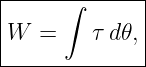
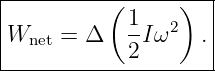
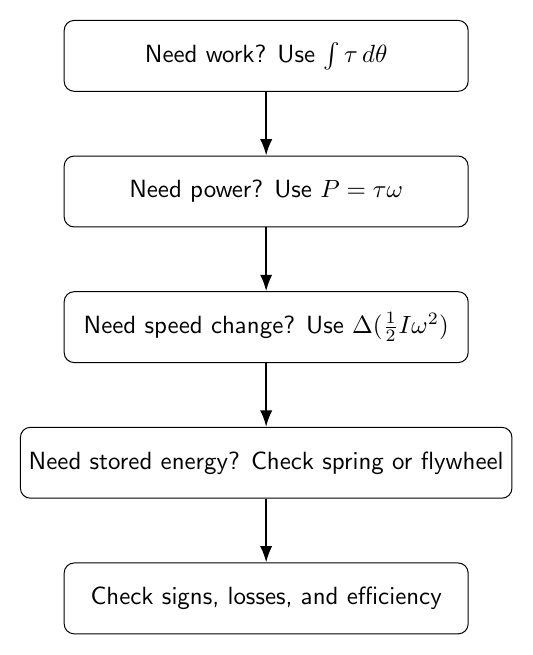
Figure 1. A compact strategy for rotational work and Power problems. Use torque-angle area for work, torque times angular speed for power, and rotational kinetic energy for state changes.
1 High-value GRE facts
Part I: Original GRE-style problems
Problem 1: constant torque workA constant torque of 6 N m acts through 10 rad. The work is
Problem 2: rotational powerA shaft rotates at 80 rad∕s while transmitting torque 25 N m. The power is
Problem 3: torque-angle graphTorque increases linearly from zero at 𝜃 = 0 to τ0 at 𝜃 = 𝜃0. The work is
Problem 4: flywheel speed scalingA flywheel’s angular speed doubles while its moment of inertia remains constant. Its rotational kinetic energy is multiplied by
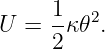
Problem 5: torsional spring energyA torsional spring has constant κ and is twisted through angle 𝜃. Its stored energy is
Problem 6: constant power motorA motor delivers constant power P at angular speed ω. Its torque is
Problem 7: damping powerA rotational damper obeys τd = −bω. Its power is
Problem 8: ideal transmissionAn ideal transmission reduces angular speed by a factor of 5. If input torque is τin, output torque is
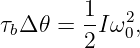
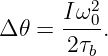
Problem 9: braking angleA rotor with moment of inertia I and initial angular speed ω0 is stopped by constant braking torque magnitude τb. The stopping angle is
Problem 10: belt powerA tangential belt force F acts at radius R of a Pulley rotating at ω. The transmitted power is
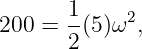
Problem 11: constant torque from restA rotor with I = 5 kg m2 starts from rest. Net torque 20 N m acts through 10 rad. The final angular speed is closest to
Problem 12: torque versus energyWhich statement is correct?
Part II: Complete worked solutions
Solution 1
Answer: (D).
Solution 2
Answer: (B).
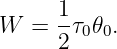
Solution 3The graph is a triangle:
Answer: (C).
Solution 4Since K =
Solution 5
Answer: (D).
Solution 6From P = τω,
Answer: (B).
Solution 7
Answer: (D).
Solution 8Ideal power conservation gives
If ωout = ωin∕5, then
Answer: (D).
Solution 9
so
Answer: (B).
Solution 10Since τ = FR,
Answer: (C).
Solution 11
Then
so
Answer: (C).
Solution 12Torque is a moment of force. Work is the scalar integral of torque through angular displacement. Answer: (B).
2 GRE checklist
References
References
"example of Rotational Work, Power, and Energy Transfer" is owned by bloftin.
This object's parent. Cross-references: displacement, kinetic energy, scalar, Pulley, force, magnitude, moment of inertia, mechanical power, rotational damping, torsional spring, dimensions, rotational power, graph, rotational kinetic energy, speed, work, Power, rotational work, relations, energy This is version 1 of example of Rotational Work, Power, and Energy Transfer, born on 2026-10-03. Object id is 1388, canonical name is ExampleOfRotationalWorkPowerAndEnergyTransfer. Accessed 11 times total. Classification:
|
|
|
|
|
|
|
![[parent]](https://images.physicslibrary.org/images/uparrow.png)