|
|
|
|||||||
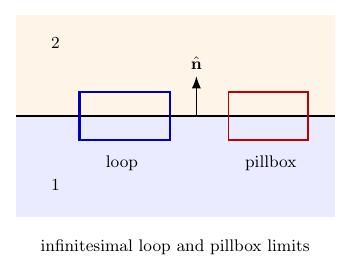
This is an electrostatic statement. A nonzero time-varying magnetic flux through the loop changes the appropriate Maxwell Equation. 2 Normal displacement jumpA pillbox crossing the interface yields ∮ D ⋅dA = Qf,enc. Let n point from medium 1 to medium 2. As pillbox thickness tends to zero,
The field D counts free charge through its divergence; bound polarization charges have already been accounted for by D = 𝜖0E + P.
Figure 1. Thin electrostatic loop and Gaussian pillbox straddling an interface. Their long directions test different field components.
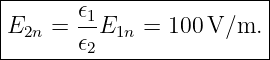
3 A purely normal field with no free interface chargeWorked example 1. Two linear homogeneous dielectrics have 𝜖1 = 2𝜖0, 𝜖2 = 5𝜖0, and E1n = 250 V∕m directed from medium 1 into 2. With σf = 0, continuity of Dn gives 𝜖1E1n = 𝜖2E2n. Therefore
The Normal electric field changes while the normal displacement remains continuous. 4 A charged material interfaceWorked example 2. Retain the same permittivities, but let the free surface charge be σf = +1.0 nC∕m2 and E 1n = 0. The jump condition gives
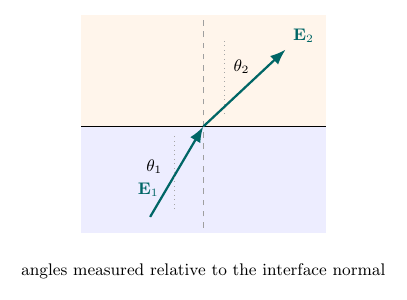
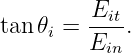
Notice that it is Dn, not En, that has a jump equal to σf. 5 Refraction of field directionWorked example 3. Suppose the interface carries no free charge and the electrostatic field has both normal and tangential components. Let angle 𝜃i be measured from the surface normal within medium i. Then
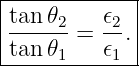
Continuity gives E2t = E1t and 𝜖1E1n = 𝜖2E2n. Divide these equations to obtain
For 𝜖2 = 4𝜖1 and 𝜃1 = 30∘, tan 𝜃
2 = 4∕
Figure 2. The interface tangent and normal define the field angles. The boundary conditions change the relative normal and tangential components.
6 Conductor-dielectric boundaryWorked example 4. The field inside an ideal electrostatic conductor is zero, and its surface is equipotential. At an interface with a dielectric, Et = 0 immediately outside, and the displacement jump is Dn = σf if the normal points into the dielectric and the metal interior has D = 0. For a linear isotropic dielectric, En = σf∕𝜖. The vacuum formula En = σf∕𝜖0 must not be used unchanged if the adjacent medium has permittivity 𝜖. 7 Exercises and complete solutionsExercise 1. In a source-free dielectric boundary with 𝜖2 = 3𝜖1, E1n = 90 V∕m. Find E2n. Solution. E2n = 30 V∕m. Exercise 2. If E1t = 12 V∕m, what is E2t in electrostatics? Solution. Exactly 12 V∕m in the same oriented tangent direction, assuming finite regular fields. Exercise 3. Derive the normal displacement difference for an interface holding −2.0 nC∕m2 free charge. Solution. By the pillbox, D2n − D1n = −2.0 nC∕m2, with normal directed from 1 to 2. Exercise 4. Why does a change in En not necessarily indicate free surface charge? Solution. Even with σf = 0, continuity of Dn = 𝜖En allows unequal En when permittivities differ. Bound polarization charge accounts for the change. References
"Dielectric Interfaces and Boundary Conditions" is owned by bloftin.
This object's parent. Cross-references: regular, boundary, formula, equipotential, conductor, relation, electrostatic field, displacement, electric field, Normal, dielectrics, Gaussian pillbox, polarization, divergence, Maxwell Equation, magnetic flux, charge, boundary conditions There are 4 references to this object. This is version 1 of Dielectric Interfaces and Boundary Conditions, born on 2026-11-28. Object id is 1641, canonical name is DielectricInterfacesAndBoundaryConditions. Accessed 11 times total. Classification:
|
|
|
|
Pending Errata and AddendaNone.
|
DiscussionNo messages.
|
Interact |




 , giving