|
|
|
|||||||
where
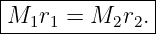
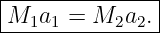
This equation is the basis of the mass-ratio relation
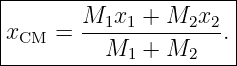
At first sight, Equation (1) looks like the familiar one-dimensional center of mass equation. That intuition is correct, but one additional step is needed for an eccentric orbit. For a circular binary, the distances from the center of mass are constant and are equal to the orbital radii. For an eccentric binary, the instantaneous distances vary with time. The reason Equation (1) still applies to the semimajor axes is that the complete barycentric orbits are constant scaled copies of the same relative Kepler orbit. This derivation develops that result in three stages:
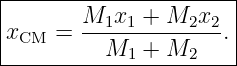
1 Start with the one-dimensional center of massFor two point masses on an x axis, the center of mass coordinate is
Choose the origin at the center of mass:
Then
Suppose star 1 lies to the right of the origin and star 2 to the left. Write
where r1 and r2 are positive distances from the center of mass. Substitution gives
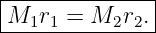
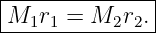
Therefore
This is the basic balance relation.
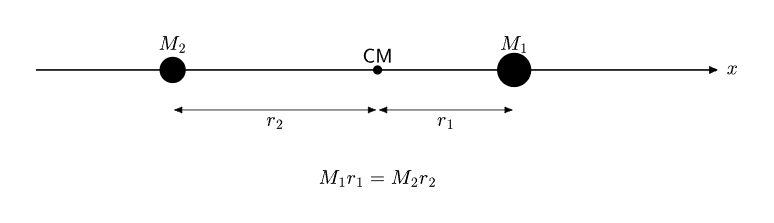
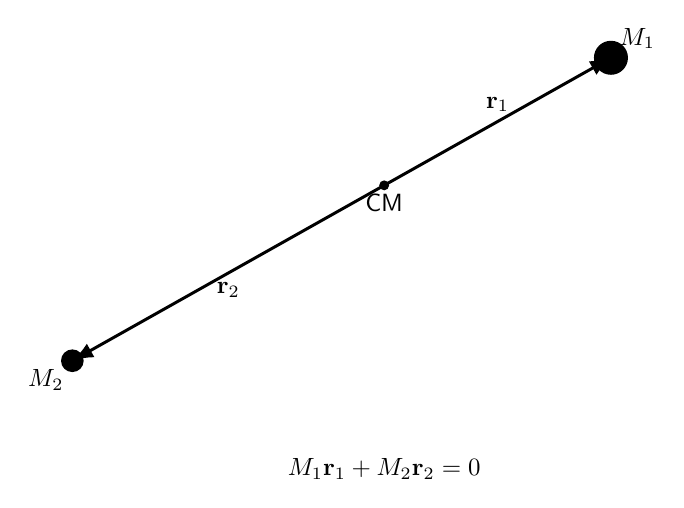
Figure 1. With the origin at the center of mass, the two signed position coordinates have opposite signs and their mass-weighted sum is zero.
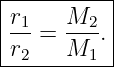
2 Physical meaning of the one-dimensional relationEquation (4) can be rearranged as
The distances from the center of mass are inversely proportional to the masses. Therefore:
This is the same principle encountered in balances, levers, and two-particle mechanics.
3 Is the binary really a one-dimensional system?No. The orbit generally occurs in a two-dimensional orbital plane embedded in three-dimensional space. The one-dimensional derivation works because, at any instant, the two masses and the center of mass lie on the same line. One can temporarily choose an x axis along that instantaneous line. The more fundamental relation is vectorial.
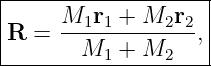
4 The vector center of massFor two bodies,
where R is the center of mass position in an arbitrary inertial frame. Choose a coordinate frame whose origin is at the center of mass. Then
Equation (6) becomes
Therefore
The minus sign means that the two barycentric position vectors always point in opposite directions. Taking magnitudes gives
Thus the one-dimensional result is simply the magnitude form of the full vector center of mass equation.
Figure 2. In the barycentric frame, the two position vectors are always antiparallel and their mass-weighted vector sum is zero.
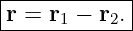
5 Introduce the relative position vectorDefine the relative position
Let
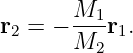
From Equation (8),
Insert this into Equation (10):
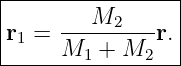
Therefore
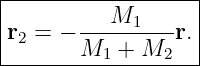
Similarly,
These two equations are the key to understanding the semimajor-axis relation.
Figure 3. Each stellar position vector is a constant mass-dependent scale factor times the relative position vector.
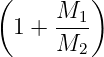
6 Why the scale factors are constantThe factors
and
contain only the stellar masses. For an isolated binary whose masses are constant, these scale factors do not change with time. Thus Equation (11) does not merely say that one instantaneous distance is a fraction of another. It says that the entire time-dependent orbit of star 1 is a scaled copy of the relative orbit. Likewise, Equation (12) says that star 2 follows a scaled copy rotated by 180∘ about the center of mass.
7 Circular-orbit caseFor a circular binary, the instantaneous barycentric distances are constant:
Equation (9) immediately becomes
So for circular motion, Equation (1) follows directly from the one-dimensional center of mass definition. This is the simplest way to introduce the relation.
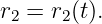
8 Why eccentric motion needs one more stepFor an eccentric binary,
and
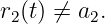
These instantaneous distances vary throughout the orbit. In general,
and
Therefore one should not derive the eccentric-orbit semimajor-axis relation by simply replacing the instantaneous distances in Equation (9) with semimajor axes. Instead, use the constant vector scaling in Equations (11) and (12).
9 Scaling an ellipseSuppose the relative orbit is an ellipse described by
If every vector on that orbit is multiplied by a constant positive number c,
then every linear dimension of the ellipse is multiplied by c. Therefore:
The eccentricity remains unchanged because it is dimensionless.
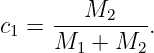
10 Apply the scaling to star 1Equation (11) has the form
with
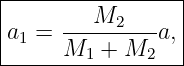
Therefore the semimajor axis of star 1 is
where a is the semimajor axis of the relative orbit.
11 Apply the scaling to star 2Equation (12) contains a minus sign. The minus sign reverses the direction by 180∘ but does not change lengths. Thus the semimajor axis of star 2 is
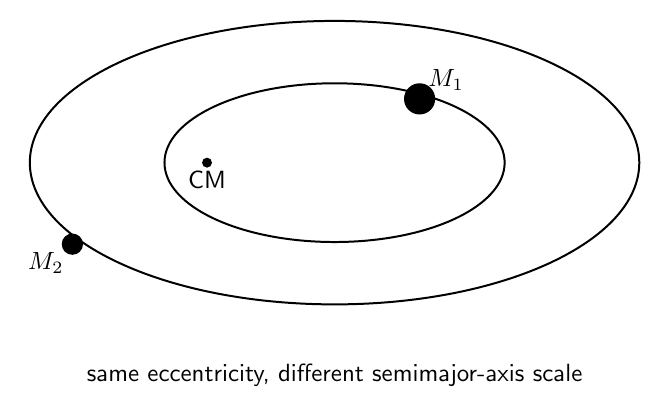
Both component orbits have the same eccentricity as the relative orbit.
Figure 4. In an eccentric binary, the instantaneous distances vary, but the two complete barycentric ellipses remain fixed scaled copies of the relative ellipse.
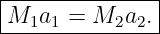
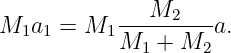
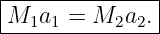
12 Derive the semimajor-axis mass relationMultiply Equation (14) by M1:
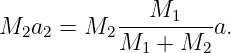
Multiply Equation (15) by M2:
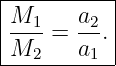
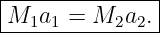
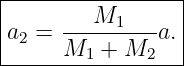
The right sides are identical. Therefore
This is Equation (15) of BIN01. The derivation is valid for both circular and elliptical Keplerian binaries.
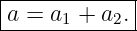
13 The relative semimajor axisAdd Equations (14) and (15):
Thus
This is another important binary star relation. The relative orbit measures the separation of one star from the other. The barycentric orbits measure each star relative to the center of mass. Their semimajor axes add to the relative semimajor axis.
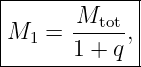
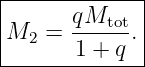
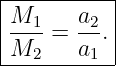
14 Mass ratioEquation (16) can be rearranged:
Divide by M2a1:
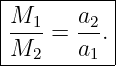
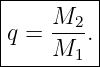
This inverse relation is physically intuitive. The more massive star has the smaller barycentric orbit. Define the mass ratio
Then
Different fields sometimes define q with the reciprocal convention, so the definition must always be stated.
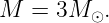
15 Example 1: unequal massesSuppose
The total mass is
Then
Check:
Therefore
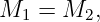
16 Example 2: equal massesIf
then Equation (18) gives
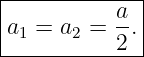
Because
we obtain
The center of mass lies halfway between the two stars at every instant.
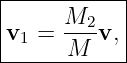
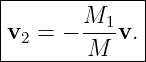
17 Connection to velocitiesDifferentiate Equation (11):
where
Similarly,
Therefore
This is simply conservation of momentum in the center of mass frame. Taking corresponding velocity amplitudes gives another inverse mass-ratio relation.
18 Connection to spectroscopic binariesFor a double-lined spectroscopic binary, the radial-velocity semiamplitudes are
and
Because both stars share the same
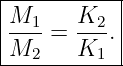
their radial-velocity amplitudes scale with their barycentric semimajor axes:
Therefore
Thus the same center of mass relation appears in both astrometry and spectroscopy.
Figure 5. The inverse mass ratio appears through barycentric orbit sizes and through radial-velocity amplitudes because both originate from the same center of mass constraint.
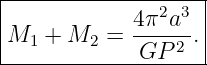
19 Connection to total dynamical massKepler’s third law gives the total mass:
The barycentric relation gives the mass ratio:
Together, total mass and mass ratio determine the individual masses. Let
Then
Thus
so
and
This is why measuring both the total orbit and the barycentric division of that orbit is so powerful.
20 A geometric interpretationEquation (8),
can be viewed as a balance of first moments about the center of mass. The quantity
is the mass multiplied by its lever-arm distance from the center of mass. The two first moments have equal magnitude and opposite direction. This is exactly the same center of mass principle used in elementary mechanics. Binary star orbital geometry is therefore a direct astronomical application of the familiar balance relation.
21 Why the center of mass is at a focusEach star follows a Kepler ellipse under the gravitational interaction. In barycentric coordinates, the common center of mass lies at a focus of each component ellipse. The two ellipses:
The barycenter is not generally the geometric center of either ellipse. This distinction becomes important when interpreting visual-binary orbit diagrams.
22 When the relation can changeThe derivation assumes:
If substantial mass is transferred or lost, the mass ratio can evolve. If a third body is present, the motion can contain additional barycentric structure. The instantaneous center of mass definition remains valid, but a simple fixed pair of Kepler ellipses may no longer describe the full motion.
23 Common mistakes
24 Practice exercises
25 SummaryThe one-dimensional center of mass relation is
Putting the origin at the center of mass gives
The full vector form is
Using the relative coordinate,
Because these scale factors are constant, the complete barycentric ellipses are scaled copies of the relative ellipse. Therefore
and hence
Thus Equation (15) in BIN01 is fundamentally a center of mass relation extended from instantaneous positions to the semimajor axes of two geometrically similar Kepler orbits.
References
References
[1] B. W. Carroll and D. A. Ostlie, An Introduction to Modern Astrophysics, 2nd ed., Cambridge University Press, 2017. [2] R. W. Hilditch, An Introduction to Close Binary Stars, Cambridge University Press, 2001. [3] J. R. Taylor, Classical Mechanics, University Science Books, 2005. [4] C. D. Murray and S. F. Dermott, Solar System Dynamics, Cambridge University Press, 1999. "center of mass relation" is owned by bloftin.
This object's parent. Cross-references: astrometric binary, system, diagrams, Kepler's third law, spectroscopic binary, velocity, momentum, fields, relative semimajor axis, BIN01, dimension, motion, magnitudes, position vectors, position, works, two-dimensional, mechanics, vector, masses, relation, center of mass This is version 1 of center of mass relation, born on 2026-10-04. Object id is 1416, canonical name is CenterOfMassRelation. Accessed 5 times total. Classification:
|
|
|
|
Pending Errata and AddendaNone.
|
DiscussionNo messages.
|
Interact |
![[parent]](https://images.physicslibrary.org/images/uparrow.png)
 : From the Center of Mass to Barycentric Orbits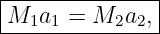





















 (12) = 4
 (12) = 8