
|
|
|
|||||||
y-axis
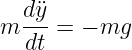
where

 Therefore the component of the velocity along the x-axis remains constant, while the component along the y-axis changes uniformly. Let v0 be the initial velocity of the projection, then when t = 0, ẋ0 = v0 cos α and ẏ0 = v0 sin α. Making these substitutions in the last two equations we obtain

 Therefore
Then the total velocity at any instant is

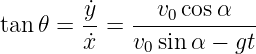
 and makes an angle 𝜃 with the horizon defined by
 Integrating equations (3) and (4) we obtain

 But when t = 0, x = y = 0, therefore c3 = c4 = 0, and consequently
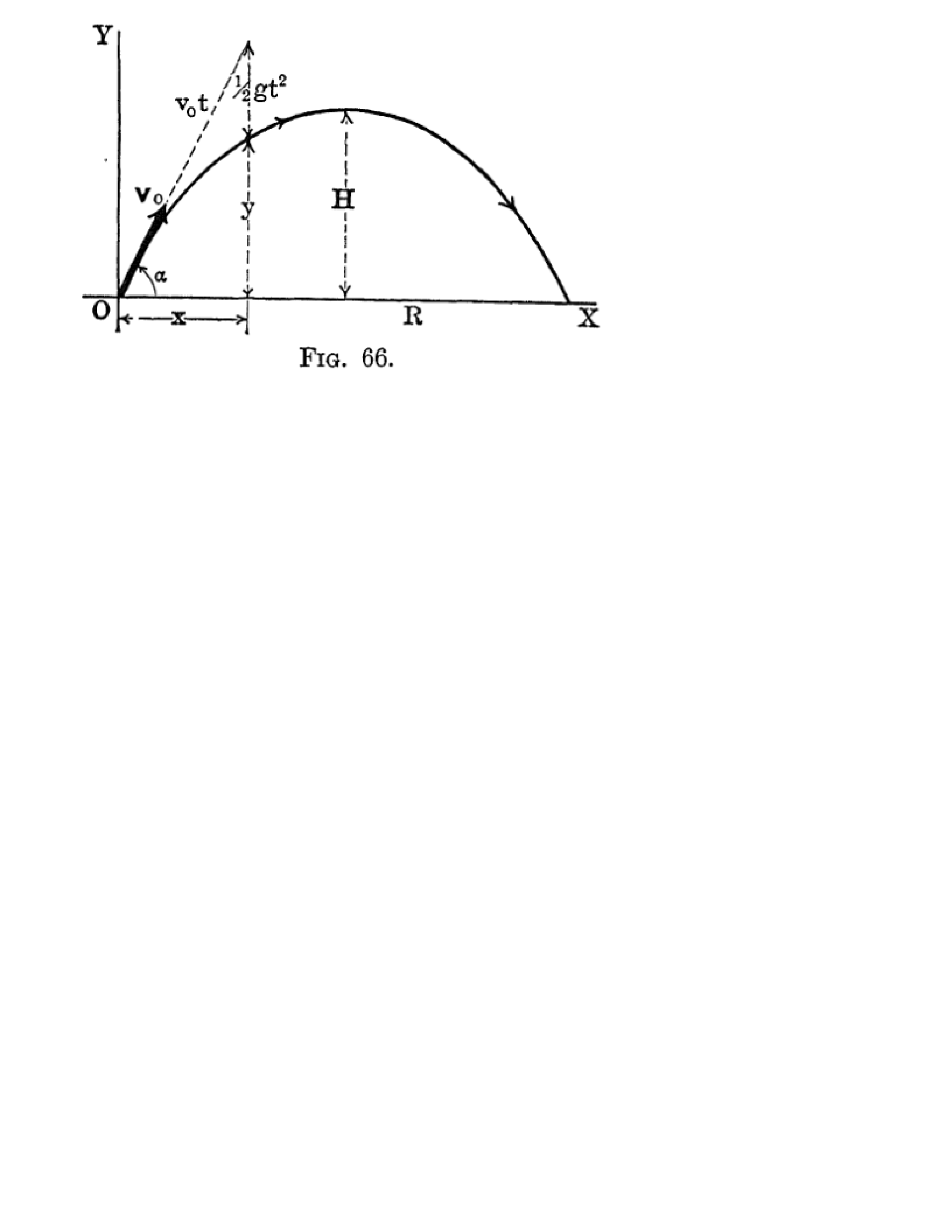
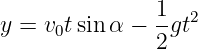
It is interesting to note that the motions in the two directions are independent. The gravitational acceleration does not affect the constant velocity along the x-axis, while the motion along the y-axis is the same as if the body were dropped vertcally with an initial velocity v0 sin α. bf The Path - The equation of the path may be obtained by eliminating t between equations (7) and (8). This gives
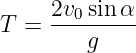
which is the equation of a parabola. bf The Time of Flight - When the projectile strikes the ground its y-coordinate is zero. Therefore substituting zero for y in equation (8) we get for the time of flight
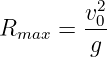
The Range - The range, or the total horizontal distance covered by the projectile, is found by replacing t in equation (7) by the value of T in equation (10), or by letting y = 0 in equation (9). By either method we obtain
Note that a basic trigonometric identity was used to simpilfy the above equation. Since v0 and g are constants the value of R depends upon α. It is evident from equation
(11) that R is maximum when sin 2α = 1, or when α =
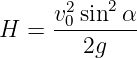
In actual practice the angle of elevation which gives the maximum range is smaller on account of the resistance of the air. The Highest Point - At the highest point ẏ = 0. Therefore substituting this value of ẏ in
equation (4) we obtain
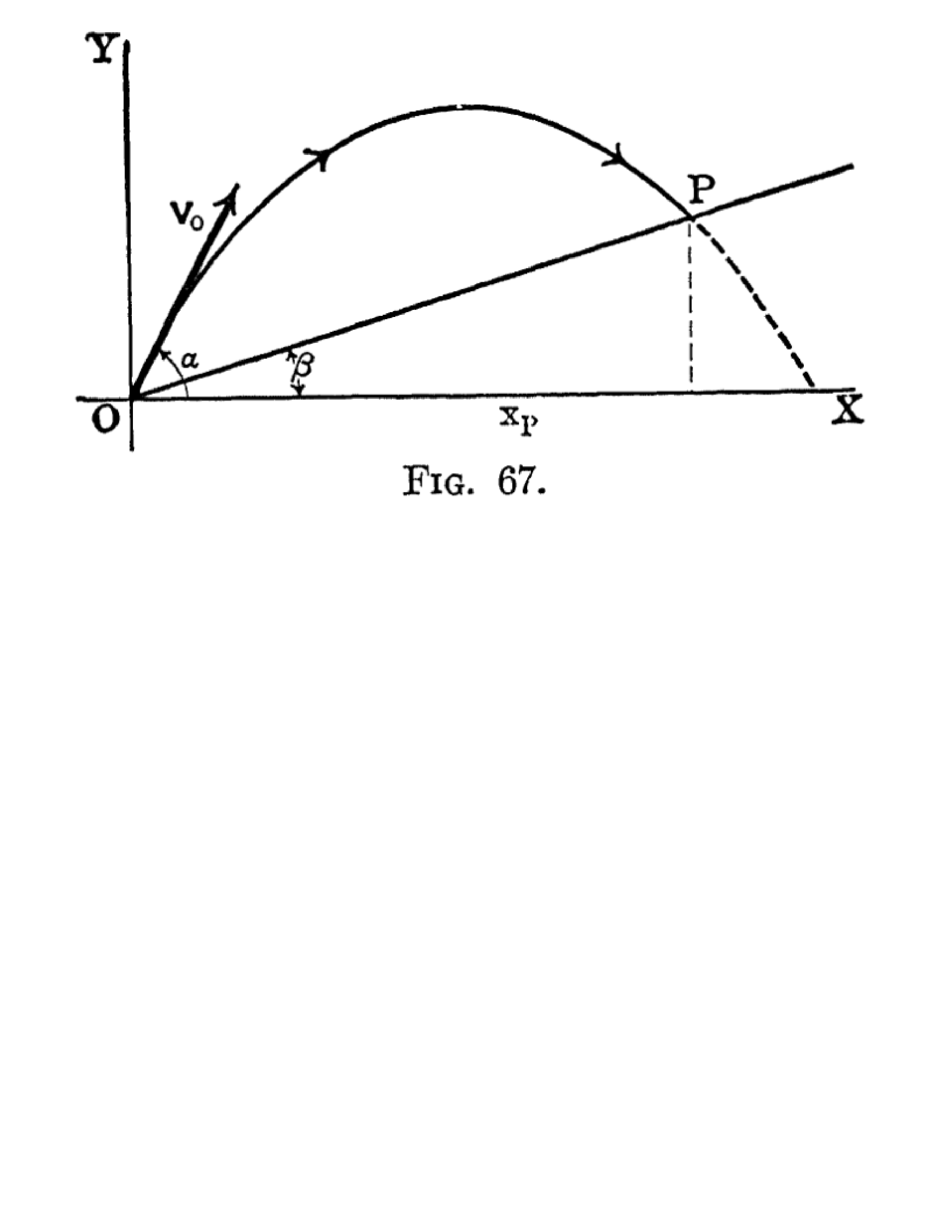
The Range for a Sloping Ground - Let β be the angle which the ground makes with the horizon. Then the range is the distance OP, Fig. 67, where P is the point where the projectile strikes the sloping ground. The equation of the line OP is
Eliminating y between equations (14) and (9) we obtain the x-coordinate of the point,
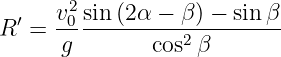
 But xp = R′ cos β, where R′ = OP. Therefore
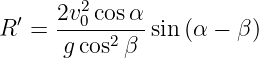
Thus for a given value of β, R′ is maximum when sin
When β = 0 equations (15) and (16) reduce to equations (12) and (13), as they should. "projectile motion" is owned by bloftin.
This object's parent.
Cross-references: resistance, identity, velocity, acceleration, Newton's laws of motion, Weight, force, drag, horizon, particle There are 6 references to this object. This is version 3 of projectile motion, born on 2006-08-06, modified 2008-02-01. Object id is 217, canonical name is ProjectileMotion. Accessed 7804 times total. Classification:
|
|
|
|
Pending Errata and AddendaNone.
|
DiscussionNo messages.
|
Interact |
![[parent]](https://images.physicslibrary.org/images/uparrow.png)


 and
and  are the components of the




 . The maximum range is,
therefore,
. The maximum range is,
therefore,
 or
or 

 = 1, that is, when
  +
+  .
.
