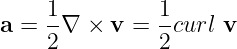
To the cross product of the gradient operator ∇× Maxwell gave the name curl.
The curl of a vector function V is itself a vector function of position in space. As the name
indicates, it is closely connected with the angular velocity or spin of the flux at each point. But
the interpretation of the curl is neither so easily obtained nor so simple as that of the
divergence.
Consider as before that V represents the flux of a fluid. Take at a definite instant an infinitesimal
sphere about any point (x,y,z). At the next instant what has become of the sphere? In the first
place it may have moved off as a whole in a certain direction by an amount dr. In other words it
may have a translational velocity of dr∕dt. In other words it may have undergone such a
deformation that it is no longer a sphere. It may have been subjected to a strain by virtue of
which it becomes slightly ellipsoidal in shape. Finally it may have been rotated as a
whole about some axis through an angle dw. That is to say, it may have an angular
velocity the magnitude of which is dw∕dt. An infinitesimal sphere therefore may have any
one of these distinct types of motion or all of them combined. First, a translation with
definite velocity. Second, a strain with three definite rates of elongation along the axes
of an ellipsoid. Third, an angular velocity about a difinite axis. It is this third type
of motion which is given by the curl. In fact, the curl of the flux V is a vector which
has at each point of space the direction of the instantaneous axis of rotation at that
point and a magnitude equal to twice the instantaneous angular velocity about that
axis.
The analytic discussion of the motion of a fluid presents more difficulties than it is necessary to
introduce in treating the curl. The motion of a rigid body is sufficiently complex to give an
adequate idea of the operation. It was seen that the velocity of the particles of a rigid body at any
instant is given by the formula
Let
expand ∇× formally as if it were the Vector Triple Product of ∇, a, and r.
Then
formally as if it were the Vector Triple Product of ∇, a, and r.
Then
v0 is a constant vector. Hence the term ∇× v0 vanishes.
Since a is a constant vector, it may be placed upon the other side of the differential operator,
∇⋅ a = a ⋅∇
Hence
Therefore in the case of the motion of a rigid body the curl of the linear velocity at any point is
equal to twice the angular velocity in magnitude and in direction.
The expansion of ∇× formally may be avoided by multiplying a×r out and then applying
the operator ∇× to the result.
formally may be avoided by multiplying a×r out and then applying
the operator ∇× to the result.
0.1 References
[1] Wilson, E. ”Vector Analysis.” Yale University Press, New Haven, 1913.
This entry is a derivative of the Public domain work [1].