|
|
|
|||||||
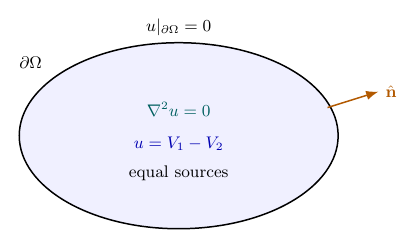
Assume they agree on the boundary ∂Ω. Define their difference u = V 1 − V 2. Subtract the equations, obtaining ∇2u = 0, while the boundary gives u = 0. Apply the product rule:
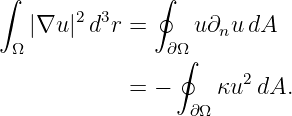
Integrate the identity over the domain and invoke the divergence theorem:
Both right-hand terms vanish. The remaining integral of the nonnegative quantity |∇u|2 is zero, so ∇u = 0. Since the boundary fixes u = 0, the only possibility is
This is the standard Dirichlet uniqueness proof in the absence of unmatched singularities or unaccounted boundaries at infinity.
Figure 1. Two candidate potentials are compared in the same physical domain with identical sources and the same prescribed boundary voltage. Their difference is harmonic and zero on the boundary.
2 Worked example 2: Neumann uniqueness and the missing constantNow suppose ∂V∕∂n is prescribed over the entire boundary rather than V itself. The difference of two solutions satisfies ∂nu = 0 on the boundary. The same Green identity gives ∇u = 0, but u can be any constant C. Thus
The Electric Field is unique; the potential requires a reference. A pure Neumann problem also obeys a compatibility condition. Integrating Poisson’s equation yields
If the prescribed Normal derivatives do not meet this condition, no solution exists. This is distinct from a question of uniqueness.
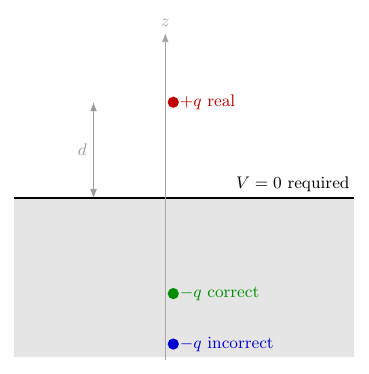
3 Worked example 3: an incorrect image is not almost correctTake a charge q > 0 at (0, 0,d) above a grounded plane z = 0. A student proposes a charge −q at (0, 0,−2d). The trial potential on the plane is
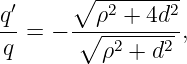
It is positive for every finite ρ and therefore fails the specified V = 0 boundary condition. Changing the image magnitude to q′ cannot fix it for all ρ: the required cancellation would demand
which depends on the observation coordinate ρ. One constant fictitious charge cannot satisfy this requirement.
Figure 2. The correct mirror charge at z = −d gives zero voltage everywhere on the plane; the incorrectly positioned image at z = −2d leaves a nonzero residual.
4 Worked example 4: an image charge placed inside the physical domainSuppose the physical domain is the exterior of a grounded sphere. If we place a trial image outside the sphere, in the vacuum region r > a, it becomes an extra singular source in the very domain whose Poisson equation we must solve. Even if the surface voltage happens to match at a few points, the candidate has the wrong source distribution. For the standard external charge at D > a the admissible image lies at b = a2∕D < a inside the excluded metal. For a charge inside a grounded spherical cavity, the physical domain is r < a, and the same inversion construction places its image outside the sphere. The location rule is therefore based on the physical domain, not an absolute rule that images always belong inside a sphere.
5 Worked example 5: a floating conducting body is not groundedConsider an isolated neutral Conductor adjacent to a point charge. One may determine the conductor’s potential is constant, but that constant is unknown. In addition, the conductor must retain zero total charge. Merely setting V = 0 on its surface imposes a different physical constraint, corresponding to grounding. A correct calculation must determine its unknown potential subject to the zero-net-charge condition. For a spherical conductor this can be done by adding a central image to the grounded-sphere solution, as in ES06E2.
6 Worked example 6: the maximum principle as an intuition checkA harmonic function on a bounded connected region cannot attain a strict interior maximum or minimum unless it is constant. For example, a charge-free region with every boundary held between 0 and 5 V cannot have an interior potential of 8 V under the usual regularity assumptions. This does not mean the electric field must be small everywhere. Potential changes rapidly near corners and sharp electrode features while remaining between its extreme boundary values. As a quick example, in the slab 0 < x < L, with V (0) = 0 and V (L) = V 0, the harmonic solution V = V 0x∕L is bounded between the two surfaces. Adding A sin(πx∕L) would preserve the endpoint values but would not solve d2V∕dx2 = 0 unless A = 0.
7 Worked example 7: an advanced Robin boundary conditionA third useful boundary specification combines voltage and normal derivative. A Robin condition on a surface can be written
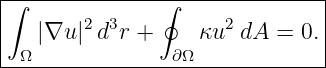
where the outward normal belongs to the physical domain and the units of κ are inverse length. Suppose two potentials solve the same Poisson equation and the same Robin data. Their difference u is harmonic and obeys ∂nu = −κu. Green’s first identity yields
Rearranging produces a sum of nonnegative terms:
Therefore u is constant, and if κ > 0 on any boundary portion of nonzero area, that constant must vanish. If κ = 0 everywhere, we recover the Neumann additive-constant ambiguity. This example shows how the same energy identity generalizes beyond purely fixed-voltage conductors.
8 Exercises and complete solutions1. Constant ambiguity. Two harmonic functions have identical normal derivatives on the entire boundary. Can they differ? Solution. Yes, by one additive constant, because gradients are uniquely fixed but the reference level is not. 2. Neumann compatibility. A bounded domain has ∂nV = 0 everywhere on its outer boundary. Can its enclosed net charge be nonzero? Solution. No, not within this source/boundary specification: the integrated Poisson equation would require a nonzero outward derivative integral, contradicting zero total normal derivative. 3. Bad candidate. Does V (x) = V 0x∕L + A sin(πx∕L) solve the 1D charge-free problem with endpoint values 0,V 0? Solution. The endpoints match, but V ′′(x) = −A(π∕L)2 sin(πx∕L). Therefore it solves Laplace’s equation only for A = 0. 4. Grounding constraint. Why is a grounded-sphere image solution not necessarily the solution for an isolated neutral sphere? Solution. It fixes the surface at V = 0 and ordinarily permits net induced charge. Isolation fixes the net metal charge, not its potential, so the conditions differ.
References
[1] D. J. Griffiths, Introduction to Electrodynamics, 5th ed., Cambridge University Press, 2023. [2] University of Virginia, Electrostatics II, https://galileoandeinstein.phys.virginia.edu/Elec_Mag/2022_Lectures/EM_07_Electrostatics_II.html. [3] J. D. Jackson, Classical Electrodynamics, 3rd ed., Wiley, 1999. "Uniqueness Theorems and Failed Image Constructions" is owned by bloftin.
This object's parent. Cross-references: isolated neutral sphere, grounded-sphere image, net charge, gradients, energy, Green's first identity, units, outward normal, harmonic function, ES06E2, grounding, Conductor, magnitude, boundary condition, charge, Normal, Electric Field, harmonic, voltage, divergence theorem, domain, identity, boundary There are 6 references to this object. This is version 1 of Uniqueness Theorems and Failed Image Constructions, born on 2026-11-28. Object id is 1649, canonical name is UniquenessTheoremsAndFailedImageConstructions. Accessed 10 times total. Classification:
|
|
|
|
Pending Errata and AddendaNone.
|
DiscussionNo messages.
|
Interact |