|
|
|
|||||||
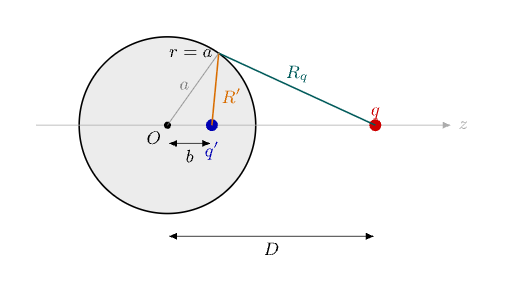
To make V (a,𝜃) = 0 for all angles, demand R′∕Rq = C independent of 𝜃. Comparing the cos 𝜃 coefficients of their squared distances gives
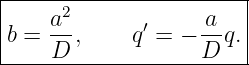
The solution with the image inside the sphere is b = a2∕D and C = a∕D. The image contribution must cancel the real potential:
The trial potential in the physical exterior is
The image is entirely outside r > a, the surface potential is exactly zero, and V → 0 at infinity. Uniqueness proves the solution.
2 Worked example 1: derive the induced surface chargeQuestion. Differentiate Equation (4) at r = a to find σ(𝜃). The metal’s outward normal is +r and the field is Er = −∂V∕∂r. Thus σ = −𝜖0∂rV |a+. Differentiate a generic Coulomb distance:
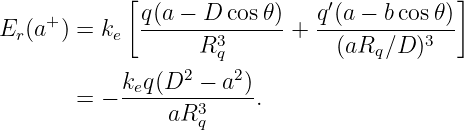
Use R′ = (a∕D)Rq, b = a2∕D, and q′ = −qa∕D at the boundary. The radial field becomes
Multiply by 𝜖0:
The induced density is everywhere negative for q > 0. It is strongest at the nearest point (𝜃 = 0), where the charge-to-surface separation is smallest.
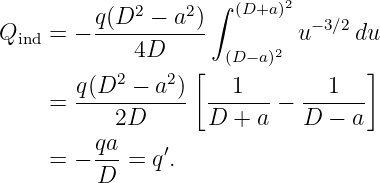
3 Worked example 2: total induced charge and conductor groundingQuestion. Determine the total induced charge and confirm that it is the image charge q′. Integrate Equation (7) over dA = a2 sin 𝜃 d𝜃 dϕ:
Let u = D2 + a2 − 2Da cos 𝜃, so du = 2Da sin 𝜃 d𝜃. At 𝜃 = 0, u = (D −a)2; at 𝜃 = π, u = (D + a)2. Therefore
Grounding permits charge to flow to or from Earth, so a net nonzero induced charge is possible. The limit D →∞ gives Qind → 0 and D → a+ gives Q ind →−q.
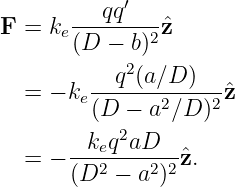
4 Worked example 3: force on the external chargeThe force from the induced charge distribution equals the Coulomb force exerted by the single mathematical image at b = a2∕D:
The force is toward the center of the sphere for q > 0, and its magnitude diverges in the ideal point-charge/conductor model as the gap D − a → 0+.
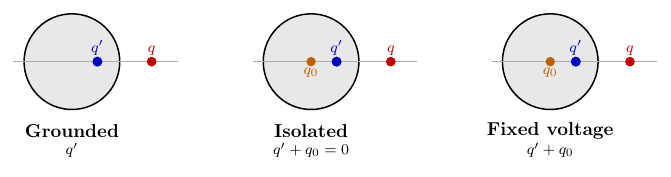
5 Worked example 4: isolated, neutral conducting sphereAn electrically isolated sphere initially has no net charge. The grounded solution has Qind = q′ = −qa∕D, and therefore violates charge conservation for this isolated metal. Add a central image q0 = −q′ = qa∕D. Because its potential is constant over r = a, the sphere remains an equipotential, though no longer grounded.
The total equivalent image charge is zero, giving zero net metal charge. On the sphere the potential is
The force on the real charge also includes the repulsion from q0:
The two image contributions are necessary to describe an isolated neutral sphere; a single negative image would give the incorrect total charge and force.
Figure 2. Grounded, isolated-neutral and prescribed-voltage spheres. The sphere boundary is equipotential in all three problems, but the charge constraint determines the extra central image.
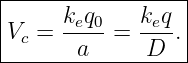
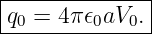
6 Worked example 5: sphere maintained at potential V 0Set the prescribed metal potential to V 0 rather than zero. Add a central image
Its potential at the surface is keq0∕a = V 0. The image q′ from Equation (3) still ensures that the off-center part vanishes there. The total metal charge becomes
Notice that choosing V 0 = keq∕D recovers the isolated neutral solution, because the central correction then equals qa∕D.
7 Worked example 6: a charge inside a grounded spherical cavityA real point charge at D < a inside a spherical grounded conductor cavity also has an image construction, but now the physical domain is r < a. The image is at b = a2∕D > a, which lies outside that domain. The same image magnitude q′ = −qa∕D enforces zero potential on the spherical wall. The actual total inner-surface induced charge is −q, found by a Gaussian surface in the metal; it is generally not equal to the fictitious exterior image charge q′. This contrast underscores why image charges are mathematical tools rather than the physical metal’s net charge in every geometry.
8 Exercises and solutions1. Sphere size. Fix D = 3a. Calculate b∕a and q′∕q. Solution. b∕a = 1∕3 and q′∕q = −1∕3. The image lies on the real-charge axis, inside the sphere. 2. Far-away limit. With D ≫ a, find the leading grounded-sphere force. Solution. D2 −a2 ≃ D2, so F ≃−keq2a∕D3 z. For the neutral isolated sphere, this leading D−3 force cancels with the central image contribution; the next term is F ≃−2keq2a3∕D5 z. 3. Zero induced charge. What voltage gives zero net metal charge at fixed q,D? Solution. Set −qa∕D + 4π𝜖0aV 0 = 0 to obtain V 0 = keq∕D. 4. Surface sign. Is it possible for the total induced charge to be negative but σ(𝜃) positive somewhere on a grounded sphere due to one exterior positive point charge? Solution. Not in this geometry. Equation (7) is strictly negative for q > 0 and D > a at every angle.
References
[1] D. J. Griffiths, Introduction to Electrodynamics, 5th ed., Cambridge University Press, 2023. [2] J. D. Jackson, Classical Electrodynamics, 3rd ed., Wiley, 1999. [3] R. Fitzpatrick, The Method of Images, University of Texas at Austin, https://farside.ph.utexas.edu/teaching/355/Surveyhtml/node85.html. "Image Charges for a Grounded or Isolated Conducting Sphere" is owned by bloftin.
This object's parent. Cross-references: Gaussian surface, domain, grounded conductor, equipotential, charge conservation, magnitude, force, boundary, outward normal, image charges, charge, conductor, voltage, grounding, net charge, induced surface charge, parameters There are 3 references to this object. This is version 1 of Image Charges for a Grounded or Isolated Conducting Sphere, born on 2026-11-28. Object id is 1647, canonical name is ImageChargesForAGroundedOrIsolatedConductingSphere. Accessed 5 times total. Classification:
|
|
|
|
Pending Errata and AddendaNone.
|
DiscussionNo messages.
|
Interact |