|
|
|
|||||||
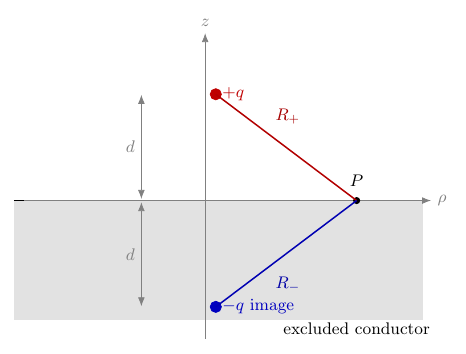
An auxiliary charge −q at (0, 0,−d) gives the correct boundary value, as the two source-to-observer distances are equal whenever z = 0.
Figure 1. The image charge is outside the physical half-space. On z = 0, distances to +q and −q are equal, forcing the potential to vanish. Let ρ =
Everywhere in z > 0 away from the real charge this is harmonic. It has the correct singular source, it vanishes at the full plane, and it vanishes at infinity. Dirichlet uniqueness therefore proves the result in the physical region.
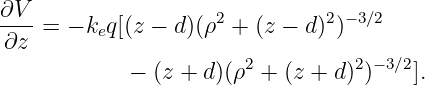
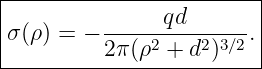
2 Worked example 1: recover the induced surface-charge densityQuestion. Derive σ(ρ) by differentiating the potential. Check its dimensions and sign. The electric field is E = −∇V . At the upper face of the conductor the outward normal from the metal into vacuum is +z, so the surface charge density is σ = 𝜖0Ez(0+). Differentiate the two inverse-distance functions using the chain rule:
At z = 0, ∂zV = 2keqd∕(ρ2 + d2)3∕2. Therefore
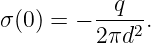
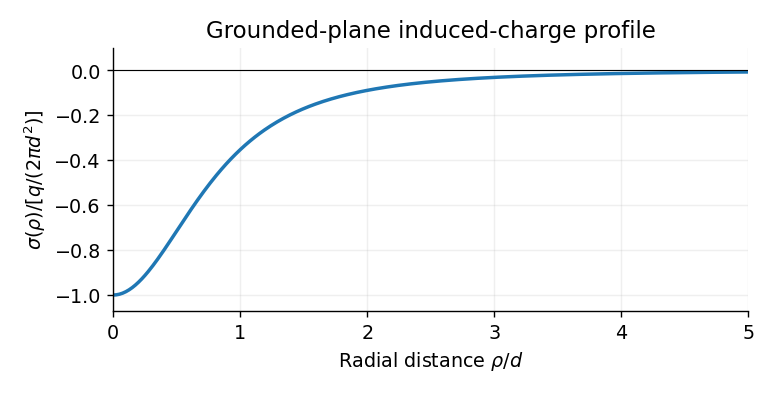
The units are C∕m2 because the numerator has units C m and the denominator has units m3. The density is negative everywhere and largest in magnitude at ρ = 0:
As ρ →∞ at fixed d, σ ∝−ρ−3.
Figure 2. Exact dimensionless induced-charge profile. The negative density peaks beneath the real source and decays with radial distance along the plane.
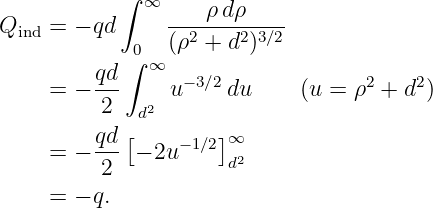
3 Worked example 2: integrate the total induced chargeQuestion. Find Qind without assuming that it must equal the image charge. The charge on an annulus of radius ρ and width dρ is dQ = σ(ρ)2πρdρ. Integrate Equation (4):
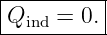
The image charge predicts the same total. This equality depends on the infinite grounded plane, not merely on the fact that the conductor is nearby.
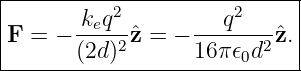
4 Worked example 3: force and correct interaction energyQuestion. Find the force on the real charge and the quasistatic energy needed to bring it from infinity to height d. At the real source location, the mathematical image is a distance 2d below it and has charge −q. The induced conductor field at q therefore points downward:
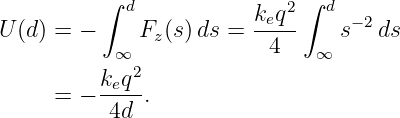
To obtain the interaction energy take U(∞) = 0. Integrate the physical force, rather than using a fictitious two-charge energy:
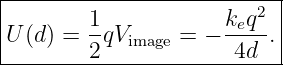
The image potential at the real point is V image = −keq∕(2d), so
The force equals that from the image, but the physical energy contains one-half of the image interaction energy. This distinction is vital for later capacitor and dielectric-force problems.
5 Worked example 4: charge at an arbitrary lateral positionQuestion. Move the real charge to (x0,y0,d). Derive the surface density at (x,y, 0). The image is at (x0,y0,−d), not at the origin. Introduce the lateral separation
The potential is Equation (2) with ρ2 replaced by s2. Differentiating at z = 0 gives
A lateral translation changes the profile’s center, not its shape, net induced charge or vertical force. This is because the ideal plane is translationally invariant.
6 Worked example 5: an external dipole parallel to the planeQuestion. Place +q at (+ℓ∕2, 0,d) and −q at (−ℓ∕2, 0,d). What images enforce grounding? What is the total induced charge? The images are −q at (+ℓ∕2, 0,−d) and +q at (−ℓ∕2, 0,−d). The trial potential is the sum of the two grounded-plane solutions. It vanishes on z = 0 term by term. By linearity, the induced densities also sum. Their total charges are −q and +q, hence
A zero net induced charge does not mean that the local induced density vanishes. Oppositely signed patches appear under the opposite source charges. The conductor still modifies the field and forces.
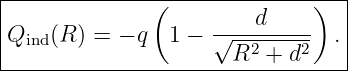
7 Exercises with full solutionsExercise 1. If d doubles, what happens to the peak |σ(0)| and force magnitude at fixed q? Solution. Both vary as d−2, so they decrease by a factor of four. The energy magnitude varies as d−1, so it is halved. Exercise 2. Find the induced charge enclosed within a circle of radius R on the plane. Solution. Integrate the annular density to R:
At R = 0 the enclosed charge is zero, and as R →∞ it approaches −q. Exercise 3. The conductor is maintained at a uniform potential V c relative to the chosen reference rather than grounded. Give a candidate potential and explain the remote boundary condition. Solution. V = V c + V grounded satisfies V = V c on the plane, and tends to V c at spatial infinity. It does not satisfy V → 0 at infinity unless V c = 0. A globally additive constant does not change E or σ. Exercise 4. A negative real charge q < 0 is placed above the grounded plane. Does the force reverse? Solution. The induced density changes sign, but the image has charge −q > 0. The force remains attractive, with magnitude keq2∕(4d2). The energy is likewise negative.
References
[1] D. J. Griffiths, Introduction to Electrodynamics, 5th ed., Cambridge University Press, 2023. [2] R. Fitzpatrick, Method of Images, University of Texas at Austin, https://farside.ph.utexas.edu/teaching/355/Surveyhtml/node85.html. [3] University of Virginia, The Image Method in Electrostatics, https://galileoandeinstein.phys.virginia.edu/Elec_Mag/2022_Lectures/EM_08_Images.html. "Image Charges for a Grounded Plane" is owned by bloftin.
This object's parent. Cross-references: boundary condition, enclosed charge, source charges, grounding, magnitude, units, functions, surface charge density, outward normal, electric field, dimensions, Dirichlet uniqueness, harmonic, image charge, Conductor, positions, energy, force, charge, boundary There is 1 reference to this object. This is version 1 of Image Charges for a Grounded Plane, born on 2026-11-28. Object id is 1646, canonical name is ImageChargesForAGroundedPlane. Accessed 6 times total. Classification:
|
|
|
|
Pending Errata and AddendaNone.
|
DiscussionNo messages.
|
Interact |


 and