|
|
|
|||||||
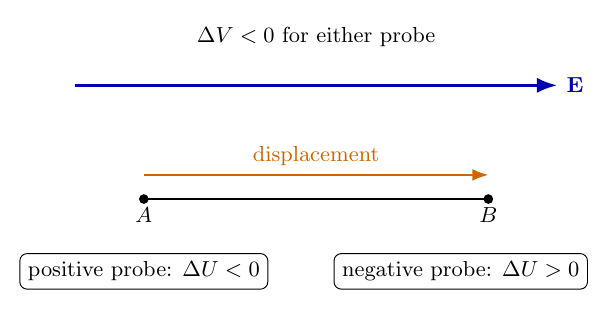
A quasistatic agent that prevents a kinetic-energy change performs Wext = +ΔU. Note that V is a property of the source, and qt changes only the energy and force of the test charge.
Figure 1. The same positive-source potential difference produces opposite potential-energy changes for positive and negative probes. The field direction is determined by the source, not by the probe.
2 Worked example 1: one positive source, two radiiA positive Q = +3.0 nC is fixed at the origin. Compare the potentials at rA = 0.20 m and rB = 0.50 m, taking V (∞) = 0. Write
The potentials are V A = 134.9 V and V B = 53.9 V . Therefore
The change is negative because the observation point moves farther from a positive source. To check the sign independently, note that E points outward, so ∫ ABE ⋅ dl > 0 and ΔV must be negative.
3 Worked example 2: two probes moved along the same pathNow move qt = +2.0 nC and qt = −2.0 nC separately from A to B in the field of Example 1. The source arrangement and ΔV = −80.9 V are unchanged. For the positive probe,
Thus We,+ = +1.62 × 10⁻⁷ J: the field assists outward motion. For the negative probe,
so We,− = −1.62 × 10⁻⁷ J: the field opposes that motion. In neither case has the potential difference changed sign.
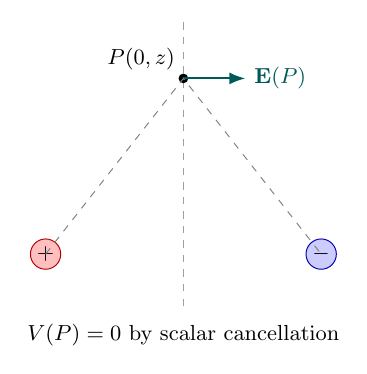
4 Worked example 3: scalar superposition of unlike chargesA source +q lies at x = −a and a source −q lies at x = +a. Find V at a point P = (0,z) on their
perpendicular bisector. Both charges are at the same distance R =
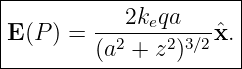
Is E(P) also zero? No. The z components cancel, but the horizontal components point toward the negative charge and add:
Thus a zero-potential surface need not be a zero-field surface. The field is determined by the gradient of V , not by its absolute value.
Figure 2. Two equal and opposite sources produce zero potential on their perpendicular bisector, but a nonzero horizontal field at P.
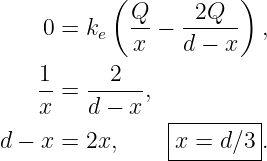
5 Worked example 4: where is the potential zero?Two fixed charges +Q and −2Q lie at x = 0 and x = d, respectively, with Q > 0. Find potential zeros between the charges. Since 0 < x < d, the source distances are x and d − x. The zero condition is
This is a potential zero, not generally a field zero. In the interval between unlike charges their field contributions point in the same direction, so E cannot vanish there.
6 Worked example 5: reference potential does not change physicsSuppose V A = +120 V and V B = +35 V in one reference convention. Shift the potential by C = −200 V . The new values are V ′A = −80 V and V ′B = −165 V , but
Therefore E = −∇V and the work done moving a fixed test charge are unchanged by an additive constant. In electrostatics the absolute zero of V is a convention; measurable potential differences are not.
7 Exercises with complete solutionsExercise 1. A source Q = −2.0 nC is at the origin. Find V (0.30 m) with zero at infinity and explain its sign. Solution. V = keQ∕r = (8.99 × 10⁹)(−2.0 × 10⁻⁹)∕0.30 = −59.9 V . A negative source produces negative potential relative to infinity. Exercise 2. Between two points A and B, the potential difference is V B −V A = +40 V . Find ΔU and We for an electron of charge −e, where e = 1.602 × 10⁻¹⁹ C. Solution. ΔU = (−e)(40 V ) = −6.41 × 10⁻¹⁸ J and W e = +6.41 × 10⁻¹⁸ J. The electron loses potential energy when moving to higher potential. Exercise 3. Sources +q and +3q lie on the x axis at 0 and d. Can the total potential equal zero at a finite field point if V (∞) = 0? Solution. No. Each source gives a positive contribution keqi∕Ri at every nonsingular point, so their sum is positive. A change of reference could set some chosen potential to zero, but that would be a different convention. Exercise 4. A negative test charge is displaced along the direction of a uniform Electric Field through a distance s. Express ΔV , ΔU, and We in terms of field magnitude E and charge magnitude q > 0. Solution. ΔV = −Es, ΔU = (−q)(−Es) = +qEs, and We = −qEs. The field force on the negative charge is opposite to the displacement.
References
"Electric Potential and the Signs of Work and Energy" is owned by bloftin.
This object's parent. Cross-references: magnitude, Electric Field, gradient, negative charge, charges, observation point, energy, displacement, force, source charge, work, potential energy There are 7 references to this object. This is version 1 of Electric Potential and the Signs of Work and Energy, born on 2026-11-28. Object id is 1626, canonical name is ElectricPotentialAndTheSignsOfWorkAndEnergy. Accessed 6 times total. Classification:
|
|
|
|
Pending Errata and AddendaNone.
|
DiscussionNo messages.
|
Interact |






 from