|
|
|
|||||||
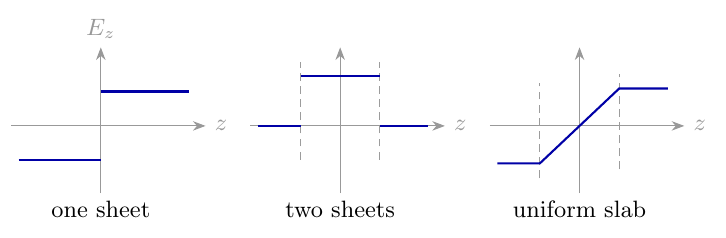
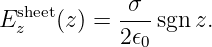
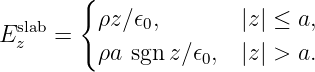
Between the two oppositely charged sheets, both individual contributions point in +z, giving Ez = σ∕𝜖0. Outside, they cancel exactly. For the slab the enclosed thickness of the centered pillbox is 2 min(z,a). Applying Gauss’s Law for z > 0 and then reflecting gives
Check. The sheet jump is σ∕𝜖0. The slab field is continuous at both boundaries because the density is finite there and has no surface delta term.
3 Practice variationShrink the slab at fixed charge per area Σ = 2aρ. Solution. At fixed z≠0 the exterior field becomes Σ sgn z∕(2𝜖0), the ideal-sheet result.
4 Follow signed flux through each part of the pillboxWrite the upper Normal as +z and the lower normal as −z. A field with Ez(−z) = −Ez(z) gives AEz(z) −AEz(−z) = 2AEz(z). Both cap contributions are outward for a positive centered source. The lateral normal has zero z component. For a sheet the enclosed charge is σA, independent of height as long as the box straddles the sheet. The sheet-field jump is the upper one-sided normal component minus the lower one, here σ∕𝜖0. A uniform slab instead encloses ρA[2 min(z,a)], so the normal field increases in proportion to height until the caps leave the material.
5 Worked example 2: integrate the field to find the voltageFor the opposing sheets let the lower sheet be positive. From the superposed field, the voltage change from −a to +a is
There is no change with z in either exterior region, but the two exterior constants differ. For the uniform slab instead, V (z) − V (0) = −ρz2∕(2𝜖 0) inside. For z > a, first integrate from 0 to a and then a to z. This yields −ρa2∕(2𝜖 0) − ρa(z − a)∕𝜖0. The pieces meet with the same slope because the slab field is continuous.
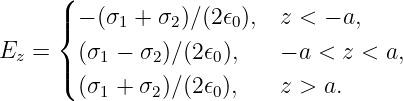
6 Additional worked example 3: sheets with unequal surface chargePlace a sheet of positive charge σ1 at z = −a and a second sheet of signed charge σ2 at z = +a. The two sheets need not be opposite or equal. By superposition, the one-sided field is
For points not on either sheet, compute the signs separately rather than using a single rule:
As a check, if σ2 = −σ1 the exterior fields vanish, while the interior field is σ1∕𝜖0. If σ1 = σ2 > 0, the interior field vanishes but both exterior fields point away from the sheets. Each discontinuity separately has magnitude equal to the signed charge density of the corresponding sheet divided by 𝜖0.
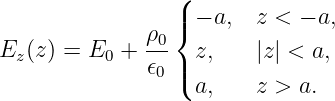
7 Additional worked example 4: a slab plus a background fieldLet a slab have uniform volume charge density ρ0 in −a < z < a. Superpose a uniform externally imposed field E0 = E0z. The slab contribution is odd and equals ρ0z∕𝜖0 inside. Therefore
The field no longer changes sign under z →−z because the background field breaks reflection symmetry. Nevertheless, the derivative inside remains dEz∕dz = ρ0∕𝜖0, and the background field has zero divergence. The source distribution is still planar, so superposition, not a new Gaussian argument, is the simplest calculation.
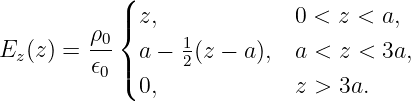
8 Additional worked example 5: charge in two stacked slabsLet ρ(z) = ρ0 for |z| < a, −ρ0∕2 for a < |z| < 3a, and zero outside. The profile is even, so the field is odd and Ez(0) = 0. At positive height z, a centered pillbox gives Ez(z) = 𝜖0−1 ∫ 0zρ(s) ds. Evaluate the three integrals separately:
The negative slab exactly cancels the total charge per unit area of the positive core: ρ0a − (ρ0∕2)(2a) = 0 on the positive side. Reflect by Ez(−z) = −Ez(z) to cover negative heights. The field is continuous at z = a and z = 3a, while its derivative changes where the volume density jumps.
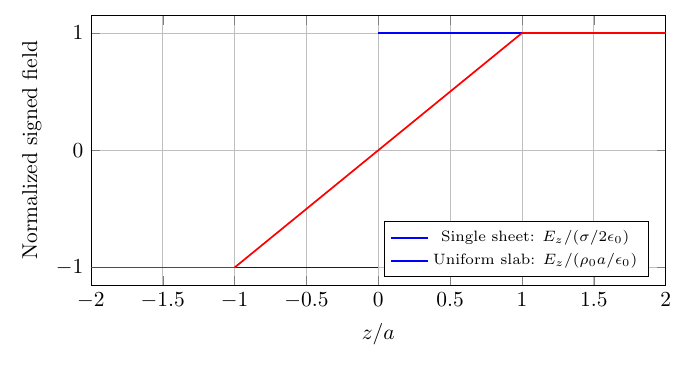
Figure 2. Analytic signed field profiles for a single sheet and a uniform slab, normalized to their natural field scales. The curve is a model, not measured data.
9 More practice with solutionsExercise 3. For sheets σ1 = 3σ0 and σ2 = −σ0, what are the fields in all three regions? Solution. Insert the values into Equation (4): below both −σ0∕𝜖0, between them 2σ0∕𝜖0, above both +σ0∕𝜖0. Exercise 4. For the two stacked slabs, find the location of the maximum magnitude of the positive-side field. Solution. It grows linearly from zero to ρ0a∕𝜖0 across the core and decreases afterward. Therefore the maximum occurs at z = a, with magnitude ρ0a∕𝜖0.
10 ExercisesExercise 1. Give the field if both sheets are +σ. Solution. Between them the lower sheet gives +σ∕(2𝜖0) and the upper gives its negative. Above both the contributions add to σ∕𝜖0, and below both they add to its negative. Exercise 2. For the slab, compare the fields at a∕2 and 2a. Solution. The first cap is inside, so its field is ρa∕(2𝜖0). The second field is on the plateau ρa∕𝜖0. The ratio is 1∕2.
References
References
"example of Fields of a Sheet, a Pair of Sheets, and a Uniform Slab" is owned by bloftin.
This object's parent. Cross-references: volume density, unit, divergence, volume charge density, charge density, magnitude, superposition, positive charge, voltage, enclosed charge, Normal, charge, Gauss's Law, flux, planar symmetry, boundaries There is 1 reference to this object. This is version 1 of example of Fields of a Sheet, a Pair of Sheets, and a Uniform Slab, born on 2026-11-27. Object id is 1620, canonical name is ExampleOfFieldsOfASheetAPairOfSheetsAndAUniformSlab. Accessed 10 times total. Classification:
|
|
|
|
Pending Errata and AddendaNone.
|
DiscussionNo messages.
|
Interact |