Physics Library
 An open source physics library
Encyclopedia | Forums | Docs | Random  

[parent] GRE Physics Companion: Discrete Oscillator Chains and Dispersion

(Example)

GRE Physics Companion: Discrete Oscillator Chains and Dispersion

For a monatomic nearest-neighbor chain,

|-----------------------------|
m-¨un-=--κ(un+1-−-2un-+-un−-1).--
(1)

The traveling normal modes satisfy

|---------------(---)---|
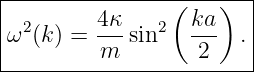
ω2 (k ) = 4κ-sin2   ka- . |
|        m        2     |
-------------------------
(2)

PIC

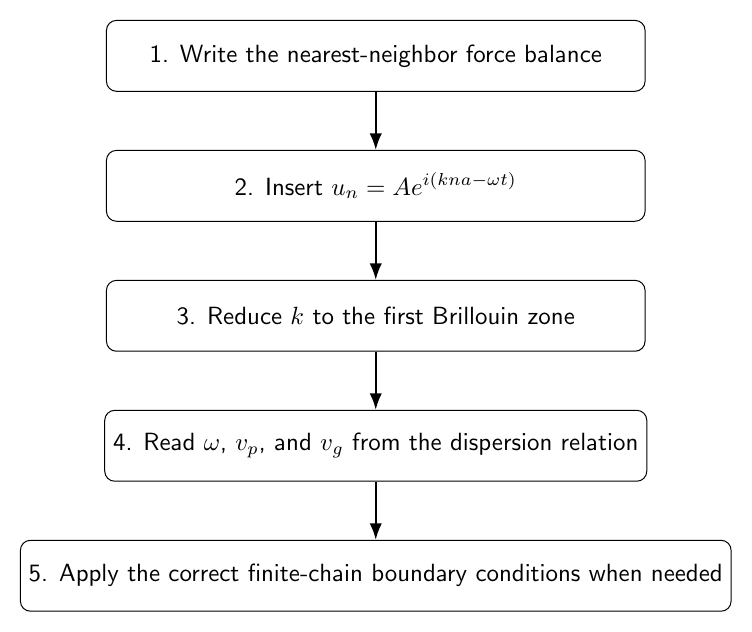
Figure 1. A compact oscillator-chain strategy: derive the discrete force balance, insert a lattice-wave ansatz, reduce wave numbers to the first Brillouin zone, then use the dispersion curve for frequency and propagation questions.

1 High-value GRE facts

  1. ω = 2∘  -----
   κ∕m| sin(ka∕2)|.
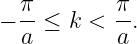
  2. Distinct wave numbers may be restricted to −π∕a ≤ k < π∕a.
  3. k and k + 2π∕a are equivalent on the lattice.
  4. ωmax = 2∘ -----
  κ∕m.
  5. The zone-boundary mode has neighboring masses in opposite phase.
  6. In the long-wavelength limit, ω ≈ c|k| with c = a∘ -----
  κ∕m.
  7. vp = ω∕|k|.
  8. vg = dω∕dk.
  9. For 0 < k < π∕a, vg = c cos(ka∕2).
  10. A fixed-end chain of N masses has exactly N normal modes.

Part I: Original GRE-style problems

Problem 1: lattice equation

For identical masses with nearest-neighbor springs,

  1. mün = κ(un+1 + un−1)
  2. mün = κ(un+1 − 2un + un−1)
  3. mün = −κun
  4. mün = κ(un+1 − un−1)
  5. ün = 0

Problem 2: dispersion relation

The monatomic-chain dispersion relation is

  1. ω2 = (κ∕m)ka
  2. ω2 = (4κ∕m) sin 2(ka∕2)
  3. ω2 = (4κ∕m) cos 2(ka∕2)
  4. ω = κk∕m
  5. ω2 = κ∕m for all k

Problem 3: maximum frequency

The maximum branch frequency is

  1. ∘ -----
  κ∕m
  2. 2∘ -----
  κ ∕m
  3. π∘ -----
  κ ∕m
  4. κ∕m
  5. unbounded

Problem 4: Brillouin-zone edge

The positive edge of the first Brillouin zone is

  1. 1∕a
  2. π∕(2a)
  3. π∕a
  4. 2π∕a
  5. a∕π

Problem 5: zone-boundary pattern

At

k =  π∕a,
(3)

the displacement pattern is proportional to

  1. 1
  2. n
  3. (−1)n
  4. e−n
  5. n2

Problem 6: continuum speed

In the long-wavelength limit,

c
(4)

equals

  1. ∘ -----
  κ∕m
  2. a∘ κ-∕m-
  3. ∘ ------
  κa ∕m
  4. κa∕m
  5. aκ∕m2

Problem 7: group velocity

For

0 < k <  π∕a,
(5)

the group velocity is

  1. c
  2. c sin(ka∕2)
  3. c cos(ka∕2)
  4. c tan(ka∕2)
  5. zero for all k

Problem 8: group velocity at zone boundary

At

k =  π∕a,
(6)

vg
(7)

is

  1. c
  2. c∕2
  3. 2c
  4. 0
  5. infinite

Problem 9: periodic chain wave numbers

For a periodic chain of

N
(8)

sites,

ks
(9)

is

  1. sπ∕(Na)
  2. 2πs∕(Na)
  3. s∕a
  4. 2πs∕a
  5. independent of N

Problem 10: fixed-end frequencies

For

N
(10)

moving masses between fixed ends,

ωr
(11)

is

  1. 2∘ κ-∕m- sin[rπ∕2(N + 1)]
  2. ∘ -----
  κ∕mr
  3. 2∘ -----
  κ ∕m cos[rπ∕2(N + 1)]
  4. ∘ -----
  κ∕m for every r
  5. zero

Problem 11: numerical group velocity

If

a = 0.10m,   κ =  400N ∕m,   m  = 1.00 kg,
(12)

then at

ka =  π∕2
(13)

the group velocity is closest to

  1. 0.71 m/s
  2. 1.00 m/s
  3. 1.41 m/s
  4. 2.00 m/s
  5. 2.83 m/s

Problem 12: shortest distinct wavelength

The shortest distinct wavelength of the monatomic lattice is

  1. a∕2
  2. a
  3. 2a
  4. 2πa
  5. arbitrarily small

Part II: Complete worked solutions

Solution 1

The two spring forces give the centered second difference:

m ¨un =  κ(un+1 − 2un + un− 1).
(14)

Answer: (B).

Solution 2

Substituting

un = Aei(kna−ωt)
(15)

gives

            (    )
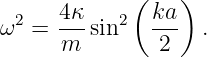
ω2 = 4κ-sin2  ka-  .
     m         2
(16)

Answer: (B).

Solution 3

The sine magnitude reaches one:

        ∘  ---
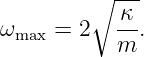
ω    = 2   κ-.
 max       m
(17)

Answer: (B).

Solution 4

One complete nonredundant interval is

  π        π
− --≤  k < --.
  a        a
(18)

The positive edge is

π ∕a.
(19)

Answer: (C).

Solution 5

At the zone boundary,

eikna = eiπn = (− 1)n.
(20)

Answer: (C).

Solution 6

For

|ka| ≪ 1,
(21)

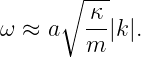
      ∘ ---
ω ≈ a   κ-|k|.
        m
(22)

Thus

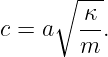
      ∘ ---
        κ
c = a   m-.
(23)

Answer: (B).

Solution 7

Differentiate

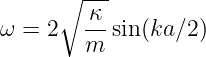
     ∘  ---
ω = 2   κ-sin(ka∕2 )
        m
(24)

for positive

k.
(25)

Then

      ∘  ---
         κ-
vg = a   m cos(ka ∕2) = ccos(ka∕2 ).
(26)

Answer: (C).

Solution 8

At

ka = π,
(27)

cos(π∕2 ) = 0.
(28)

Therefore

vg = 0.
(29)

Answer: (D).

Solution 9

Periodic boundary conditions require

eikNa =  1.
(30)

Therefore

k =  2πs-.
 s   N a
(31)

Answer: (B).

Solution 10

For fixed ends,

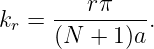
kr = ----rπ---.
     (N  + 1)a
(32)

Substitution into the infinite-chain dispersion relation gives

      ∘  ---   [         ]
         κ-     ---rπ----
ωr = 2   m sin  2(N  + 1)  .
(33)

Answer: (A).

Solution 11

First,

        √ ----
c = 0.10  400 = 2.00 m ∕s.
(34)

Then

                    √ --
vg = 2.00 cos(π∕4 ) =  2 m ∕s ≈ 1.41 m ∕s.
(35)

Answer: (C).

Solution 12

The zone boundary has

k =  π∕a.
(36)

Thus

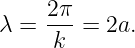
     2π
λ =  ---= 2a.
     k
(37)

Answer: (C).

2 GRE checklist

  1. Start with the centered second-difference force law.
  2. Insert the lattice-wave phase factor carefully.
  3. Reduce wave numbers modulo 2π∕a.
  4. Use the long-wavelength approximation only when |ka|≪ 1.
  5. Distinguish phase velocity from group velocity.
  6. At the zone boundary, remember the alternating pattern and zero group velocity.
  7. Match the wave-number quantization to the actual boundary conditions.
  8. Count exactly one normal mode per independent scalar displacement degree of freedom.

References

References

[1]   PhysicsLibrary, M06-05, Small Oscillations and the Normal-Mode Eigenvalue Problem.

[2]   PhysicsLibrary, M06-04, Coupled Oscillators and Normal Modes.

[3]   A. P. French, Vibrations and Waves, W. W. Norton, 1971.

[4]   C. Kittel, Introduction to Solid State Physics, 8th ed., Wiley, 2005.


"GRE Physics Companion: Discrete Oscillator Chains and Dispersion" is owned by bloftin.
(view preamble)
View style:
Other names:  M06-06G
Keywords:  GRE physics, oscillator chain, dispersion relation, lattice waves, Brillouin zone, phase velocity, group velocity, normal modes, Fourier modes, continuum limit

This object's parent.

Cross-references: scalar, quantization, phase velocity, phase factor, boundary, magnitude, periodic, group velocity, displacement, dispersion relation, phase, masses, zone-boundary mode, frequency, first Brillouin zone, force, normal modes

This is version 1 of GRE Physics Companion: Discrete Oscillator Chains and Dispersion, born on 2026-10-18.
Object id is 1499, canonical name is GREPhysicsCompanionDiscreteOscillatorChainsAndDispersion.
Accessed 16 times total.

Classification:
Physics Classification: 45.50.-j (Dynamics and kinematics of a particle and a system of particles)
 45.05.+x (General theory of classical mechanics of discrete systems)

Pending Errata and Addenda

None.

Discussion

No messages.

Interact