
|
|
|
|||||||
with
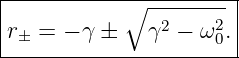
The characteristic roots are
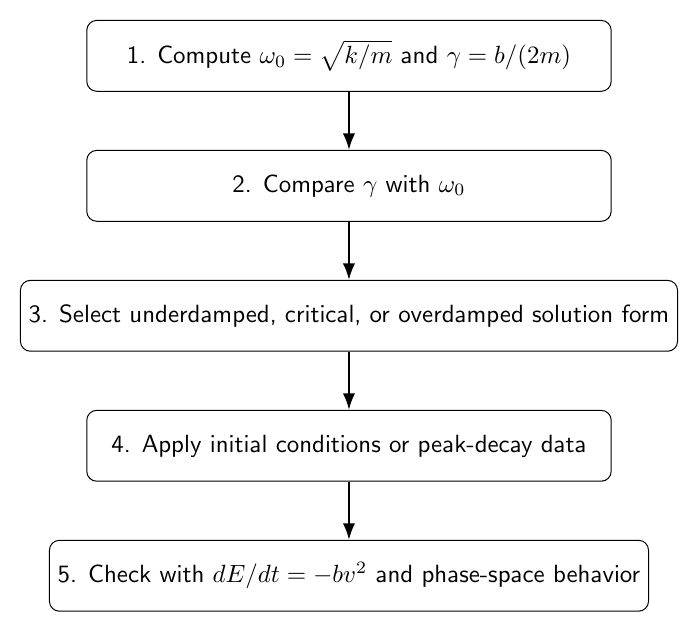
Figure 1. A compact damping strategy: compute ω0 and γ, classify the roots, choose the correct solution form, then use energy or peak decay as an independent check.
1 High-value GRE facts
Part I: Original GRE-style problems
Problem 1: damping rateFor
the damping rate in
is
Problem 2: regime classificationA system has
It is
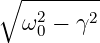
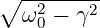
Problem 3: damped frequencyFor the system in Problem 2,
is
Problem 4: amplitude decayFor an underdamped oscillator with
the amplitude envelope after
is multiplied by
Problem 5: critical coefficientFor
critical damping requires
Problem 6: critical solutionThe general critically damped displacement has the form
Problem 7: energy loss rateFor viscous damping,
equals
Problem 8: phase planeThe underdamped phase-plane trajectory is approximately
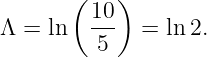
Problem 9: logarithmic decrementSuccessive same-sign peaks are
The logarithmic decrement is
Problem 10: overdamped rootsFor an overdamped oscillator, the characteristic roots are
Problem 11: weak-damping quality factorFor weak viscous damping,
is approximately
Problem 12: damping and periodFor an underdamped oscillator,
Part II: Complete worked solutions
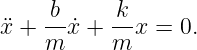
Solution 1Dividing by mass gives
Therefore
so
Answer: (B).
Solution 2Because
The system is underdamped. Answer: (B).
Solution 3
Answer: (C).
Solution 4The envelope factor is
Answer: (B).
Solution 5
Answer: (C).
Solution 6A repeated root produces
Answer: (C).
Solution 7
Thus
Answer: (B).
Solution 8Damping removes energy, so the closed undamped phase-plane orbit contracts toward the origin. In the underdamped case it spirals inward. Answer: (C).
Solution 9
Answer: (B).
Solution 10For
is real and smaller than
Thus both roots are real, distinct, and negative. Answer: (C).
Solution 11For weak damping,
Answer: (B).
Solution 12
Answer: (C).
2 GRE checklist
References
References
"GRE Physics Companion: Damped Harmonic Motion" is owned by bloftin.
This object's parent. Cross-references: power, force, mass, complex conjugates, viscous damping, displacement, amplitude, system, damping rate, logarithmic decrement, mechanical energy, critical damping, angular frequency, energy, oscillator This is version 1 of GRE Physics Companion: Damped Harmonic Motion, born on 2026-10-18. Object id is 1491, canonical name is GREPhysicsCompanionDampedHarmonicMotion. Accessed 6 times total. Classification:
|
|
|
|
Pending Errata and AddendaNone.
|
DiscussionNo messages.
|
Interact |
![[parent]](https://images.physicslibrary.org/images/uparrow.png)

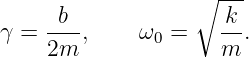
 is the undamped natural
 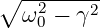 in the underdamped regime.
 .
.





 rad/s
rad/s

















 .
.