Physics Library
 An open source physics library
Encyclopedia | Forums | Docs | Random  

[parent] GRE Physics Companion: Angular Velocity and Angular Acceleration as Vectors

(Example)

GRE Physics Companion: Angular Velocity and Angular Acceleration as Vectors

The central rigid body kinematics relations are

|--------------------|
-vB-=-vA--+-ω-×-rB-∕A--
(1)

and

|--------------------------------------|
aB--=-aA-+-α--×-rB∕A-+-ω-×--(ω--×-rB∕A).-
(2)

For rotation about a fixed point,

|------------|
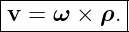
|v =  ω × ρ. |
-------------
(3)

PIC

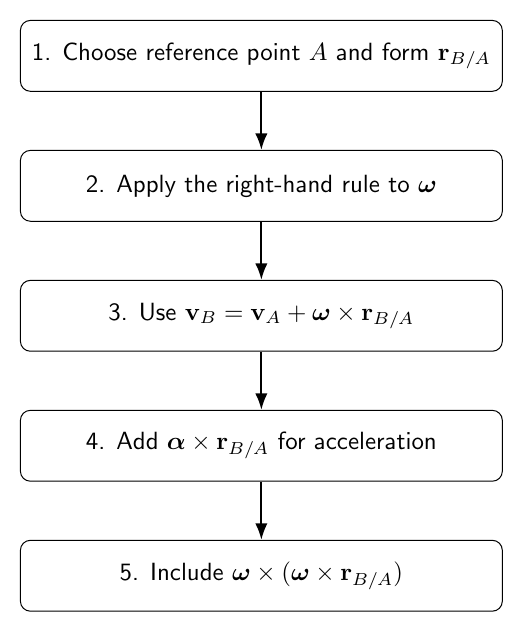
Figure 1. A compact strategy for vector rotational kinematics. Choose a reference point, form the separation vector, apply the angular-velocity cross product, and include both angular-acceleration and Normal terms for acceleration.

1 High-value GRE facts

  1. ω points along the instantaneous rotation axis by the right-hand rule.
  2. Finite three-dimensional rotations do not generally commute.
  3. Infinitesimal rotations behave vectorially to first order.
  4. v = ω ×ρ.
  5. α = dω∕dt can be nonzero even when |ω| is constant.
  6. The normal acceleration term is ω × (ω ×ρ).
  7. For a rigid body, one common ω relates every pair of points.
  8. vB − vA is perpendicular to rB∕A.
  9. [ω×] is skew-symmetric.
  10. Only the component of α parallel to ω changes angular speed.

Part I: Original GRE-style problems

Problem 1: right-hand rule

A disk rotates counterclockwise when viewed from the +z side. Its angular velocity vector points

  1. +x
  2. −x
  3. +y
  4. +z
  5. −z

Problem 2: point velocity

Let

ω = 3ez rad ∕s
(4)

and

ρ =  2ex m.
(5)

Then the point velocity is

  1. 6ex m∕s
  2. −6ex m∕s
  3. 6ey m∕s
  4. −6ey m∕s
  5. zero

Problem 3: point on the axis

If ρ is parallel to ω, then the rotational velocity ω ×ρ is

  1. parallel to ω
  2. perpendicular to ω with magnitude ωρ
  3. zero
  4. equal to ρ
  5. undefined

Problem 4: changing direction

A body has constant angular speed but the direction of ω changes. Which statement is correct?

  1. α = 0
  2. α must be parallel to ω
  3. α can be nonzero
  4. the body cannot be rigid
  5. the angular speed must increase

Problem 5: normal acceleration

For fixed angular velocity and position ρ perpendicular to the axis,

ω × (ω × ρ )
(6)

points

  1. along ρ
  2. opposite ρ
  3. along ω
  4. tangent to the circle
  5. out of the plane at random

Problem 6: relative velocity

Points A and B on a rigid body satisfy

rB∕A = 2ex m,      ω = 4ez rad ∕s.
(7)

Then

vB − vA
(8)

is

  1. 8ex m∕s
  2. −8ex m∕s
  3. 8ey m∕s
  4. −8ey m∕s
  5. zero

Problem 7: rigidity condition

For two points on a rigid body, the relative velocity vB − vA is always

  1. parallel to rB∕A
  2. perpendicular to rB∕A
  3. zero
  4. parallel to ω
  5. equal to rB∕A

Problem 8: skew matrix

The matrix representing cross product with ω satisfies

  1. [ω×]T = [ω×]
  2. [ω×]T = −[ω×]
  3. [ω×]2 = 0 always
  4. its determinant is always one
  5. it is diagonal

Problem 9: angular-speed derivative

If α ⊥ ω at an instant, then at that instant

  1. angular speed is increasing
  2. angular speed is decreasing
  3. ω = 0
  4. ω = 0
  5. α = 0

Problem 10: finite rotations

Two finite rotations about different axes are generally

  1. commutative
  2. noncommutative
  3. always equivalent to scalar addition
  4. independent of order only when both are 90∘
  5. impossible for a rigid body

Problem 11: acceleration with zero angular acceleration

If α = 0 but ω≠0, a point away from the axis has

  1. zero acceleration
  2. only the normal double-cross-product acceleration
  3. only tangential acceleration
  4. acceleration parallel to velocity
  5. arbitrary acceleration unrelated to rotation

Problem 12: translating reference point

For a translating and rotating rigid body, the velocity of point B is

  1. ω × rB∕A only
  2. vA + ω × rB∕A
  3. vA + α× rB∕A
  4. vA + ω2r B∕A
  5. always equal to vA

Part II: Complete worked solutions

Solution 1

Counterclockwise rotation viewed from +z corresponds to the right-hand thumb pointing along +z.

Answer: (D).

Solution 2

v = ω ×ρ (9)
= (3ez) × (2ex) (10)
= 6ey m∕s. (11)

Answer: (C).

Solution 3

Parallel vectors have zero cross product:

ω  × ρ = 0.
(12)

Answer: (C).

Solution 4

angular acceleration is the vector derivative

α =  dω ∕dt.
(13)

A changing direction produces a nonzero derivative even if the magnitude remains fixed.

Answer: (C).

Solution 5

For ρ ⊥ ω,

ω × (ω  × ρ) = − ω2ρ.
(14)

Answer: (B).

Solution 6

vB − vA = ω × rB∕A (15)
= (4ez) × (2ex) (16)
= 8ey m∕s. (17)

Answer: (C).

Solution 7

The rigid distance constraint gives

rB ∕A ⋅ (vB − vA) = 0.
(18)

Thus the relative velocity is perpendicular to the separation vector.

Answer: (B).

Solution 8

The cross-product matrix is skew-symmetric:

[ω × ]T =  − [ω ×].
(19)

Answer: (B).

Solution 9

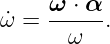
ω˙=  ω-⋅ α-.
       ω
(20)

If the vectors are perpendicular, their dot product is zero.

Answer: (C).

Solution 10

Finite rotations about different axes generally depend on order.

Answer: (B).

Solution 11

With α = 0,

a = ω  × (ω × ρ ).
(21)

Answer: (B).

Solution 12

For two points on the same rigid body,

vB  = vA + ω  × rB∕A.
(22)

Answer: (B).

2 GRE checklist

  1. Apply the right-hand rule before doing component algebra.
  2. Preserve cross-product order.
  3. Distinguish angular speed from angular velocity vector.
  4. Remember that direction change of ω contributes to α.
  5. For acceleration, include both α× r and the double-cross-product term.
  6. For translating bodies, include the reference-point velocity or acceleration.
  7. Use the rigid body orthogonality check rB∕A ⋅ (vB − vA) = 0.
  8. Recognize [ω×] as a skew-symmetric matrix.

References

References

[1]   J. R. Taylor, Classical Mechanics, University Science Books, 2005.

[2]   D. Kleppner and R. Kolenkow, An Introduction to Mechanics, 2nd ed., Cambridge University Press, 2014.

[3]   OpenStax, University Physics, Volume 1, Rice University, 2016.


"GRE Physics Companion: Angular Velocity and Angular Acceleration as Vectors" is owned by bloftin.
(view preamble)
View style:
Other names:  M05-02G
Keywords:  GRE physics, angular velocity vector, angular acceleration vector, rigid body, cross product, relative velocity, relative acceleration, skew-symmetric matrix, rotational kinematics

This object's parent.

Cross-references: skew-symmetric matrix, dot product, angular acceleration, scalar, noncommutative, determinant, matrix, position, angular velocity, magnitude, velocity, angular velocity vector, speed, commute, acceleration, Normal, cross product, vector, relations, kinematics, rigid body

This is version 1 of GRE Physics Companion: Angular Velocity and Angular Acceleration as Vectors, born on 2026-10-05.
Object id is 1421, canonical name is GREPhysicsCompanionAngularVelocityAndAngularAccelerationAsVectors.
Accessed 5 times total.

Classification:
Physics Classification: 45.40.-f (Dynamics and kinematics of rigid bodies)
 45.20.Dd (Newtonian mechanics)

Pending Errata and Addenda

None.

Discussion

No messages.

Interact