|
|
|
|||||||
The angle is always the angle between the force and the displacement. Do not automatically use the angle drawn relative to the horizontal or vertical unless that is also the angle between force and displacement.
1 Fast triage
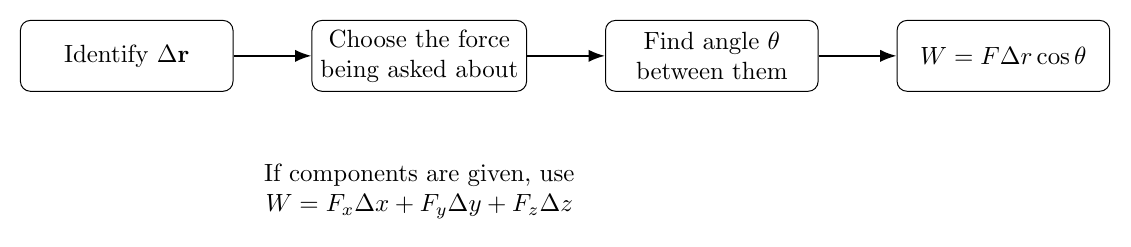
Figure 1. GRE work triage: identify the displacement, isolate the force being asked about, determine the angle between them, and then evaluate the dot product. High-value shortcuts are
and
2 Cosine controls the sign
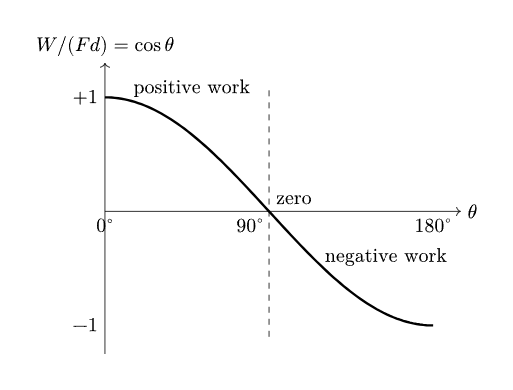
Figure 2. The sign of work follows the sign of the cosine of the angle between force and displacement. Perpendicular force and displacement give zero work. This makes angle questions extremely fast. If a force becomes more nearly parallel to the displacement while F and Δr stay fixed, its work increases. If it becomes more nearly perpendicular, its work approaches zero.
3 Component shortcutWhen vectors are given in components, skip angle reconstruction and use
This avoids unnecessary inverse trigonometric calculations.
4 Worked GRE example 1: rank forces by workThree forces of equal magnitude F act through the same displacement d. Their angles between force and displacement are 0∘, 60∘, and 120∘. Rank their works from greatest to least. Because
we have
Therefore
The negative result is smaller than zero, not merely smaller in magnitude.
5 Worked GRE example 2: component dot productA force and displacement are
Then
Thus
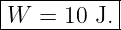
No angle calculation is needed.
6 GRE practice questions
7 Answers
8 Final checklist
References
"GRE Physics Companion: Work Done by a Force" is owned by bloftin.
This object's parent. Cross-references: graph, net work, scalar, particle, magnitude, vectors, displacement, force, dot product, work This is version 2 of GRE Physics Companion: Work Done by a Force, born on 2026-10-03, modified 2026-10-03. Object id is 1374, canonical name is GREPhysicsCompanionWorkDoneByAForce. Accessed 12 times total. Classification:
|
|
|
|
|
|
|
![[parent]](https://images.physicslibrary.org/images/uparrow.png)