Dynamics of Circular Motion
Circular motion is not produced by a special force called “centripetal force.” Rather, circular
motion occurs when the vector sum of the real forces acting on a body has an inward component.
Newton’s second law then requires that inward component to equal the mass times the Normal, or
centripetal, acceleration.
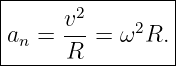
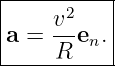
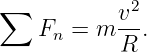
For motion along a circular path of radius R, the inward acceleration has magnitude
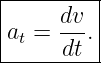
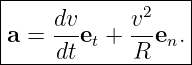
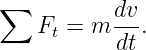
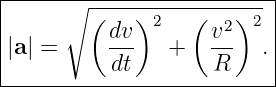
If the speed is changing, there can also be a tangential acceleration
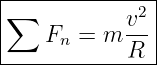
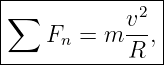
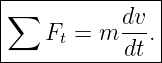
The force equations therefore separate naturally into
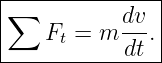
and
The first equation controls the curvature of the path. The second controls how the speed changes
along the path. This article develops these equations for flat turns, banked curves, vertical circles,
contact forces, and conical pendulums.
1 The normal and tangential directions
For a particle constrained to a circular path, let et point tangent to the path in the
direction of motion and let en point toward the center of curvature. The acceleration
is
The inward term exists even when the speed is constant because the velocity vector changes
direction.
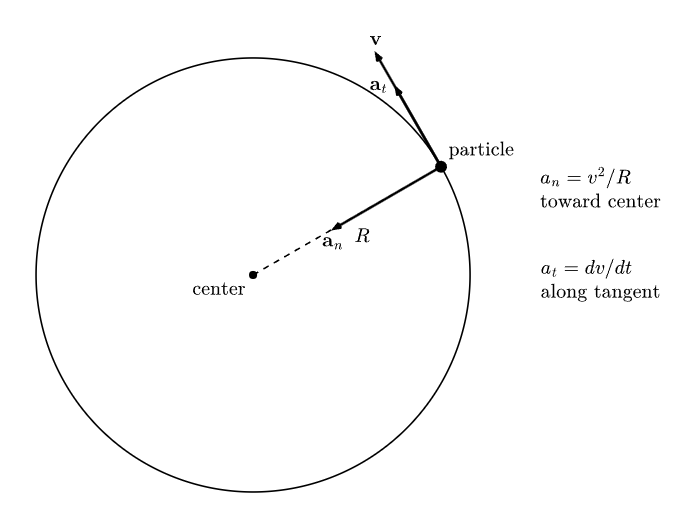
Figure 1. The tangential direction follows the instantaneous velocity. The normal direction points
toward the center of curvature. A changing speed produces tangential acceleration, while
curvature produces inward normal acceleration.
For uniform circular motion, dv∕dt = 0, so
The acceleration is nonzero even though the speed is constant.
2 Centripetal force is not an additional force
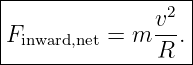
The phrase centripetal force means the net inward force required by circular motion:
It is not another force to add to the free body diagram. The inward force may be supplied by
Friction, Tension, gravity, a normal force, or a combination of real forces.
For example, on a flat road the inward force on a turning CAR can be static friction. For a ball on
a string it can be tension. For a satellite it can be gravity. For a roller coaster it can be a
combination of gravity and the normal force.
A useful procedure is:
- Draw only the real forces.
- Choose the inward normal direction.
- Resolve the real forces along that direction.
- Set their inward sum equal to mv2∕R.
- Use a separate tangential equation if the speed is changing.
3 Flat turns and friction
Consider a car of mass m moving around a level circular road of radius R. The vertical forces
balance,
so
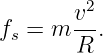
The horizontal inward force is supplied by static friction.
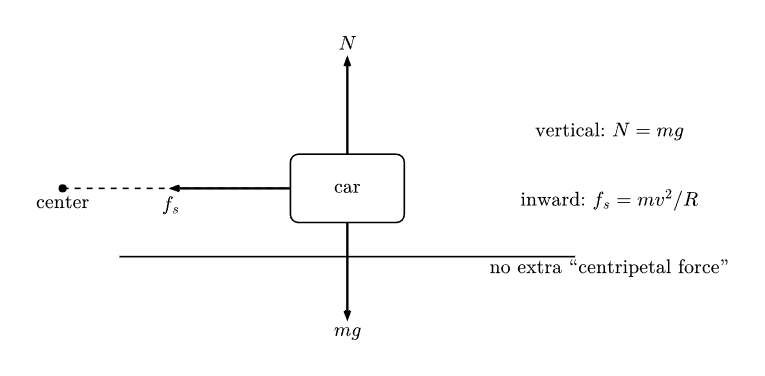
Figure 2. On a level turn, static friction can supply the inward force required for circular motion.
The normal force and weight balance vertically. “Centripetal force” is not drawn as an extra force.
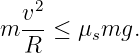
The radial equation is
Static friction adjusts as needed up to
Therefore the no-slip condition is
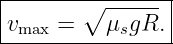
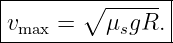
The maximum speed without slipping is
Notice that the vehicle mass cancels in this ideal model.
4 Worked example 1: maximum speed on a flat curve
A car rounds a level curve of radius R = 65.0 m. The coefficient of static friction between the tires
and the road is μs = 0.650. Find the maximum speed for which the car can follow the circular path
without slipping.
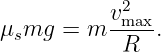
At the limiting condition,
Thus
Substitution gives
Therefore
The static friction force is below its maximum value at any lower speed.
5 Banked curves without friction
A banked road tilts the normal force so that it has an inward horizontal component. At one
particular speed, no friction is required.
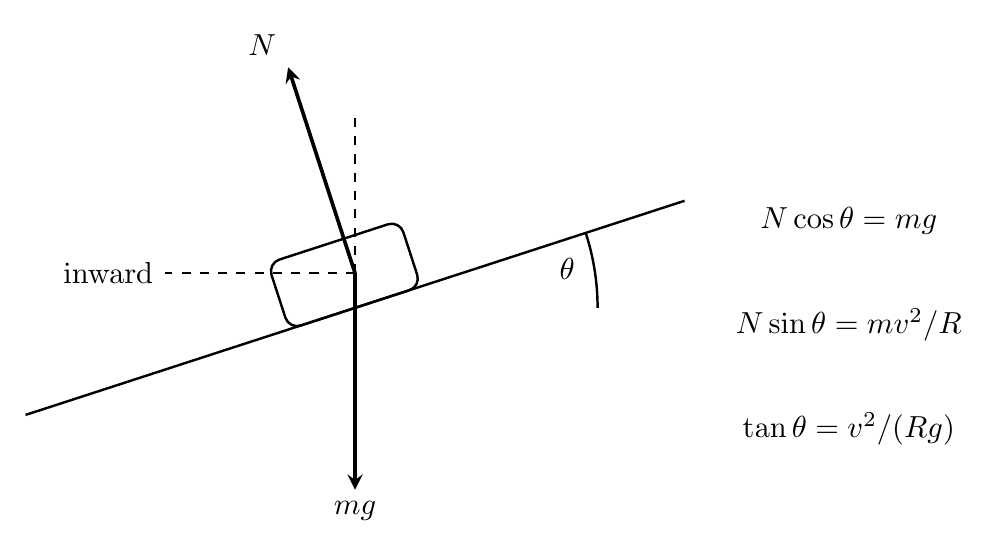
Figure 3. For a frictionless banked curve, the vertical component of the normal force balances the
weight while the horizontal component supplies the inward force.
If the road is banked by angle 𝜃, the vertical equation is
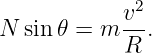
and the inward equation is
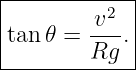
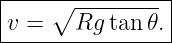
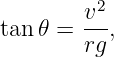
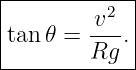
Dividing the equations eliminates N and m:
Equivalently, the frictionless design speed is
6 Worked example 2: frictionless banked turn
A highway curve has radius R = 120 m and is banked at 𝜃 = 12.0∘. Find the speed for which no
friction is required.
Using
we obtain
Thus
At other speeds, friction may be needed to maintain the same circular path.
7 Vertical circular motion
When a body moves in a vertical circle, gravity changes its radial contribution around the path.
The radial equation must be written separately at each location.
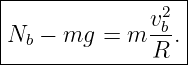
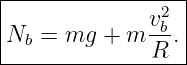
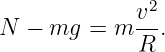
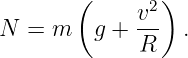
For a body moving on the inside of a vertical circular track, at the bottom the inward direction is
upward. Therefore
Hence
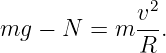
At the top, the inward direction is downward. Both gravity and the normal force point
inward:
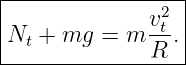
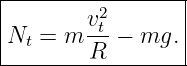
Thus
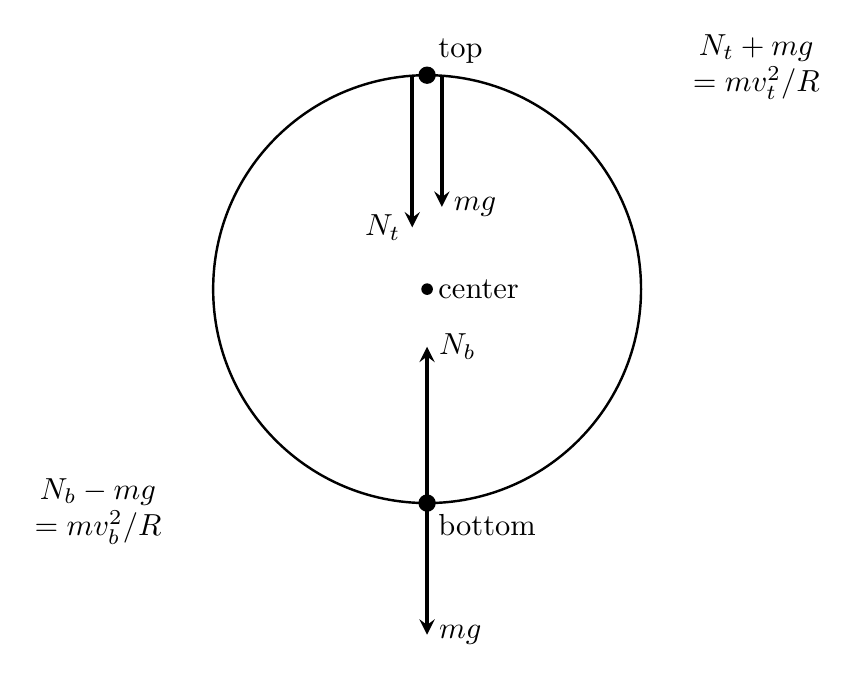
Figure 4. Radial force equations at the bottom and top of an inside vertical circular path. The
inward direction changes with position, so signs must be assigned locally.
The normal force is a contact force and cannot pull the body toward the track. Therefore physical
contact requires
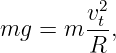
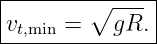
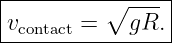
At the top, the limiting condition Nt = 0 gives
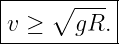
so the minimum top speed for contact is
This result is purely local. Determining what speed is required at some other point to arrive at the
top with this value requires an additional dynamical or energy analysis.
8 Worked example 3: apparent weight in a circular dip
A 70.0 kg rider passes through the bottom of a circular dip of radius R = 25.0 m at a speed of
v = 18.0 m∕s. Find the normal force exerted by the seat on the rider.
At the bottom, inward is upward, so
Therefore
Substitution gives
Hence
The seat force exceeds the rider’s Weight because an additional upward net force is required to
curve the motion upward.
9 Crests, contact loss, and apparent weight
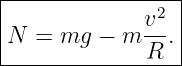
At the top of a convex circular hill, the inward direction points downward. Gravity points inward
while the normal force points outward. The radial equation is
Thus
As the speed increases, the normal force decreases. The limiting contact condition is N = 0,
giving
If a mathematical calculation predicts N < 0, the assumed contact motion is no longer physically
possible. The object loses contact instead.
10 Worked example 4: contact at the top of a loop
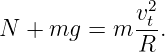
A small cart moves on the inside of a vertical circular track of radius R = 4.00 m. At the top of
the loop its speed is vt = 7.50 m∕s. Find the normal force per unit mass and determine whether
contact is maintained.
At the top,
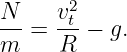
Divide by m:
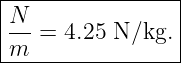
Numerically,
Therefore
Because N > 0, contact is maintained. The minimum top speed would be
so 7.50 m∕s is safely above the local contact threshold.
11 Conical pendulum
A conical pendulum is a mass attached to a string of length L that moves in a horizontal circle
while the string makes a constant angle 𝜃 with the vertical.
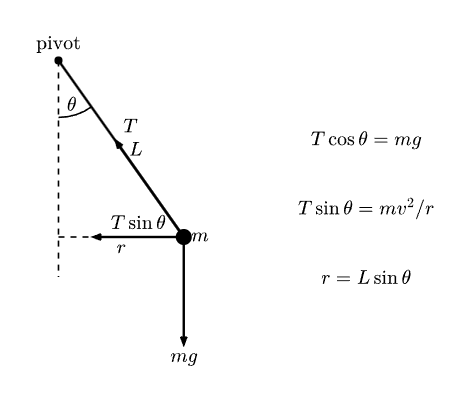
Figure 5. In a conical pendulum, the vertical component of tension balances the weight while the
horizontal component supplies the inward force. The circular radius is r = Lsin𝜃.
The vertical force balance is
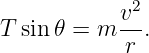
The horizontal inward equation is
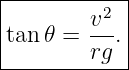
Dividing gives
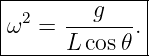
Since
we may also write the angular-speed relation
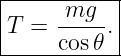
The tension is
12 Worked example 5: conical pendulum
A 0.500 kg mass is attached to a 1.20 m string and moves as a conical pendulum with the string at
30.0∘ from the vertical. Find the radius of the horizontal circle, the tension, the speed, and the
period.
The circular radius is
The tension is
From
we obtain
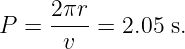
The period is circumference divided by speed:
Thus
13 When speed changes around a circle
Circular motion does not require constant speed. If a tangential component of net force exists,
then
At the same instant, the radial equation remains
The two equations answer different questions. The tangential force changes the magnitude of the
velocity. The inward force changes its direction.
The total acceleration magnitude is
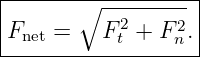
Likewise, if the net force has perpendicular tangential and normal components,
14 Common mistakes
- Drawing a separate “centripetal force” in addition to the real forces.
- Setting one particular force equal to mv2∕R without first finding the net inward force.
- Assuming circular motion means constant speed.
- Forgetting that the inward direction changes continuously around the path.
- Using N = mg in a vertical circle, dip, hill, or banked turn without checking the force
equations.
- Assuming the normal force can become negative. A passive contact force can push but
cannot pull.
- Using kinetic friction for a car that is rolling without slipping around a curve. The
relevant tire-road force is ordinarily static friction.
- Reversing the force directions at the top of an inside vertical loop. Both gravity and
the inward normal force point toward the center there.
- Treating the bank angle equation as valid for every speed. The frictionless relation
selects one design speed for a specified R and 𝜃.
15 Practice problems
Use g = 9.81 m∕s2 unless otherwise stated.
- A particle moves at 8.00 m∕s on a circular path of radius 5.00 m. Find its inward
acceleration.
- A 2.50 kg object moves at 6.00 m∕s in a circle of radius 3.00 m. Find the required net
inward force.
- A 1200 kg car rounds a level curve of radius 80.0 m at 18.0 m∕s. Find the static
friction force required and the minimum coefficient of static friction.
- A level road has μs = 0.500 and curve radius 50.0 m. Find the maximum no-slip speed.
- A frictionless banked curve has radius 90.0 m and bank angle 10.0∘. Find its design
speed.
- A frictionless curve is designed for v = 25.0 m∕s at radius R = 180 m. Find the bank
angle.
- A 65.0 kg passenger moves through the bottom of a circular dip of radius 30.0 m at
20.0 m∕s. Find the normal force.
- A car passes over the top of a convex hill of radius 45.0 m at 15.0 m∕s. Express the
normal force as a fraction of the car’s weight.
- For the hill in Problem 8, find the speed at which the car would just lose contact with
the road.
- A 0.750 kg cart moves on the inside of a vertical loop of radius 2.50 m. At the top its
speed is 6.00 m∕s. Find the normal force.
- A conical pendulum has length 0.800 m and angle 25.0∘ from the vertical. Find the
angular speed and period.
- At an instant, a 3.00 kg particle moves on a circle of radius 4.00 m with speed 5.00 m∕s.
Its speed is increasing at 2.00 m∕s2. Find the normal force component, the tangential
force component, and the magnitude of the net force.
16 Answers
- 12.8 m∕s2 inward.
- 30.0 N inward.
- 4.86 × 10³ N inward; μ
s ≥ 0.413.
- 15.7 m∕s.
- 12.5 m∕s.
- 𝜃 = 19.5∘.
- 1.50 × 10³ N.
- N∕W = 1 − v2∕(Rg) = 0.490.
- 21.0 m∕s.
- 3.44 N toward the center.
- ω = 3.68 rad∕s; P = 1.71 s.
- Fn = 18.8 N, Ft = 6.00 N, Fnet = 19.7 N.
17 Summary
Circular dynamics is Newton’s second law resolved into directions adapted to the path. The normal
equation is
while changing speed is governed by
The term mv2∕R is not a new force. It is the required net inward force. Identifying
which real forces provide that inward component is the central step in circular-motion
dynamics.
For a level friction-limited turn,
For a frictionless banked curve,
At the top of an inside vertical loop, maintaining contact requires
These results all come from the same principle: draw the real forces, choose the inward direction,
and apply Newton’s second law.
References
[1] PhysicsLibrary, M01-08, Uniform Circular Motion.
[2] PhysicsLibrary, M01-12, Tangential-Normal Kinematics.
[3] PhysicsLibrary, M02-01, Newton’s Laws of Motion.
[4] PhysicsLibrary, M02-02, Free Body Diagrams.
[5] OpenStax, University Physics, Volume 1, sections on uniform circular motion and
dynamics, CC BY 4.0.
[6] J. Moore et al., Mechanics Map, sections on particle kinetics in normal and tangential
coordinates, CC BY-SA 4.0.