GRE Physics Companion: Pulleys and Atwood Machines
This companion emphasizes the patterns most useful for timed mechanics problems: identify the
rope geometry, write the constraint before assuming an acceleration relation, then apply Newton’s
second law.
1 Fast triage
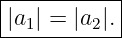
For one inextensible string over a fixed Pulley,
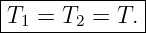
For one continuous massless string over an ideal pulley,
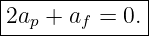
For a movable pulley, do not assume equal acceleration magnitudes. Write the rope length first. In
the simplest arrangement,
so
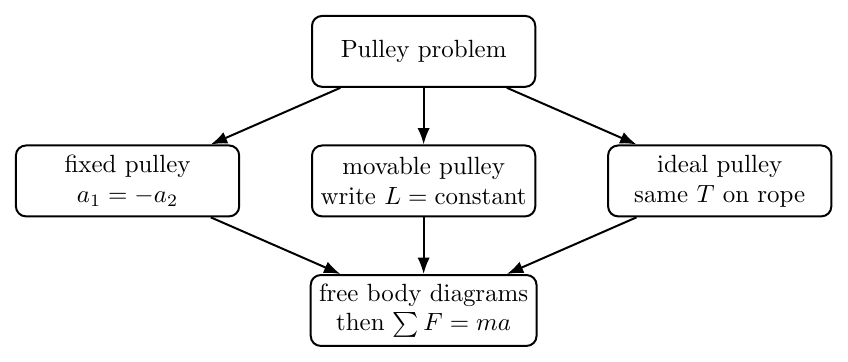
Figure 1. GRE pulley triage. Determine whether the pulley is fixed or movable, use one tension
along an ideal rope, derive the length constraint, and then write the force equations.
2 Atwood machine formulas worth recognizing
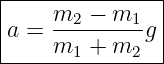
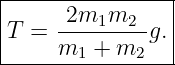
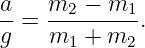
For m2 > m1,
and
These formulas should still be understood from the two free body diagrams rather than treated as
isolated facts.
A useful dimensionless form is
Thus a = 0 when the masses are equal, while a → g if one mass becomes negligible compared with
the other.
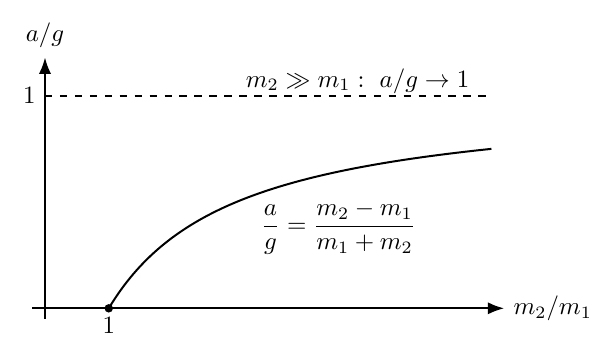
Figure 2. The Atwood acceleration approaches zero for equal masses and approaches g as the
mass ratio becomes very large.
3 Worked GRE example 1: mass ratio shortcut
An ideal Atwood Machine has masses m and 3m. Find the acceleration and tension.
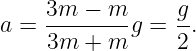
The acceleration is
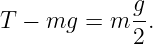
For the lighter mass,
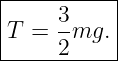
Therefore
The result also passes the physical check
4 Worked GRE example 2: movable pulley constraint
A 600 N load is supported at rest by one ideal movable pulley. One end of the rope is fixed and the
free end is pulled by a person. Find the required pull and the free end displacement required to
raise the load 0.20 m.
Two rope segments support the load, so
Hence
The rope length constraint gives
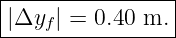
Raising the load 0.20 m requires the free end to move 0.40 m downward:
5 GRE speed questions
- An ideal Atwood machine has masses m and 3m. Its acceleration magnitude is (A) g∕4
(B) g∕3 (C) g∕2 (D) 3g∕4.
- For the machine in Question 1, the tension is (A) mg∕2 (B) mg (C) 3mg∕2 (D) 3mg.
- A block of mass m on a frictionless table is connected over an ideal pulley to a hanging
mass m. The acceleration magnitude is (A) 0 (B) g∕4 (C) g∕2 (D) g.
- One inextensible string passes over a fixed pulley. If one end moves downward at speed
v, the other end moves (A) downward at v (B) upward at v (C) upward at 2v (D) at
a speed that depends on the masses.
- A load of Weight W is held at rest by one ideal movable pulley supported by two
segments of the same rope. The free end force is (A) W∕4 (B) W∕2 (C) W (D) 2W.
- A real pulley has appreciable Rotational Inertia and angularly accelerates. Which
statement is generally correct? (A) the tensions must still be equal (B) the tensions
can differ (C) both tensions are zero (D) the string must be extensible.
6 Answers and rationales
- C. (3m − m)∕(3m + m) = 1∕2.
- C. Using the lighter mass, T − mg = m(g∕2), so T = 3mg∕2.
- C. The only unbalanced driving force is mg and the total moving mass is 2m, so
a = g∕2.
- B. The fixed string length gives equal speed magnitudes in opposite directions.
- B. Static balance of the movable pulley gives 2T = W, and the free end force equals
T in the ideal model.
- B. A difference in tension can supply the net torque needed to angularly accelerate a
massive pulley.
References
[1] PhysicsLibrary, M02-06, Pulleys and Atwood Machines.
[2] PhysicsLibrary, M02-05, Tension and Massless Strings.
[3] J. Moore et al., Mechanics Map, CC BY-SA 4.0.

![[parent]](https://images.physicslibrary.org/images/uparrow.png)