GRE Physics Companion: Tension and Massless Strings
This companion is designed for rapid review after M02-05. Most tension questions become
straightforward once the system choice and string assumptions are identified before the algebra
begins.
1 Fast triage
For a body attached to a taut string, draw the tension force along the string and away from the
body.
For a massless ideal string segment with no other tangential force,
For an inextensible string, use the fixed length relation to connect the motions of the attached
bodies.
For multiple connected bodies, it is often fastest to find the common acceleration from the full
system first and then isolate one body to find the tension.
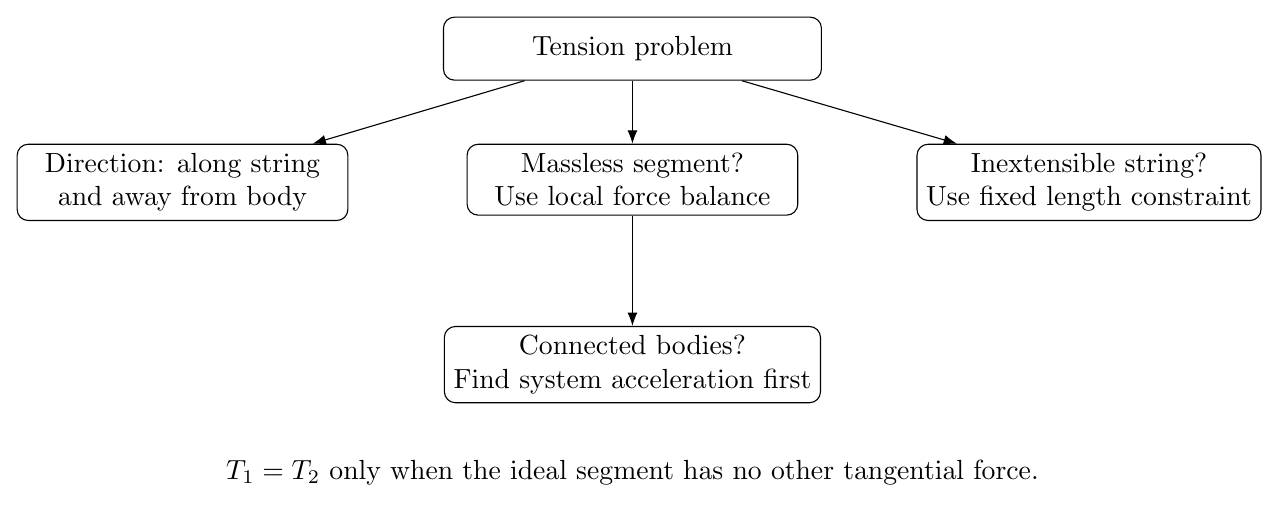
Figure 1. GRE tension triage. Separate the force rule, the massless string rule, and the
inextensible string constraint before solving.
2 Common traps
A hanging body does not imply T = mg. Instead,
A string that goes slack has
Two different strings do not generally have equal tension.
Equal tension magnitude along one ideal massless string does not mean the tension vectors on two
different attached bodies point in the same direction.
Massless and inextensible are different assumptions: massless controls force balance on the
connector, while inextensible controls the geometric length constraint.
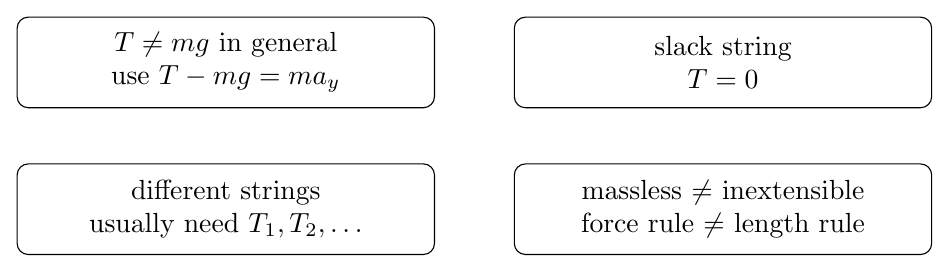
Figure 2. Common GRE traps. Tension is not automatically mg, a slack string cannot push,
different strings need separate labels, and massless is not the same assumption as inextensible.
3 Worked GRE example 1: two connected blocks
Two blocks of masses m and 2m lie on a frictionless horizontal surface and are connected
by a massless inextensible string. A horizontal force F pulls the 2m block. Find the
tension.
For the full system,
Thus
Now isolate the block of mass m. Its only horizontal force is tension:
Therefore
The common acceleration came from the total external force; the internal tension came from one
block’s equation.
4 Worked GRE example 2: nearly horizontal support cables
A Weight W is supported symmetrically by two cables, each making angle 𝜃 above the
horizontal. Find the tension in each cable and describe what happens as 𝜃 becomes
small.
Vertical equilibrium gives
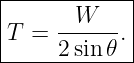
Hence
As 𝜃 → 0, sin 𝜃 → 0 and the required tension grows very large. A nearly horizontal cable must
provide the required vertical support through a small vertical component of a large
tension.
5 GRE speed questions
- A 5 kg mass hangs motionless from a light string. The string tension is (A) zero (B)
less than mg (C) equal to mg (D) greater than mg.
- A hanging mass accelerates downward with magnitude a < g. Its string tension is (A)
m(g − a) (B) mg (C) m(g + a) (D) zero for every downward acceleration.
- Two blocks of masses m and 3m are connected on a frictionless table. A force F pulls
the 3m block. The common acceleration is (A) F∕m (B) F∕(2m) (C) F∕(3m) (D)
F∕(4m).
- In Question 3, the tension in the connector is (A) F∕4 (B) F∕3 (C) 3F∕4 (D) F.
- Which assumption gives the fixed length relation between positions of bodies connected
by an ideal string? (A) massless (B) inextensible (C) frictionless (D) weightless.
- A flexible ideal string becomes slack. Its tension is (A) negative (B) zero (C) mg (D)
unchanged from the taut value.
6 Answers and rationales
- C. Zero acceleration gives T − mg = 0.
- A. Taking upward as positive, ay = −a, so T = m(g − a).
- D. The total mass is 4m, so a = F∕(4m).
- A. The block of mass m is accelerated only by tension, so T = ma = F∕4.
- B. Inextensibility fixes the total string length and therefore supplies the kinematic
constraint.
- B. A flexible string cannot sustain compression; when slack, the ideal tension is zero.
References
[1] PhysicsLibrary, M02-05, Tension and Massless Strings.
[2] J. Moore et al., Mechanics Map, CC BY-SA 4.0.

![[parent]](https://images.physicslibrary.org/images/uparrow.png)