Oscillations in Physics: Definition, Characteristics, and Physical Models
An oscillation is a repeated or approximately repeated variation of a physical quantity about a
reference state. The quantity may be a mechanical displacement, an angle, an Electric Charge, a
current, a pressure, an electromagnetic field component, a molecular coordinate, or some other
dynamical variable. The defining idea is therefore broader than the motion of a mass moving back
and forth.
A periodic oscillation returns exactly to the same state after a fixed time. Many important
oscillations, however, are not exactly periodic. Damping can cause the amplitude to decay,
external forcing can produce transients and beats, and nonlinear systems can oscillate with
amplitude-dependent frequency or more complicated time histories. Thus harmonic motion is
a particularly important type of oscillation, but it is not the definition of oscillation
itself.
This article provides a general physics-level definition and organizes the concepts that recur in
mechanics, Electromagnetism, wave physics, acoustics, circuits, molecular physics, and quantum
theory. More specialized PhysicsLibrary entries can then develop the simple harmonic oscillator,
damped and driven oscillators, resonance, Anharmonicity, normal modes, and waves in greater
detail.
1 The basic physical idea
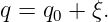
Consider a dynamical quantity q(t). A reference value q0 is chosen, and the departure from that
reference is
In many elementary oscillators, q0 is a stable equilibrium. If the system is displaced slightly from
equilibrium, its dynamics tend to drive it back toward equilibrium. Inertia then carries the system
past equilibrium, after which the restoring tendency reverses. Repetition of this exchange produces
oscillatory behavior.
The most familiar mechanical picture is a mass attached to a spring, but the same structure occurs
in many different variables. An LC circuit oscillates through exchange between electric and
magnetic energy; a pendulum oscillates in angle; a molecule vibrates in an internal coordinate; and
the Electric Field at a fixed point in a sinusoidal electromagnetic wave oscillates in
time.
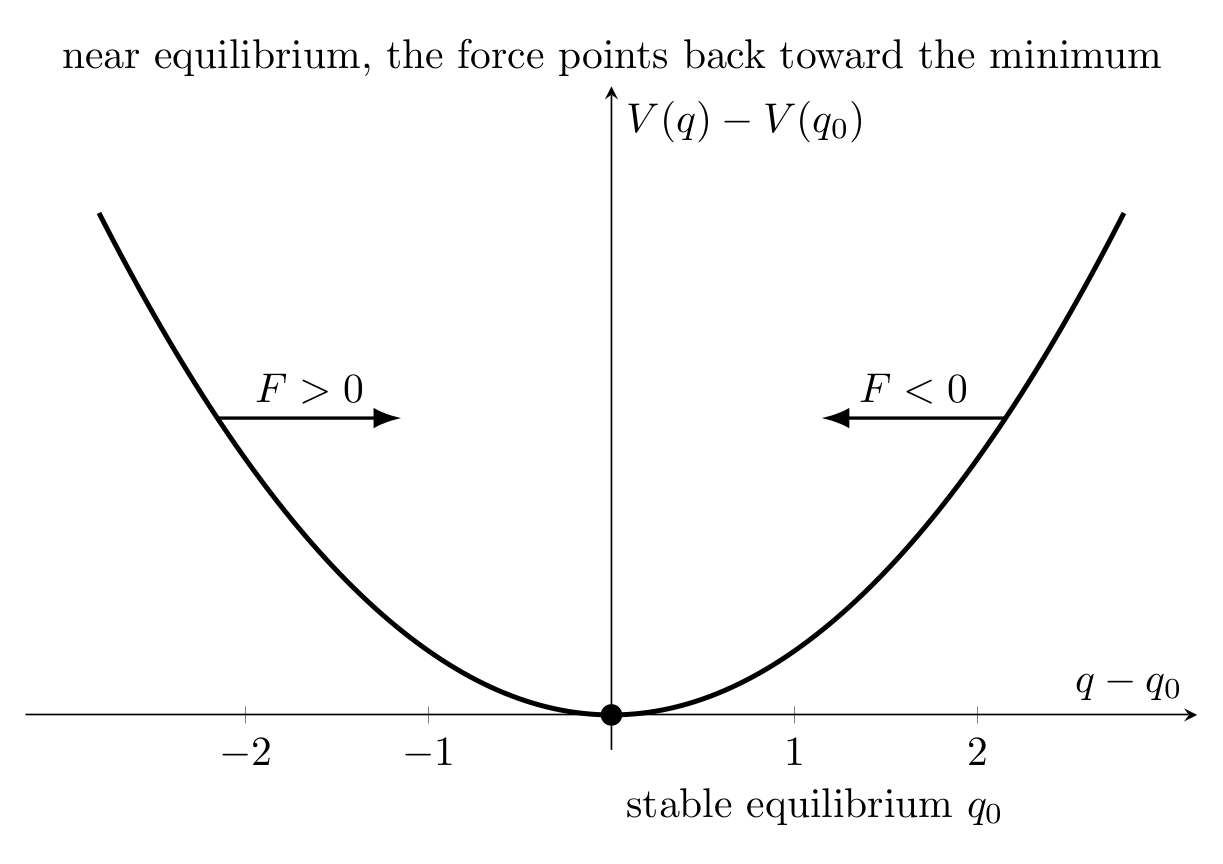
Figure 1. A stable equilibrium and restoring tendency. Near a local minimum of potential energy,
a displacement to either side produces a force directed back toward equilibrium.
2 Periodic motion
An oscillation is periodic if there exists a positive time T such that
for all times for which the motion is defined. The smallest positive value of T for which this
relation holds is the fundamental period.
The frequency is
with SI unit hertz,
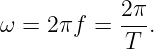
The angular frequency is
One cycle corresponds to an increase of phase by 2π radians. Frequency counts cycles per unit
time, while angular frequency measures the rate at which phase advances.
3 Amplitude
For an oscillation about q0, amplitude measures the characteristic size of the departure from the
reference state. For a simple symmetric periodic oscillation,
This definition must be used with care outside elementary periodic motion. A damped oscillator
has a time-dependent envelope rather than one permanent amplitude. A driven nonlinear oscillator
may have several characteristic amplitudes. Random or irregular oscillations may instead be
described using root-mean-square values or spectra.
Amplitude therefore describes how large an oscillation is; it does not by itself specify how rapidly
the system oscillates.
4 Harmonic oscillation as a special case
The simplest smooth periodic oscillation is sinusoidal:
Here A is the amplitude, ω is angular frequency, and ϕ is the phase constant. Such motion is called
simple harmonic motion when it arises from a linear restoring law.
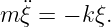
For a one-dimensional mass-spring oscillator,
so Newton’s second law gives
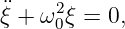
Thus
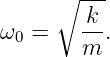
where
The harmonic oscillator is central because it is exactly solvable and because many physical systems
become approximately harmonic when displaced only slightly from stable equilibrium.
5 Why small oscillations are often harmonic
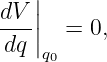
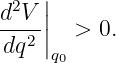
Suppose a particle moves in a smooth one-dimensional potential V (q) and has a stable equilibrium
at q = q0. Equilibrium requires
and stability requires
Write
Near equilibrium, the Taylor expansion has the form
where
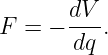
The force is
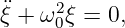
To lowest order in small ξ,
Therefore
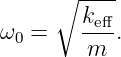
The small-oscillation angular frequency is then
This argument explains why harmonic motion appears so widely in physics. It is often
the leading approximation near a stable equilibrium, even when the exact system is
nonlinear.
6 Oscillation does not require exact periodicity
Exact periodicity is an important special case, but real physical oscillations often evolve in
time.
Damped oscillation
A simple damped mechanical model is
For weak enough damping, the system is underdamped and oscillates with a decaying
envelope. The motion is no longer exactly periodic because successive maxima have smaller
amplitudes.
If the damping is sufficiently strong, the system can return to equilibrium without overshooting.
Such critically damped or overdamped motion is usually not called oscillatory, even though it
arises from the same underlying oscillator model.
Driven oscillation
An external periodic force gives the model
The motion generally contains a transient part and a driven steady-state part. When the driving
frequency lies near a natural frequency, the response can become large. This is the phenomenon of
resonance.
Anharmonic and nonlinear oscillation
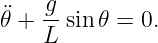
A nonlinear restoring law need not produce a sinusoid. For example, the exact simple pendulum
satisfies
Only for sufficiently small angles can
be used to obtain a harmonic oscillator. At larger amplitudes the oscillation remains periodic in
the ideal undamped pendulum, but its period depends on amplitude.
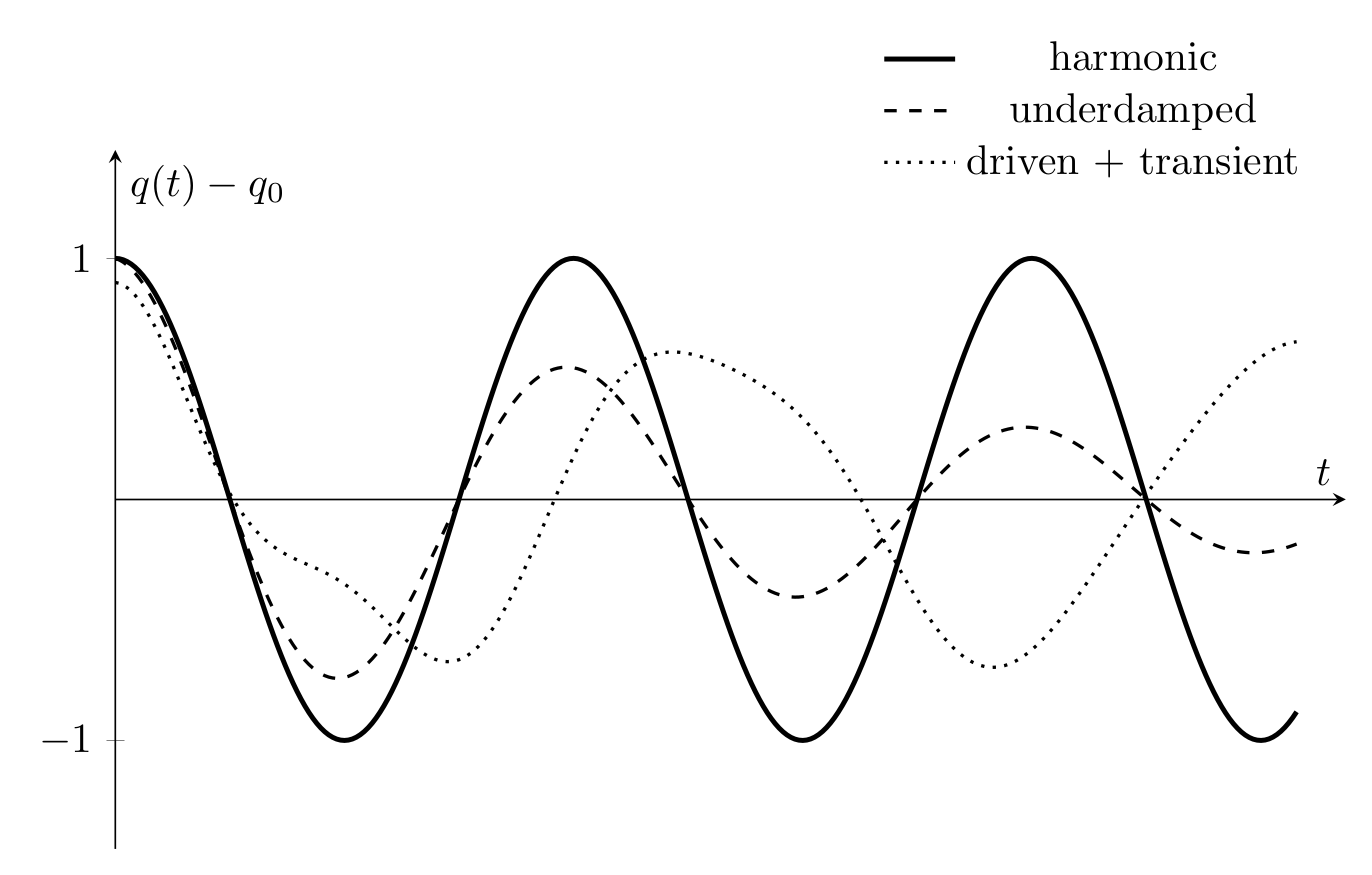
Figure 2. Different time histories can all belong to oscillator physics. Harmonic motion has
constant amplitude, an underdamped oscillator has a decaying envelope, and driven motion can
contain a transient before approaching a steady response.
7 Energy exchange in an oscillator
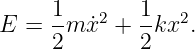
In a conservative harmonic oscillator,
At maximum displacement,
so the energy is entirely potential. At equilibrium,
so the energy is entirely kinetic. The repeated exchange between these forms of stored energy is
another useful way to recognize oscillatory dynamics.
This energy-exchange picture generalizes. In an ideal LC circuit, energy alternates between the
electric field of the capacitor and the magnetic field of the inductor. In a wave, local kinetic and
potential or electric and magnetic energy can oscillate while energy is also transported through
space.
8 Phase-space description
An oscillator can also be described by its state rather than only by its time history. For a
one-dimensional mechanical oscillator, a convenient state is
A conservative harmonic oscillator traces a closed curve in this phase plane. After one period, both
position and velocity return to their original values, so the system has returned to the same
dynamical state.
An underdamped oscillator instead spirals inward toward equilibrium because mechanical energy is
continually removed.
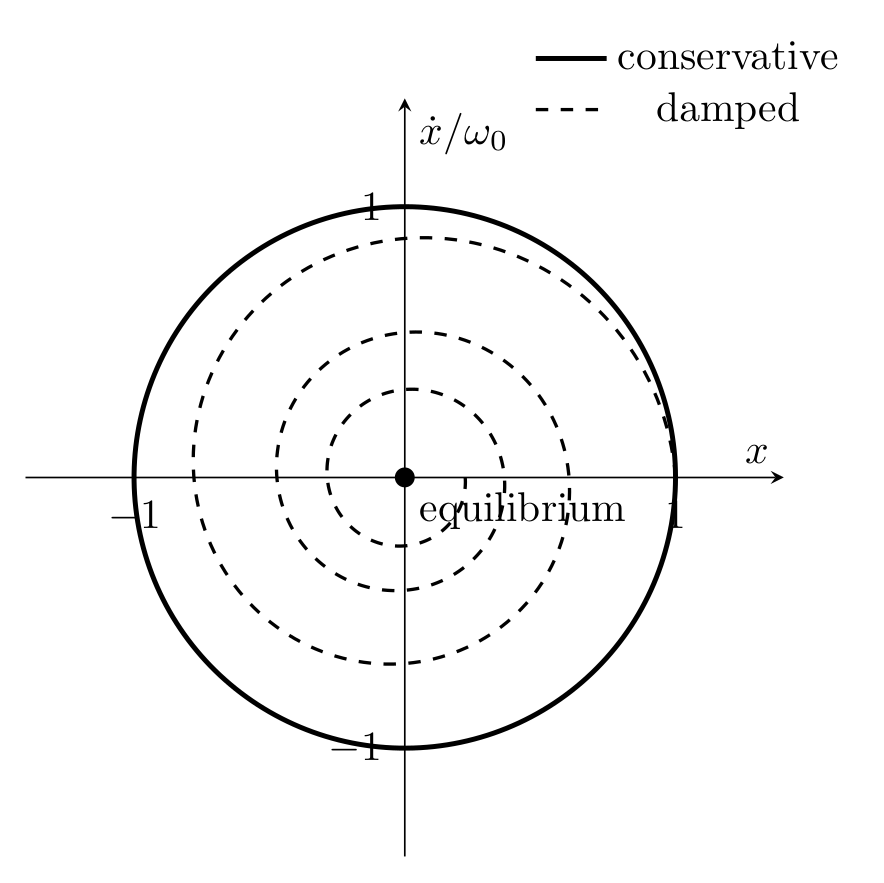
Figure 3. Phase-space view of oscillation. A conservative harmonic oscillator follows a closed
orbit; damping causes the state to spiral inward toward equilibrium.
This viewpoint is especially useful because returning to the same displacement does not necessarily
mean returning to the same state. The oscillator may pass through the same position while moving
in the opposite direction.
9 Natural frequency
A system capable of free oscillation often possesses one or more natural frequencies.
These are frequencies selected by the dynamics and boundary conditions of the unforced
system.
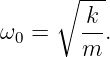
For a mass-spring oscillator,
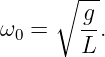
For a small-angle pendulum,
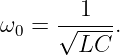
For an ideal LC circuit,
The physical variables and energy storage mechanisms differ, but each system has the same
mathematical harmonic-oscillator structure.
10 Several degrees of freedom and normal modes
A system with several dynamical coordinates can support several independent patterns of
oscillation. Near stable equilibrium, a linear mechanical system can often be written schematically
as
where M is a mass matrix, K is a stiffness matrix, and q is the displacement vector from
equilibrium.
A normal-mode trial form
leads to
Nonzero mode shapes require
The allowed values of ω are the natural frequencies, and the corresponding vectors a are the
normal modes. Each normal mode is a coordinated oscillation of the entire system at a single
frequency.
11 From coupled oscillators to waves
A wave and an oscillation are related concepts, but they are not synonyms.
An oscillation describes variation of a dynamical quantity in time. A wave additionally has spatial
structure and typically describes how a disturbance, phase pattern, or energy propagates through
space.
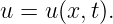
A field may be written as
At a fixed position x = x0, the quantity
may oscillate in time. Neighboring positions are coupled, so the phase and amplitude can vary with
position as well.
A traveling sinusoidal wave has the form
At each fixed x, the field oscillates with angular frequency ω, while the spatial phase pattern moves
through the medium or field.
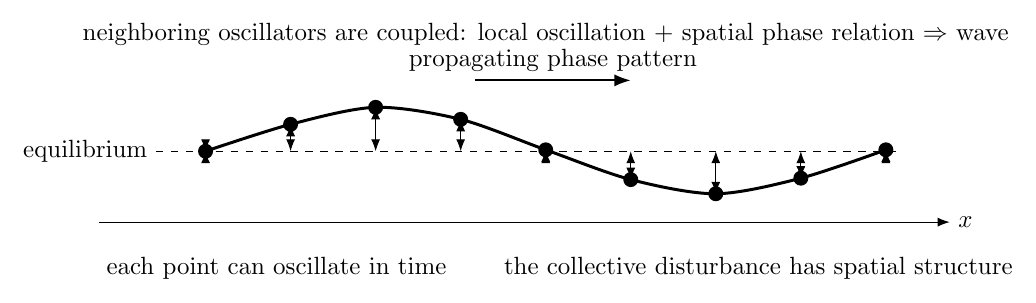
Figure 4. A wave can be viewed as spatially coupled oscillatory degrees of freedom. Oscillation
describes the local time dependence; coupling and spatial phase relationships produce wave
behavior.
This distinction is important. A single pendulum can oscillate without forming a wave. A chain of
coupled oscillators can support waves because motion at one location influences neighboring
locations.
12 Oscillation versus vibration
The words oscillation and vibration are often used interchangeably, but their emphasis differs.
Oscillation is the broader mathematical and physical idea of repeated variation. Vibration
most often refers to mechanical oscillation of a body, structure, molecule, or elastic
medium.
Thus a bridge deck vibrates, an electric current oscillates, and an electromagnetic field oscillates.
All three can be studied using oscillator concepts.
13 Self-sustained oscillations and limit cycles
Not every sustained oscillation is a conservative motion about a static equilibrium. Some nonlinear
systems contain an energy source and a dissipative mechanism that together produce a stable
repeating cycle. Examples occur in electronic oscillators, lasers, fluid instabilities, and biological
rhythms.
In phase space, such a stable repeating trajectory is called a limit cycle. This is a more advanced
form of oscillatory behavior and shows why the general concept of oscillation should not be
restricted to the mass-spring model.
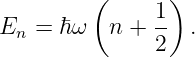
14 Oscillations in quantum physics
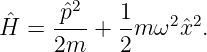
In quantum mechanics, the word oscillator can refer to a dynamical system whose Hamiltonian has
oscillator form rather than to a particle following a literal sinusoidal trajectory. The quantum
harmonic oscillator is defined by
Its stationary energy levels are
The classical and quantum harmonic oscillators are closely related mathematically, but their
physical interpretations are different. Quantum states, expectation values, and transition
amplitudes require a separate treatment.
15 Examples across physics
Oscillatory phenomena include:
- a mass on a spring;
- a pendulum;
- torsional vibration of a shaft;
- acoustic pressure at a fixed location;
- charge and current in an RLC circuit;
- electric and magnetic fields in electromagnetic radiation;
- molecular vibrations;
- lattice vibrations and phonons in solids;
- plasma oscillations;
- coupled structural modes;
- self-sustained electronic or mechanical oscillators.
The details differ, but recurring ideas include equilibrium, restoring dynamics, inertia or energy
storage, amplitude, frequency, phase, damping, forcing, coupling, and nonlinearity.
16 Common misconceptions
Every oscillation is sinusoidal
False. A sinusoid is the hallmark of ideal harmonic motion. Nonlinear, driven, damped, pulsed, and
relaxation oscillators need not be sinusoidal.
Every oscillation is exactly periodic
False. Damped oscillations change amplitude, transients evolve, and quasiperiodic or noisy systems
need not possess one exact period.
Every periodic function is a mechanical oscillation
Not necessarily. Periodicity is a mathematical property. To describe a physical oscillator, the
periodic quantity must arise from a physical dynamical system.
An oscillation and a wave are the same thing
False. A wave has spatial dependence and coupling or propagation. Oscillation is the local
temporal behavior from which many waves are built.
Stable equilibrium guarantees indefinitely sustained oscillation
Not in a real dissipative system. A displaced system may oscillate while losing energy and
eventually settle to equilibrium unless energy is supplied.
17 A practical hierarchy for PhysicsLibrary
A useful sequence for later study is
Anharmonicity and nonlinear dynamics extend this chain beyond the ideal linear oscillator.
18 Summary
An oscillation is a repeated or approximately repeated variation of a physical quantity about a
reference state or recurring dynamical state. Exact periodicity is an important special case, not an
absolute requirement. The key descriptors of periodic oscillation are amplitude, period, frequency,
angular frequency, and phase.
Near a stable equilibrium, many smooth systems reduce approximately to
which explains the extraordinary importance of the harmonic oscillator. Damping, driving,
coupling, and nonlinearity enlarge this basic model and lead to resonance, normal modes, complex
oscillations, and waves.
The concept therefore serves as a common language connecting mechanics, circuits, acoustics,
electromagnetism, molecular physics, solid-state physics, and quantum theory.
Related PhysicsLibrary entries
For more specialized treatments, see the PhysicsLibrary entries on oscillation at one point,
sinusoidal oscillation, resonance, anharmonicity, simple harmonic oscillators, and the Wave
Mechanics series.
References
[1] John R. Taylor, Classical Mechanics, University Science Books, 2005.
[2] Stephen T. Thornton and Jerry B. Marion, Classical Dynamics of Particles and
Systems, 5th ed., Brooks/Cole, 2004.
[3] A. P. French, Vibrations and Waves, W. W. Norton, 1971.
[4] Frank S. Crawford, Waves, Berkeley Physics Course, Vol. 3, McGraw-Hill, 1968.
[5] L. D. Landau and E. M. Lifshitz, Mechanics, 3rd ed., Butterworth-Heinemann, 1976.
[6] Steven H. Strogatz, Nonlinear Dynamics and Chaos, 2nd ed., Westview Press, 2015.