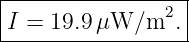
Electromagnetic Waves, Antennas, and RF: Electromagnetic Momentum, Radiation Pressure, and
Photon Momentum - Exercises and Complete Worked Solutions
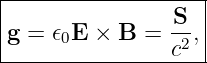
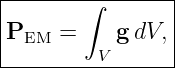
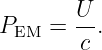
EM18 established that electromagnetic fields carry momentum as well as energy. This companion
article develops that result through worked problems ranging from local field momentum density to
radiation pressure, the Maxwell stress tensor, solar-sail acceleration, photon momentum, and the
agreement between classical and quantum momentum accounting.
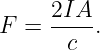
The central vacuum relations are
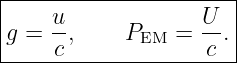
and, for a plane wave,
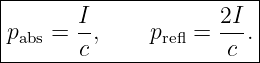
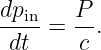
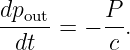
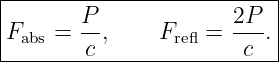
At normal incidence, the radiation-pressure limits are
The photon description uses
The problems below are intended to make these formulas consequences of momentum conservation
rather than isolated facts [1, 2, 3, 4, 5].
How to use this problem set
Attempt all exercises in Part I before consulting Part II. In every radiation-pressure problem,
identify three things before calculating: the direction of the incident momentum, what fraction of
that momentum leaves after interaction, and whether the requested force is along the beam
direction or normal to a material surface. This prevents most sign and factor-of-two
errors.
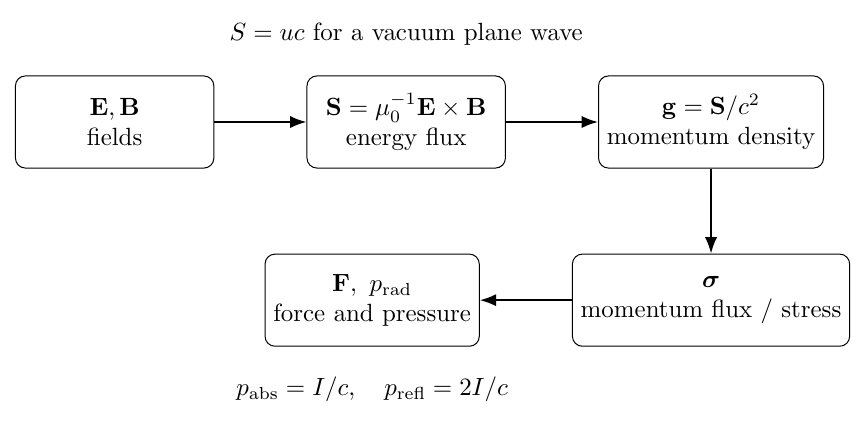
Figure. The electromagnetic momentum chain. The fields determine the Poynting vector,
the Poynting vector determines momentum density, and momentum flux produces force
and pressure when the radiation interacts with matter.
Part I: Exercises
Exercise 1: momentum density of a vacuum plane wave
At a particular point and instant, a vacuum plane wave has
and propagates in the +z direction.
Find:
- the corresponding magnetic-field vector B;
- the instantaneous Poynting vector S;
- the electromagnetic momentum density g using g = S∕c2;
- the total instantaneous energy density u;
- verify numerically that g = u∕c.
Exercise 2: total momentum in a finite electromagnetic pulse
A short vacuum pulse carries total electromagnetic energy
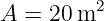
through a beam of cross-sectional area
Its duration is
Assume a uniform rectangular pulse profile.
Find:
- the total electromagnetic momentum of the pulse;
- the pulse length L = cτ;
- the pulse volume V = AL;
- the average energy density u = U∕V inside the pulse;
- the average momentum density g = u∕c;
- verify that gV = U∕c.
Exercise 3: absorbing surface under a known intensity
A normally incident electromagnetic beam has intensity
and completely illuminates an absorbing plate of area
Find:
- the radiation pressure;
- the force on the plate;
- the momentum transferred to the plate during 10 s.
Exercise 4: perfect mirror and the factor of two
A 8.0 W laser beam is completely intercepted by a perfect mirror at normal incidence.
Find:
- the incident electromagnetic momentum arriving per second;
- the reflected electromagnetic momentum leaving per second, including its direction;
- the force on the mirror;
- explain from momentum conservation why the result is twice the absorbing-surface
force for the same beam power.
Exercise 5: partial absorption, reflection, and transmission
A plane wave of intensity
strikes a planar optical element at normal incidence. The power fractions are
Assume the incident, reflected, and transmitted beams are all in vacuum, with transmission
continuing in the original direction.
Find:
- the incoming momentum flux;
- the outgoing reflected and transmitted momentum fluxes, with signs;
- the radiation pressure on the element;
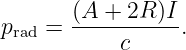
- verify the equivalent formula
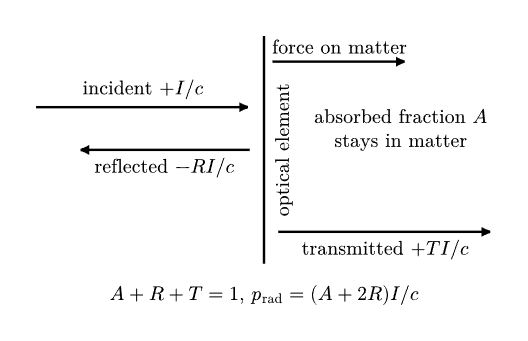
Figure. Momentum bookkeeping for a surface that absorbs, reflects, and transmits
portions of an incident wave. The reflected momentum reverses sign, which is why
reflection contributes twice its fractional power to the pressure.
Exercise 6: oblique reflection
Sunlight with intensity
strikes a perfectly reflecting flat sail of actual area
at an angle
measured from the surface normal.
Find:
- the projected area seen by the beam;
- the incident power intercepted by the sail;
- the normal radiation pressure;
- the normal force on the sail.
Explain physically why two factors of cos 𝜃 appear in the normal force.
Exercise 7: Maxwell stress tensor for a plane wave
A sinusoidal plane wave propagates in the +z direction with peak electric-field amplitude
At an instant when the Electric Field is at its positive peak, take
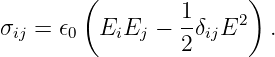
Using
find:
- the instantaneous total energy density u;
- σzz at the field peak;
- the cycle-averaged magnitude ⟨|σzz|⟩;
- verify that ⟨|σzz|⟩ = I∕c.
Exercise 8: stress tensor of a static electric field
A uniform electrostatic field is
Find the Maxwell stress tensor in Cartesian coordinates.
Then determine the traction vector
for surfaces whose outward normals are:
- n = x;
- n = y.
Interpret the signs as Tension along the field direction and compression transverse to the
field.
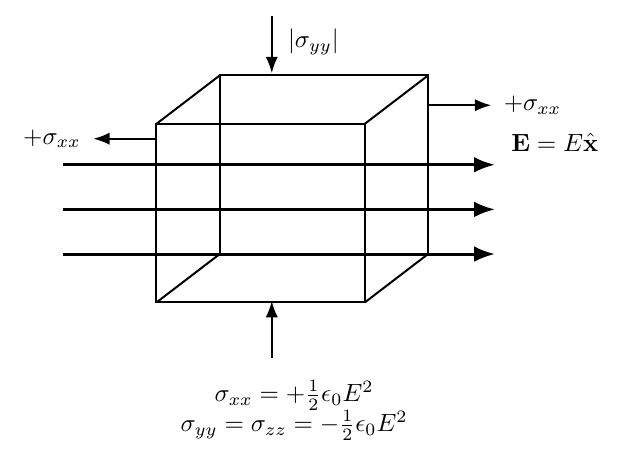
Figure. A static electric field produces anisotropic electromagnetic stress: tensile along the
field direction and compressive on transverse faces in the stated stress-tensor sign
convention.
Exercise 9: impulse from reflecting a finite-energy pulse
A light pulse of energy
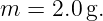
reflects normally from a free mirror of mass
Assume the mirror is initially at rest and its acquired speed is sufficiently small that the change in
photon energy can be neglected to first order.
Find:
- the impulse delivered to the mirror;
- the mirror’s change in speed.
Exercise 10: idealized solar-sail acceleration
At approximately 1 AU from the Sun, take the solar intensity to be
An ideal perfectly reflecting sail has area
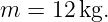
and total spacecraft mass
Assume normal incidence and neglect all other forces and the variation of solar intensity with
distance.
Find:
- the radiation force;
- the resulting acceleration;
- the idealized change in speed after one day.
Exercise 11: energy and momentum of a green photon
A photon has wavelength
Find:
- the frequency;
- the photon energy in joules;
- the photon momentum;
- verify numerically that Eγ = pγc.
Exercise 12: photon counting reproduces laser radiation pressure
A continuous laser has power
and wavelength
Find:
- the energy of one photon;
- the photon rate Ṅ;
- the momentum of one photon;
- the force on a perfectly absorbing target from photon counting;
- the force on a perfect mirror;
- verify that the answers reduce to P∕c and 2P∕c.
Exercise 13: wavelength dependence at fixed optical power
Two lasers each have output power
Laser A has wavelength 400 nm and Laser B has wavelength 800 nm.
For each laser, calculate:
- photon energy;
- photon momentum;
- photon rate;
- momentum delivered per second to a perfectly absorbing target.
Explain why the shorter-wavelength laser has larger momentum per photon but does not exert a
larger force at the same total power.
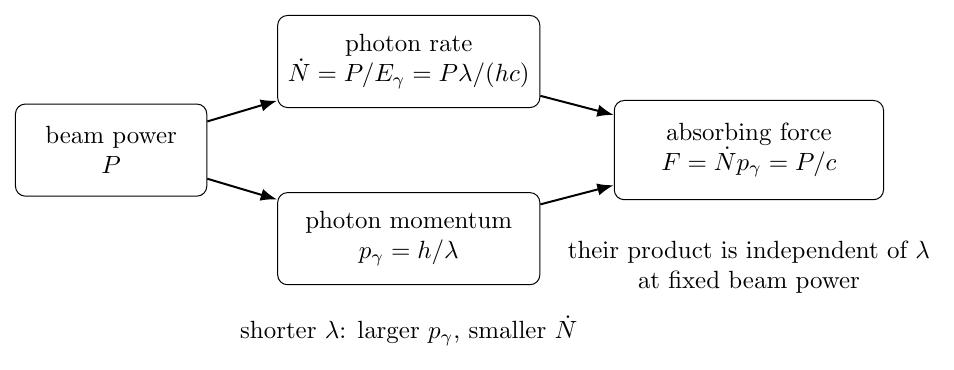
Figure. At fixed beam power, shorter-wavelength photons carry more momentum
individually but arrive at a lower photon rate. The product Ṅpγ remains P∕c for complete
absorption.
Exercise 14: RF beam momentum transfer in the far field
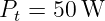
A transmitting antenna radiates
with linear gain
in the direction of a receiving panel located
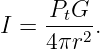
away. Assume free-space far-field spreading and use
If an absorbing panel of area
is normal to the beam and intercepts the local radiation uniformly, find:
- the local intensity;
- the radiation pressure;
- the force on the panel.
Comment on why momentum transfer is usually negligible in ordinary RF link budgets even
though the same electromagnetic fields carry both energy and momentum.
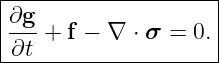
Exercise 15: derive local electromagnetic momentum conservation
Starting with the Lorentz force density
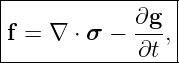
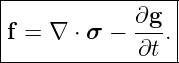
use Maxwell’s Equations to show that it can be written as
where
and
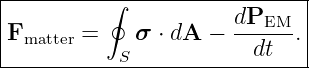
State the physical meaning of each term in the final equation and write the corresponding integral
momentum-balance equation over a fixed volume.
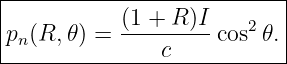
Exercise 16: Julia sweep of reflectivity and incidence angle
Consider an opaque surface, so that
For incidence angle 𝜃 measured from the surface normal, the normal pressure is
Using
write a Julia program that evaluates pn for
and
Verify numerically that:
- at fixed angle the pressure is linear in 1 + R;
- at fixed reflectivity it scales as cos 2𝜃;
- the R = 0, 𝜃 = 0 case gives I∕c;
- the R = 1, 𝜃 = 0 case gives 2I∕c.
Part II: Complete Worked Solutions
Solution 1: momentum density of a vacuum plane wave
For a vacuum plane wave,
Therefore
| B | = 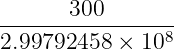 | (47)
|
| = 1.00069 × 10⁻⁶ T. | (48) |
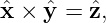
Because the propagation direction is +z and
we have
The instantaneous Poynting vector is
| S | =  E × B E × B | (51)
|
| = 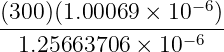 z z | (52)
|
| = 238.90 z W/m2. | (53) |
Thus
The momentum density is
| g | =  | (55)
|
| = 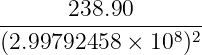 z z | (56)
|
| = 2.6581 × 10⁻¹⁵z kg/(m2s). | (57) |
Therefore
For a plane wave, the electric and magnetic energy densities are equal, so
Hence
| u | = (8.85418781 × 10⁻¹²)(300)2 | (60)
|
| = 7.96877 × 10⁻⁷ J/m3. | (61) |
Thus
Finally,
 | = 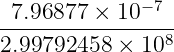 | (63)
|
| = 2.6581 × 10⁻¹⁵ kg/(m2s), | (64) |
which agrees with the momentum density obtained from S∕c2.
Solution 2: total momentum in a finite electromagnetic pulse
For a vacuum plane-wave pulse,
Therefore
| PEM | = 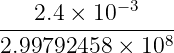 | (66)
|
| = 8.01 × 10⁻¹² kg m/s. | (67) |
Thus
The pulse length is
| L | = cτ | (69)
|
| = (2.99792458 × 10⁸)(8.0 × 10⁻⁹) | (70)
|
| = 2.398 m. | (71) |
The area is
Therefore the pulse volume is
| V | = AL | (73)
|
| = (3.0 × 10⁻⁴)(2.398) | (74)
|
| = 7.195 × 10⁻⁴ m3. | (75) |
The average energy density is
| u | =  | (76)
|
| = 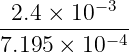 | (77)
|
| = 3.336 J/m3. | (78) |
The average momentum density is then
| g | =  | (79)
|
| = 1.113 × 10⁻⁸ kg/(m2s). | (80) |
Multiplying by the pulse volume gives
| gV | = (1.113 × 10⁻⁸)(7.195 × 10⁻⁴) | (81)
|
| = 8.01 × 10⁻¹² kg m/s, | (82) |
which is exactly the same result as U∕c to rounding.
Solution 3: absorbing surface under a known intensity
For complete absorption at normal incidence,
Thus
| pabs | = 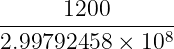 | (84)
|
| = 4.003 × 10⁻⁶ Pa. | (85) |
Therefore
The force is
| F | = pA | (87)
|
| = (4.003 × 10⁻⁶)(0.35) | (88)
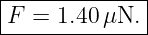
|
| = 1.401 × 10⁻⁶ N. | (89) |
Hence
The momentum delivered in 10 s is the impulse
| Δp | = FΔt | (91)
|
| = (1.401 × 10⁻⁶)(10) | (92)
|
| = 1.401 × 10⁻⁵ kg m/s. | (93) |
So
Solution 4: perfect mirror and the factor of two
The incident momentum arriving per unit time is
For P = 8.0 W,
 | = 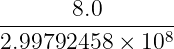 | (96)
|
| = 2.6685 × 10⁻⁸ N. | (97) |
Take the incident direction as positive. The reflected radiation carries momentum away in the
negative direction at the rate
Therefore the field momentum changes at the rate
 Δpfield Δpfield | = − − − | (99)
|
| = − . . | (100) |
The mirror receives the opposite force:
| Fmirror | =  | (101)
|
| = 5.337 × 10⁻⁸ N. | (102) |
Hence
An absorber removes the incident momentum +P∕c from the field. A mirror changes the field
momentum from +P∕c to −P∕c. The total change is therefore twice as large.
Solution 5: partial absorption, reflection, and transmission
The incoming momentum flux is
Numerically,
| Πin | = 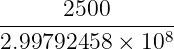 | (105)
|
| = 8.339 × 10⁻⁶ Pa. | (106) |
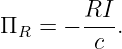
The reflected momentum flux is negative because it travels opposite the incident direction:
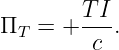
The transmitted momentum flux remains positive:
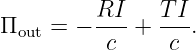
Thus the net outgoing momentum flux is
The momentum delivered to the element per unit area per unit time is
| prad | = Πin − Πout | (110)
|
| = 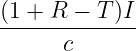 . . | (111) |
Using the given fractions,
Hence
| prad | = 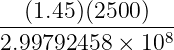 | (113)
|
| = 1.209 × 10⁻⁵ Pa. | (114) |
Therefore
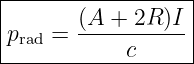
Since
we have
| A + 2R | = (1 − R − T) + 2R | (117)
|
| = 1 + R − T, | (118) |
so
is identical to the momentum-flux result.
Solution 6: oblique reflection
The projected area normal to the beam is
| A⊥ | = A cos 𝜃 | (120)
|
| = (20) cos 35∘ | (121)
|
| = 16.38 m2. | (122) |
The intercepted power is therefore
| Pinc | = IA cos 𝜃 | (123)
|
| = (1360)(20) cos 35∘ | (124)
|
| = 2.228 × 10⁴ W. | (125) |
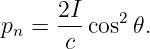
For ideal specular reflection, the normal component of momentum reverses. The normal pressure
on the actual surface is
Thus
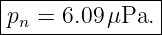
| pn | = 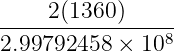 cos 235∘ cos 235∘ | (127)
|
| = 6.088 × 10⁻⁶ Pa. | (128) |
Hence
The normal force is
| Fn | = pnA | (130)
|
| = (6.088 × 10⁻⁶)(20) | (131)
|
| = 1.218 × 10⁻⁴ N. | (132) |
Therefore
One factor of cos 𝜃 comes from the projected collecting area A cos 𝜃. The second comes from taking
the normal component of the incident and reflected momentum.
Solution 7: Maxwell stress tensor for a plane wave
At the electric-field peak, a vacuum plane wave has equal electric and magnetic energy densities, so
the total instantaneous energy density is
Thus
| u | = (8.85418781 × 10⁻¹²)(300)2 | (135)
|
| = 7.96877 × 10⁻⁷ J/m3. | (136) |
For propagation along z, both Ez and Bz vanish. Hence
| σzz | = − 𝜖0E2 − 𝜖0E2 − | (137)
|
| = −u. | (138) |
At the peak,
For sinusoidal fields, the cycle average of E2 is E
02∕2. Therefore
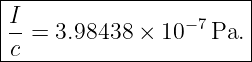
 | =  𝜖0E02 𝜖0E02 | (140)
|
| = 3.98438 × 10⁻⁷ Pa. | (141) |
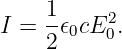
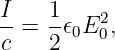
The average wave intensity is
Therefore
which is exactly the same average stress magnitude.
Numerically,
so
Solution 8: stress tensor of a static electric field
With B = 0, the stress tensor is
For
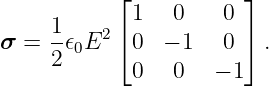
we have
Therefore
The stress scale is
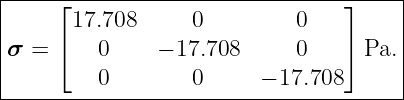
 𝜖0E2 𝜖0E2 | =  (8.85418781 × 10⁻¹²)(2.0 × 10⁶)2 (8.85418781 × 10⁻¹²)(2.0 × 10⁶)2 | (150)
|
| = 17.708 Pa. | (151) |
Thus
For a surface normal to +x,
For a surface normal to +y,
The field therefore produces a tensile stress along its own direction and a compressive stress
transverse to that direction in this sign convention.
Solution 9: impulse from reflecting a finite-energy pulse
The incident pulse momentum is
Ideal reflection reverses the electromagnetic momentum, so the mirror receives an impulse
Thus
| J | = 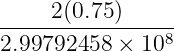 | (157)
|
| = 5.0035 × 10⁻⁹ N s. | (158) |
Therefore
The mirror mass is
Hence
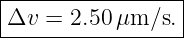
| Δv | =  | (161)
|
| = 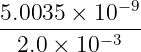 | (162)
|
| = 2.502 × 10⁻⁶ m/s. | (163) |
So
Solution 10: idealized solar-sail acceleration
For a perfectly reflecting sail at normal incidence,
Therefore
| F | = 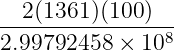 | (166)
|
| = 9.080 × 10⁻⁴ N. | (167) |
Thus
The acceleration is
| a | =  | (169)
|
| = 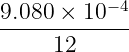 | (170)
|
| = 7.566 × 10⁻⁵ m/s2. | (171) |
Hence
One day is
Under the stated constant-acceleration approximation,
| Δv | = aΔt | (174)
|
| = (7.566 × 10⁻⁵)(86400) | (175)
|
| = 6.54 m/s. | (176) |
Therefore
under the idealized assumptions. A real trajectory requires solar gravity, sail orientation,
reflectivity, thermal effects, and the variation of solar flux with heliocentric distance.
Solution 11: energy and momentum of a green photon
The frequency is
With
we obtain
| ν | = 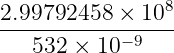 | (180)
|
| = 5.6352 × 10¹⁴ Hz. | (181) |
The photon energy is
| Eγ | = hν | (182)
|
| = (6.62607015 × 10⁻³⁴)(5.6352 × 10¹⁴) | (183)
|
| = 3.7339 × 10⁻¹⁹ J. | (184) |
The photon momentum is
| pγ | =  | (185)
|
| = 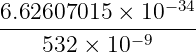 | (186)
|
| = 1.2455 × 10⁻²⁷ kg m/s. | (187) |
Thus
Finally,
| pγc | = (1.2455 × 10⁻²⁷)(2.99792458 × 10⁸) | (189)
|
| = 3.7339 × 10⁻¹⁹ J, | (190) |
so Eγ = pγc is verified numerically.
Solution 12: photon counting reproduces laser radiation pressure
The photon energy is
For λ = 632.8 nm,
| Eγ | =  | (192)
|
| = 3.1391 × 10⁻¹⁹ J. | (193) |
The photon arrival rate is
| Ṅ | =  | (194)
|
| = 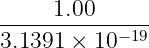 | (195)
|
| = 3.1856 × 10¹⁸ s−1. | (196) |
The momentum per photon is
| pγ | =  | (197)
|
| = 1.0471 × 10⁻²⁷ kg m/s. | (198) |
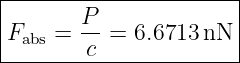
For complete absorption, each photon transfers pγ. Therefore
| Fabs | = Ṅpγ | (199)
|
| = (3.1856 × 10¹⁸)(1.0471 × 10⁻²⁷) | (200)
|
| = 3.3356 × 10⁻⁹ N. | (201) |
Thus
For perfect reflection, each photon reverses momentum and transfers 2pγ:
Algebraically,
Thus photon counting gives exactly the classical result
Solution 13: wavelength dependence at fixed optical power
For each laser,
For the 400 nm laser,
| Eγ,400 | = 4.9661 × 10⁻¹⁹ J, | (208)
|
| pγ,400 | = 1.6565 × 10⁻²⁷ kg m/s, | (209)
|
| Ṅ400 | = 4.0273 × 10¹⁸ s−1. | (210) |
Therefore
For the 800 nm laser,
| Eγ,800 | = 2.4831 × 10⁻¹⁹ J, | (212)
|
| pγ,800 | = 8.2826 × 10⁻²⁸ kg m/s, | (213)
|
| Ṅ800 | = 8.0546 × 10¹⁸ s−1. | (214) |
Therefore
The 400 nm photon has twice the momentum of the 800 nm photon, but only half as
many 400 nm photons are needed per second to carry the same power. The two effects
cancel:
for both beams.
Solution 14: RF beam momentum transfer in the far field
The far-field intensity is
| I | =  | (217)
|
| = 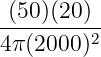 | (218)
|
| = 1.9894 × 10⁻⁵ W/m2. | (219) |
Thus
For complete absorption,
| prad | =  | (221)
|
| = 6.636 × 10⁻¹⁴ Pa. | (222) |
Therefore
The force on the 1.2 m2 panel is
| F | = pradA | (224)
|
| = (6.636 × 10⁻¹⁴)(1.2) | (225)
|
| = 7.96 × 10⁻¹⁴ N. | (226) |
Hence
This is extraordinarily small mechanically. In most RF systems the energy transfer and
signal-to-noise ratio matter enormously, while the corresponding radiation force is far below
ordinary mechanical disturbances.
Solution 15: derive local electromagnetic momentum conservation
Begin with the Lorentz force density
Use Gauss’s Law,
and the Ampere–Maxwell law,
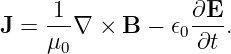
Substitution gives
| f | = 𝜖0(∇⋅ E)E +  (∇× B) × B − 𝜖0 (∇× B) × B − 𝜖0 × B. × B. | (231) |
Differentiate the cross product:
Hence
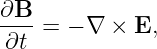
Use Faraday’s law,
so
Therefore
| f | = 𝜖0(∇⋅ E)E − 𝜖0E × (∇× E) | (236)
|
| +  (∇× B) × B − (∇× B) × B −  . . | (237) |
Now use
and
where ∇⋅ B = 0 has been used in the magnetic identity.
Then
| f | = 𝜖0![[ 1 ]
(∇ ⋅ E )E + (E ⋅ ∇ )E −-∇ (E2 )
2](https://images.physicslibrary.org/cache/objects/1248/make4ht/ElectromagneticWavesElectromagneticMomentumRadiationPressureAndPhotonMomentumExercises172x.png) | (240)
|
| +  ![[ ]
1- 2
(B ⋅ ∇ )B − 2∇ (B )](https://images.physicslibrary.org/cache/objects/1248/make4ht/ElectromagneticWavesElectromagneticMomentumRadiationPressureAndPhotonMomentumExercises174x.png) | (241)
|
| −  . . | (242) |
The spatial terms are precisely the divergence of the Maxwell stress tensor,
Define
Thus
Equivalently,
The terms have direct physical meanings:
- ∂g∕∂t is the local rate of change of electromagnetic momentum density;
- f is the force density exerted by the fields on matter;
- ∇⋅σ accounts for momentum transported through electromagnetic stresses.
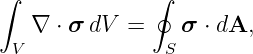
Integrate over a fixed volume V :
Using the tensor form of the divergence theorem,
so the integral momentum balance is
This equation is the momentum analogue of Poynting’s energy theorem.
Solution 16: Julia sweep of reflectivity and incidence angle
For an opaque surface,
so
| A + 2R | = 1 − R + 2R | (251)
|
| = 1 + R. | (252) |
The normal pressure is therefore
Note Julia verbatim code did not render so opening issue to tackle and leaving out
here.
References
[1] David J. Griffiths, Introduction to Electrodynamics, 4th ed., Cambridge University
Press, 2017, sections on electromagnetic momentum and the Maxwell stress tensor.
[2] John David Jackson, Classical Electrodynamics, 3rd ed., Wiley, 1999, sections on
electromagnetic conservation laws, momentum, and stress.
[3] Samuel J. Ling, Jeff Sanny, and William Moebs, University Physics, Volume 2,
OpenStax, 2016, sections on electromagnetic waves, momentum, and radiation pressure.
[4] Richard P. Feynman, Robert B. Leighton, and Matthew Sands, The Feynman
Lectures on Physics, Volume I, Addison-Wesley, 1963, chapters on radiation, photons,
and momentum transfer.
[5] Richard P. Feynman, Robert B. Leighton, and Matthew Sands, The Feynman Lectures
on Physics, Volume II, Addison-Wesley, 1964, chapters on electromagnetic energy,
momentum, and stress.
[6] Stephen M. Barnett, “Resolution of the Abraham–Minkowski Dilemma,” Physical
Review Letters, Vol. 104, 070401, 2010.