In fluid mechanics, it is often desireable to describe the properties of a fluid following the motion of
the fluid parcel. This is referred to as the Lagrangian description. The Eularian description, on
the other hand, considers the fluid properties at a fixed location in space. Suppose, for
instance, that two researchers, Dan and Tom, wish to measure the temperature change
over time in a river. Dan decides to do so in the Lagrangian description, while Tom
chooses the Eularian. Tom attaches a thermometer to a rock on the river bed, and records
the temperature on a uniform time interval. Tom has thus measured the temperature
change at a fixed location in the river. Dan attaches his thermometer to a free floating
buoy, recording the temperature of the river as the thermometer moves along with the
flow. Dan has thus measured the temperature change of the river following the fluid
parcel.
To apply Newton’s second law, and thus study the mechanics of the flow, we must first understand
mathematically and conceptually what the Lagrangian derivative represents. Following the
example given above, we will relate the temperature measurements made by Dan and Tom, thus
relating the Eularian to the Lagrangian descriptions.
Let T denote temperature, where T = T(x,t), with x the position vector x = (x1,x2,x3), and t is
time. Suppose that the fluid parcel is moving in the river with a velocity u(x,t) = (u1,u2,u3).
Then, by definition of the derivative, the time rate of change of temperature is given
by
We can expand the term at time t + δt as a Taylor series, giving
where δt is assumed small enough that the quadratic and higher terms in the expansion are
negligible. Note that the spatial derivative can be written in terms of the velocity vector, and the
gradient of temperature; specifically,
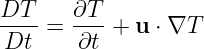
Substituting this result into the expression for DT∕Dt we see that,
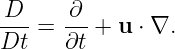
after simplifications. This provides us with the Lagrangian definition of the derivative. If the
specific example is removed, the expression can be written as an operator, which can apply to any
fluid property i.e.
The term on the left hand side, D∕Dt is the Lagrangian derivative; the time rate of change of some
quantity following the flow of that property. The derivative ∂∕∂t is the Eularian derivative: the
time rate of change of some quantity in fixed space. The final term, u ⋅∇ is the advective term.
Notice that the advection term does not have a time derivative. Rather, the change in
the property over time is related through the transport of that property. For example,
atmospheric scientists may speak of the advection of pollutants in the atmosphere,
such as advection of nitrogen oxide with the jet stream. It is the advective term that
accounts for the fluid flow, and thus bridges the gap between the Eularian and Lagrangian
descriptions.