Rigid-Body Mechanics: Similarity Transformation of the Inertia Tensor
The inertia tensor is a physical property of a rigid body about a specified point, but
the matrix used to represent that tensor depends on the coordinate frame. When the
coordinate axes are rotated, the physical mass distribution has not changed; only its matrix
representation has changed. The correct coordinate transformation is an orthogonal similarity
transformation.
This article derives that result carefully and connects it to angular momentum, rotational kinetic
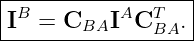
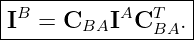
energy, the mass-integral definition of inertia, and principal-axis diagonalization. The key result
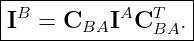
is
when CBA maps vector components from frame A into frame B.
1 Video companion at the start of the derivation
Companion video for the inertia-tensor similarity-transformation derivation.
The video is placed here intentionally, immediately before the mathematical derivation, so that the
PhysicsLibrary video-embedding macro can be tested in the same location where a learner would
naturally use it.
2 What the inertia tensor represents
Consider a rigid body and a reference point O. Let r denote the position of a mass element dm
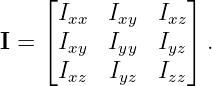
relative to O. In an orthonormal Cartesian frame, the inertia tensor is represented by the
symmetric matrix
where 13 is the 3 × 3 identity matrix [1, 2, 3].
Written component-by-component,
Depending on the convention used for products of inertia, some engineering texts write the
off-diagonal entries as −Ixy, −Ixz, and −Iyz. The transformation law derived below is unchanged
as long as the matrix convention is used consistently.
The tensor appears directly in three important physical relations. Angular momentum about O
is
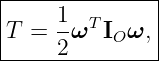
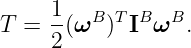
rotational kinetic energy is
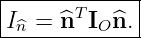
and the scalar moment of inertia about a unit axis n through O is
These relations describe physical quantities and therefore cannot depend on an arbitrary choice of
coordinate axes.
3 Coordinate-frame convention
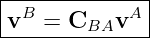
Let frames A and B be orthonormal frames with the same origin O. Define the direction cosine
matrix CBA by
for every geometric vector v.
Because CBA represents a proper orthogonal rotation,
and therefore
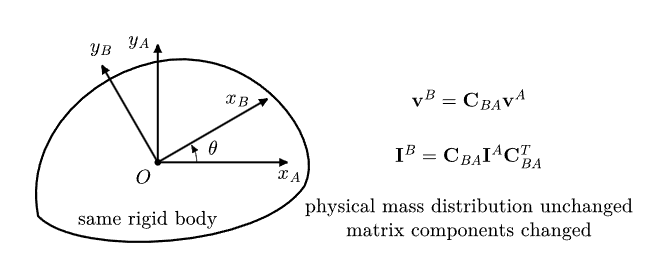
Figure. The same rigid body and the same physical inertia tensor are described using two
rotated coordinate frames. Only the matrix components change.
4 Derivation from angular momentum
This is the shortest physical derivation of the similarity transformation.
In frame A,
The geometric vectors H and ω transform according to the ordinary vector rule,
From Equation (9),
Substitute Equation (10) into Equation (11):
Now substitute Equation (13):
But in frame B the same physical angular-momentum law must be
Since Equations (15) and (16) must agree for arbitrary ωB,
Finally, orthogonality gives
The matrix has to appear on both sides of IA. A second-order tensor has two coordinate indices, so
both indices must be transformed.
5 Why this is called a similarity transformation
In linear algebra, a similarity transformation has the form
Equation (17) has exactly this form with
For an orthogonal rotation,
so the transformation becomes
This expression is also called an orthogonal congruence transformation. For a rotation matrix, the
distinction disappears algebraically because inverse and transpose are identical. Conceptually,
however, the similarity viewpoint is especially useful because it immediately explains why the
eigenvalues are preserved [4].
6 Independent derivation from the mass integral
The transformation law can also be derived directly from the definition of inertia.
Let
The Euclidean norm is unchanged by rotation:
| (rB)T rB | = (rA)T C
BAT C
BArA | (24)
|
| = (rA)T rA. | (25) |
The outer product transforms as
| rB(rB)T | = C
BArA(rA)T C
BAT . | (26) |
Insert these expressions into the inertia integral:
| IB | = ∫
![[ ]
(rB )T rB 13 − rB(rB)T](https://images.physicslibrary.org/cache/objects/1244/make4ht/SimilarityTransformationOfTheInertiaTensor23x.png) dm dm | (27)
|
| = ∫
![[ A T A A A T T ]
(r ) r 13 − CBAr (r ) CBA](https://images.physicslibrary.org/cache/objects/1244/make4ht/SimilarityTransformationOfTheInertiaTensor24x.png) dm. dm. | (28) |
Because
we may factor the rotation matrices outside the integral:
| IB | = C
BA![{∫ }
[ A T A A A T ]
(r ) r 13 − r (r ) dm](https://images.physicslibrary.org/cache/objects/1244/make4ht/SimilarityTransformationOfTheInertiaTensor26x.png) CBAT CBAT | (30)
|
| = CBAIAC
BAT . | (31) |
Thus the same transformation follows directly from the mass distribution itself.
7 Rotational kinetic energy is invariant
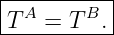
The same physical rigid body must have the same rotational kinetic energy no matter which frame
is used to write the components.
Starting in frame B,
Substitute
and Equation (18):
| T | =  (ωA)T C
BAT C
BAIAC
BAT C
BAωA (ωA)T C
BAT C
BAIAC
BAT C
BAωA | (34)
|
| =  (ωA)T IAωA. (ωA)T IAωA. | (35) |
Hence
The matrix entries may change, but the physical scalar does not.
8 Principal axes are the eigenvectors of the inertia tensor
Because the inertia tensor is real and symmetric, it possesses three mutually orthogonal
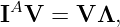
eigenvectors and real eigenvalues. Let
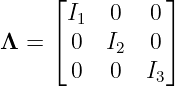
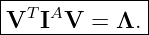
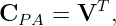
where the columns of V are orthonormal eigenvectors expressed in frame A, and
contains the principal moments of inertia.
Since V is orthogonal,
Multiplying Equation (37) on the left by VT gives
This is precisely the inertia-tensor similarity transformation. If frame P is chosen to have its axes
along the principal axes, then
and
The products of inertia vanish in the principal-axis frame.
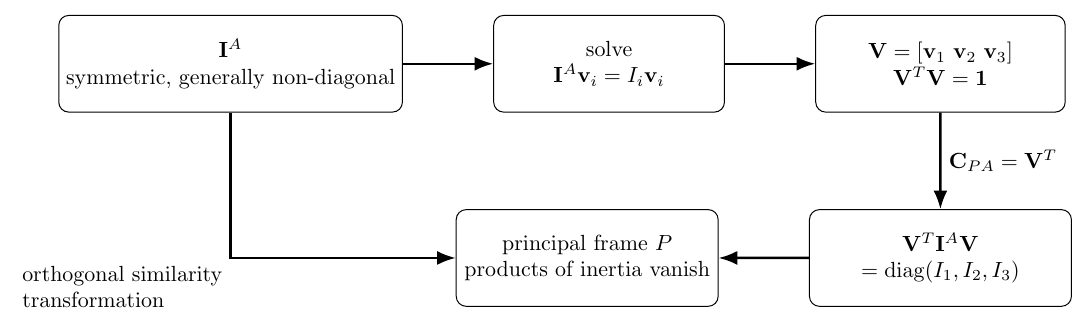
Figure. Diagonalization of the inertia tensor is an orthogonal similarity transformation.
The eigenvectors define the principal frame and the eigenvalues are the principal moments.
9 What the similarity transformation preserves
Similar matrices have the same characteristic polynomial. Therefore rotating the coordinate frame
preserves
- the three eigenvalues, which are the principal moments of inertia;
- the trace;
- the determinant;
- the characteristic polynomial;
- positive-definite or positive-semidefinite character;
- rotational kinetic energy when the angular-velocity components are transformed
consistently.
For example,
Using the cyclic property of the trace,
| tr(IB) | = tr(IAC
ABCBA) | (44)
|
| = tr(IA). | (45) |
Likewise,
| det(IB) | = det(C
BA) det(IA) det(C
AB) | (46)
|
| = det(IA). | (47) |
These invariants are useful software checks after transforming an inertia matrix.
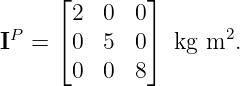
10 Worked numerical example: rotate a principal inertia tensor
Suppose the principal-axis inertia matrix is
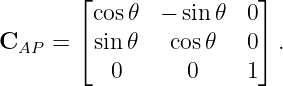
Let frame A be rotated relative to the principal frame by 𝜃 = 30∘ about the common z axis.
Let
The inertia matrix expressed in frame A is
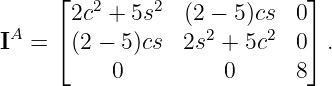
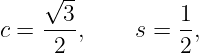
Writing c = cos 𝜃 and s = sin 𝜃,
At 𝜃 = 30∘,
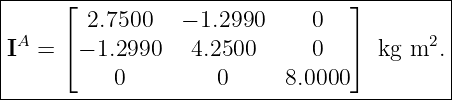
so
Nothing physical happened to the body. The off-diagonal entries appeared only because frame A is
not aligned with the principal axes.
To recover the principal frame,
which returns Equation (48).
The invariants provide immediate checks:
while
The eigenvalues of IA are likewise 2, 5, and 8 kg m2.
11 Moment of inertia about a physical axis is also invariant
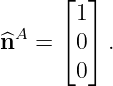
Let the physical axis be the xA direction,
From Equation (53),
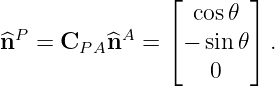
In the principal frame,
Then
| In | = (nP )T IP nP | (60)
|
| = 2 cos 2𝜃 + 5 sin 2𝜃 | (61)
|
| = 2.75 kg m2. | (62) |
The components changed, but the physical moment of inertia about the chosen physical axis did
not.
12 Similarity transformation versus the parallel-axis theorem
These two operations are often confused, but they solve different problems.
A similarity transformation changes the orientation of the coordinate basis while keeping the same
reference point and the same physical inertia tensor:
The parallel-axis theorem changes the reference point about which the inertia is computed. If G is
the center of mass and O is displaced from G by d, then
Equation (64) changes the tensor itself because the moment reference point has changed. Equation
(18) changes only its coordinate representation.
If both the point and frame change, apply both operations, keeping the geometry and frame
convention explicit.
13 Passive frame change versus active body rotation
There are two geometrically different situations that can produce the same matrix pattern.
In a passive frame change, the body remains fixed and the coordinate axes are changed. With the
convention of Equation (7),
In an active rotation, the coordinate frame is held fixed while the physical body is rotated. If Q
maps the old physical directions into the new physical directions in that fixed frame, then the
newly oriented tensor is
The algebra looks the same, but the interpretation is different. Confusing active and passive
meanings is a common source of transposes and sign errors.
14 Connection with covariance transformations
The same two-sided transformation appears in estimation theory. If a random vector transforms
as
then its covariance transforms as
The reason is structurally identical: a covariance matrix, like the inertia tensor matrix, represents a
second-order object with two coordinate indices. This analogy is especially useful in navigation,
estimation, and rigid-body dynamics.
15 Common mistakes
- Transforming inertia like a vector, for example using only CI. A second-order tensor
requires a two-sided transformation.
- Using CT IC without first stating what direction C maps. Both orders occur in
textbooks because DCM conventions differ.
- Treating the off-diagonal products of inertia as intrinsic properties that must have the
same numerical values in every frame. They are coordinate-dependent components.
- Assuming diagonal inertia means a body is geometrically symmetric. Every real
symmetric inertia tensor has orthogonal principal axes even for an asymmetric body.
- Confusing a coordinate rotation with the parallel-axis theorem.
- Forgetting to rotate vectors such as ω, H, or the axis vector n consistently when
checking physical invariance.
- Calling every expression CICT a similarity transformation without noting that the
inverse equals the transpose only for an orthogonal matrix.
16 Compact derivation chain
The essential logic can be summarized in four lines:
| HA | = IAωA, | (69)
|
| HB | = C
BAHA, | (70)
|
| ωA | = C
ABωB, | (71)
|
| ∴ IB | = C
BAIAC
AB . | (72) |
For orthonormal Cartesian frames,
Choosing B to be the eigenvector, or principal-axis, frame gives
Thus principal-axis diagonalization is not a separate trick. It is the similarity transformation
applied with the special rotation that aligns the coordinate axes with the eigenvectors of the
inertia tensor.
References
[1] Herbert Goldstein, Charles Poole, and John Safko, Classical Mechanics, 3rd ed.,
Addison Wesley, 2002.
[2] Thomas R. Kane and David A. Levinson, Dynamics: Theory and Applications,
McGraw-Hill, 1985.
[3] Jason K. Moore, Learn Multibody Dynamics, chapter on mass distribution, inertia
dyadics, and principal axes.
[4] Gilbert Strang, Linear Algebra and Its Applications, 4th ed., Brooks/Cole, 2006.


![|-----∫---------------------|
| [ T T ] |
IO = (r r)13 − rr dm |
-----------------------------](https://images.physicslibrary.org/cache/objects/1244/make4ht/SimilarityTransformationOfTheInertiaTensor1x.png)


























![|------------------------------|
| [ T T] |
IO-=--IG +-m--(d--d)13-−-dd---.-](https://images.physicslibrary.org/cache/objects/1244/make4ht/SimilarityTransformationOfTheInertiaTensor52x.png)