The differential equations for the motion of a particle under any forces when we use rectangular
coordinates are known from Newston’s laws of motion
where Fx,Fy,Fz are the components of the actual forces on the particle resolved parallel to each
of the fixed rectangular axes, or rather their equivalents mẍ,mÿ,mz, are called the effective
forces on the particle. They are of course a set of forces mechanically equivalent to the actual
forces acting on the particle.
The equations of motion of the particle in terms of any other system of coordinates are easily
obtained.
Let q1,q2,q3, be the coordinates in question. The appropriate formulas for transformation of
coordinates express x,y,z in terms of q1,q2,q3.
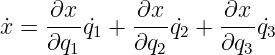
For the component velocity ẋ we have
and ẋ,ẏ,ż are explicit functions of q1,q2,q3,q1,q2,q3 linear and homogeneous in terms of
q1,q2,q3.
We may note in passing that it follows from this fact that ẋ2,ẏ2,ż2 are homogeneous quadratic
functions of q1,q2,q3.
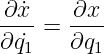
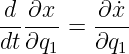
Obviously
and since
and
Let us now find an expression for the work δq1W done by the effective forces when
the coordinate q1 is changed by an infinitesimal amount δq1 without changing q2 or
q3. If δx,δy,δz are changes thus produced in x,y,z, obviously from the definition of
work
if expressed in rectangular coordinates. We need, however, to express δq1W in terms of our
coordinates q1,q2,q3.
Now
but from earlier definitions
Hence
and therefore
where
and is the kinetic energy of the particle.
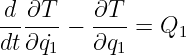
To get our differential equation we have only to write the second member of (1) equal to the work
done by the actual forces when q1 is changed by δq1.
If we represent the work in question by Q1δq1, our equation is
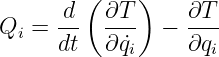
and of course we get such an equation for every coordinate. Even though we derived this
differential equation for a single particle in free motion, it is the same for a systems of particles,
except the kinetic energy is for all the particles in the system, which brings us to Lagrange’s
equations
In any concrete problem, T must be expressed in terms of q1,q2,q3, and their time derivatives
before we can form the expression for the work done by the effective forces. Q1δq1,Q2δq2,Q3δq3,
the work done by the actual forces, must be obtained from direct examination of the
problem.






![δq1W = m [¨xδx + ¨yδy + z¨δz]](https://images.physicslibrary.org/cache/objects/286/make4ht/GeneralizedCoordinatesForFreeMotion9x.png)
![[ ]
∂x ∂y ∂z
δq1W = m ¨x ∂q--+ ¨y∂q--+ ¨z ∂q-- δq1
1 1 1](https://images.physicslibrary.org/cache/objects/286/make4ht/GeneralizedCoordinatesForFreeMotion10x.png)



![[ ]
d ∂T ∂T
δq1W = dt∂-˙q-− ∂q-- δq1
1 1](https://images.physicslibrary.org/cache/objects/286/make4ht/GeneralizedCoordinatesForFreeMotion14x.png)
![m-[ 2 2 2]
T = 2 x˙ + y˙ + z˙](https://images.physicslibrary.org/cache/objects/286/make4ht/GeneralizedCoordinatesForFreeMotion15x.png)