0.1 General Results of the Theory
From Relativity: The Special and General Theory by Albert Einstein It is clear from our previous
considerations that the (special) theory of relativity has grown out of electrodynamics and optics.
In these fields it has not appreciably altered the predictions of theory, but it has considerably
simplified the theoretical structure, i.e. the derivation of laws, and—what is incomparably more
important—it has considerably reduced the number of independent hypothese forming the basis of
theory. The special theory of relativity has rendered the Maxwell-Lorentz theory so plausible, that
the latter would have been generally accepted by physicists even if experiment had decided less
unequivocally in its favour.
Classical Mechanics required to be modified before it could come into line with the demands of the
special theory of relativity. For the main part, however, this modification affects only the laws for
rapid motions, in which the velocities of matter v are not very small as compared with the velocity
of light. We have experience of such rapid motions only in the case of electrons and ions; for
other motions the variations from the laws of classical mechanics are too small to make
themselves evident in practice. We shall not consider the motion of stars until we come to
speak of the general theory of relativity. In accordance with the theory of relativity
the kinetic energy of a material point of mass m is no longer given by the well-known
expression
but by the expression
This expression approaches infinity as the velocity v approaches the velocity of light c. The velocity
must therefore always remain less than c, however great may be the energies used to produce the
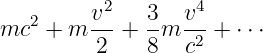
acceleration. If we develop the expression for the kinetic energy in the form of a series, we
obtain
When v2∕c2 is small compared with unity, the third of these terms is always small in comparison
with the second, which last is alone considered in classical mechanics. The first term mc2 does not
contain the velocity, and requires no consideration if we are only dealing with the question as to
how the energy of a point-mass; depends on the velocity. We shall speak of its essential significance
later.
The most important result of a general character to which the special theory of relativity has led is
concerned with the conception of mass. Before the advent of relativity, physics recognised two
conservation laws of fundamental importance, namely, the law of the canservation of energy and
the law of the conservation of mass these two fundamental laws appeared to be quite independent
of each other. By means of the theory of relativity they have been united into one law. We shall
now briefly consider how this unification came about, and what meaning is to be attached to
it.
The principle of relativity requires that the law of the concervation of energy should hold not only
with reference to a co-ordinate system K, but also with respect to every co-ordinate system K′
which is in a state of uniform motion of translation relative to K, or, briefly, relative
to every “Galileian” system of co-ordinates. In contrast to classical mechanics; The
Lorentz transformation is the deciding factor in the transition from one such system to
another.
By means of comparatively simple considerations we are led to draw the following conclusion from
these premises, in conjunction with the fundamental equations of the electrodynamics of Maxwell:
A body moving with the velocity v, which absorbs an amount of energy E0 in the form of
radiation without suffering an alteration in velocity in the process, has, as a consequence, its
energy increased by an amount
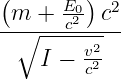
In consideration of the expression given above for the kinetic energy of the body, the required
energy of the body comes out to be
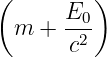
Thus the body has the same energy as a body of mass
moving with the velocity v. Hence we can say: If a body takes up an amount of energy E0, then its
inertial mass increases by an amount
the inertial mass of a body is not a constant but varies according to the change in the energy of
the body. The inertial mass of a system of bodies can even be regarded as a measure
of its energy. The law of the conservation of the mass of a system becomes identical
with the law of the conservation of energy, and is only valid provided that the system
neither takes up nor sends out energy. Writing the expression for the energy in the
form
we see that the term mc2, which has hitherto attracted our attention, is nothing else than the
energy possessed by the body before it absorbed the energy E0.
A direct comparison of this relation with experiment is not possible at the present time (1920; see
Note, p. 48), owing to the fact that the changes in energy E[0] to which we can Subject a system
are not large enough to make themselves perceptible as a change in the inertial mass of the
system.
is too small in comparison with the mass m, which was present before the alteration of the energy.
It is owing to this circumstance that classical mechanics was able to establish successfully the
conservation of mass as a law of independent validity.
Let me add a final remark of a fundamental nature. The success of the Faraday-Maxwell
interpretation of electromagnetic action at a distance resulted in physicists becoming convinced
that there are no such things as instantaneous actions at a distance (not involving an intermediary
medium) of the type of Newton’s law of gravitation. According to the theory of relativity, action at
a distance with the velocity of light always takes the place of instantaneous action at
a distance or of action at a distance with an infinite velocity of transmission. This is
connected with the fact that the velocity c plays a fundamental role in this theory. In
Part II we shall see in what way this result becomes modified in the general theory of
relativity.
0.2 References
This article is derived from the Einstein Reference Archive (marxists.org) 1999, 2002. Einstein
Reference Archive which is under the FDL copyright.

![[parent]](https://images.physicslibrary.org/images/uparrow.png)