
|
|
|
|||||||
At a lossless junction,
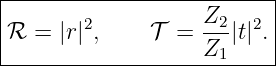
The power fractions are
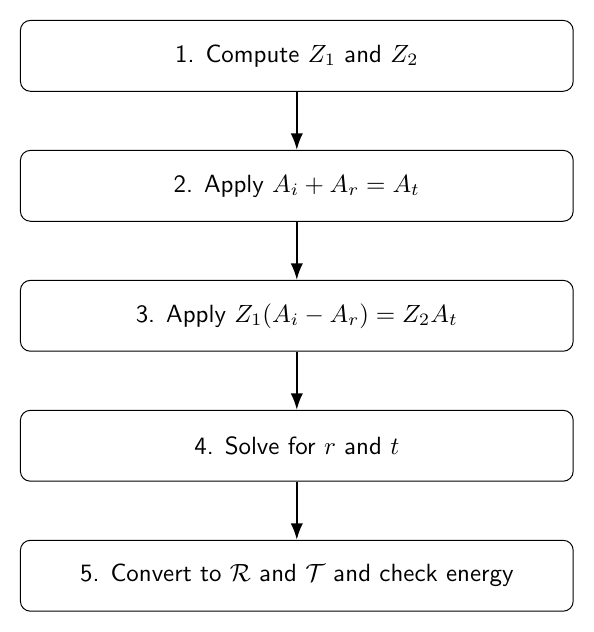
Figure 1. A compact interface strategy: compute each string impedance, apply displacement and transverse-force continuity, find amplitude coefficients, then convert amplitudes to power fractions.
1 High-value GRE facts
Part I: Original GRE-style problems
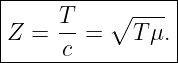
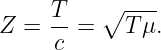
Problem 1: string impedanceFor an ideal string,
Problem 2: displacement continuityAt an ideal attached junction,
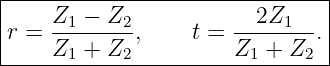
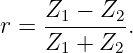
Problem 3: reflection amplitudeThe displacement reflection coefficient is
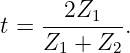
Problem 4: transmission amplitudeThe displacement transmission coefficient is
Problem 5: low-to-high impedance reflectionIf
the reflected displacement is
Problem 6: fixed endA perfectly fixed end has
Problem 7: free endA perfectly free end has
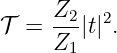
Problem 8: power transmissionThe transmitted power fraction is
Problem 9: matched stringsIf
then
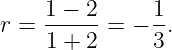
Problem 10: numerical reflectionIf
then
is
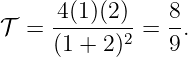
Problem 11: same interface powerFor the interface in Problem 10, the transmitted power fraction is
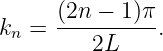
Problem 12: fixed-free resonanceA string fixed at one end and free at the other satisfies
Part II: Complete worked solutions
Solution 1For an ideal string,
Answer: (B).
Solution 2The attached junction has one displacement:
Answer: (B).
Solution 3Combining displacement and force continuity gives
Answer: (B).
Solution 4Since
Answer: (A).
Solution 5If
then
The reflected displacement is inverted. Answer: (A).
Solution 6A fixed end requires zero total displacement:
Thus
Answer: (B).
Solution 7A free end requires zero transverse force, which gives
Thus
Answer: (A).
Solution 8Power is proportional to
Therefore
Answer: (C).
Solution 9If
then
The interface is impedance matched. Answer: (C).
Solution 10
Answer: (A).
Solution 11
Answer: (D).
Solution 12A fixed reflection contributes phase
and a free reflection contributes zero displacement phase shift. The round-trip condition gives
Answer: (B).
2 GRE checklist
References
References
"GRE Physics Companion: Waves on Strings: Reflection, Transmission, and Mechanical Impedance" is owned by bloftin.
This object's parent. Cross-references: phase, displacement transmission coefficient, displacement reflection coefficient, impedance matching, force, amplitude, displacement, impedance, power This is version 1 of GRE Physics Companion: Waves on Strings: Reflection, Transmission, and Mechanical Impedance, born on 2026-10-18. Object id is 1505, canonical name is GREPhysicsCompanionWavesOnStringsReflectionTransmissionAndMechanicalImpedance. Accessed 8 times total. Classification:
|
|
|
|
Pending Errata and AddendaNone.
|
DiscussionNo messages.
|
Interact |
![[parent]](https://images.physicslibrary.org/images/uparrow.png)
 .
.
















 before deciding the reflection phase.