Physics Library
 An open source physics library
Encyclopedia | Forums | Docs | Random  

[parent] GRE Physics Companion: Supersonic Motion, Mach Cones, and Shock Waves

(Example)

GRE Physics Companion: Supersonic Motion, Mach Cones, and Shock Waves

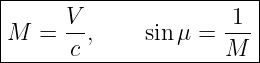
The key geometric relations are

|------------------------|
|M  =  V-,    sinμ =  1--|
-------c--------------M--|
(1)

for M > 1.

For a finite normal shock, conservation laws connect upstream and downstream states, while entropy increases.

PIC

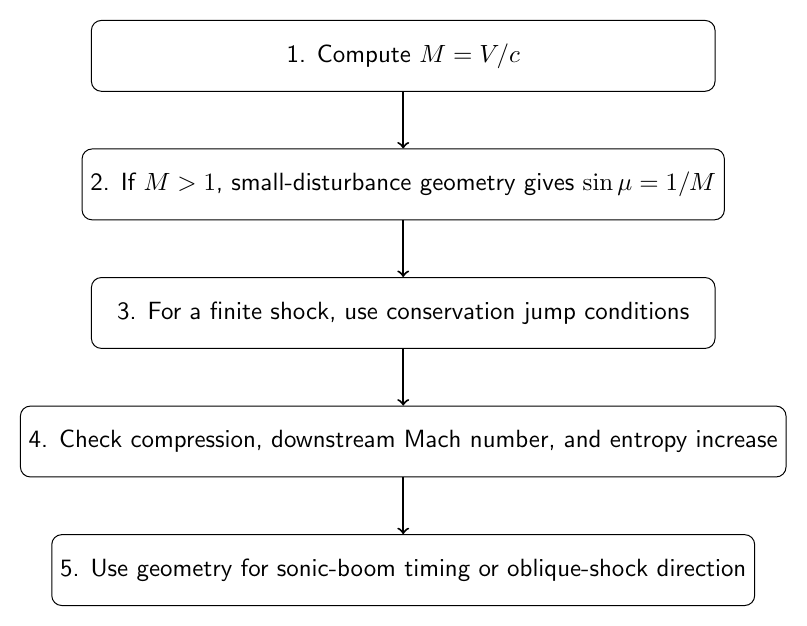
Figure 1. A compact strategy: compute Mach number first, use Mach-cone geometry for small disturbances, and switch to conservation jump conditions when a finite shock is present.

1 High-value GRE facts

  1. M = V∕c.
  2. Supersonic means M > 1.
  3. sin μ = 1∕M.
  4. Increasing Mach number narrows the Mach cone.
  5. A Mach wave is the infinitesimal disturbance limit, not automatically a finite shock.
  6. Across a compressive normal shock, pressure and density rise while Normal flow speed falls.
  7. A supersonic upstream normal flow becomes subsonic downstream.
  8. Entropy increases across a physical shock.
  9. Stagnation temperature is unchanged across an adiabatic no-work shock, but stagnation pressure decreases.
  10. A sonic boom occurs when the shock system passes an observer.

Part I: Original GRE-style problems

Problem 1: Mach number

An aircraft travels at 686 m∕s where c = 343 m∕s. Its Mach number is

  1. 0.5
  2. 1
  3. 2
  4. 3
  5. 4

Problem 2: Mach angle

For M = 2, the Mach angle is

  1. 15∘
  2. 30∘
  3. 45∘
  4. 60∘
  5. 90∘

Problem 3: higher Mach number

As Mach number increases well above one, the Mach angle

  1. increases toward 180∘
  2. increases toward 90∘
  3. remains fixed
  4. decreases
  5. becomes undefined

Problem 4: shock compression

Across a physical compressive normal shock in an ideal gas,

  1. pressure and density both decrease
  2. pressure rises and density decreases
  3. pressure and density both rise
  4. pressure is unchanged
  5. entropy decreases

Problem 5: downstream speed

mass conservation across a compressive normal shock implies

  1. u2 > u1
  2. u2 = u1
  3. u2 < u1
  4. u2 = 0 always
  5. no relation between the speeds

Problem 6: density ratio at Mach 2

For air with γ = 1.4 and M1 = 2, the density ratio is closest to

  1. 1.33
  2. 2.00
  3. 2.67
  4. 4.50
  5. 6.00

Problem 7: pressure ratio at Mach 2

For the same shock, the pressure ratio is closest to

  1. 1.69
  2. 2.67
  3. 3.00
  4. 4.50
  5. 6.00

Problem 8: downstream Mach number

For air with γ = 1.4 and M1 = 2, the downstream Mach number is closest to

  1. 0.29
  2. 0.58
  3. 1.00
  4. 1.73
  5. 2.00

Problem 9: entropy

Across a physical adiabatic shock,

  1. entropy decreases
  2. entropy is constant
  3. entropy increases
  4. temperature must decrease
  5. density must remain constant

Problem 10: sonic-boom distance

An aircraft at M = 2 flies horizontally at altitude 10.0 km. Approximately how far ahead of an observer is it when the ideal Mach cone reaches that observer?

  1. 5.0 km
  2. 10.0 km
  3. 17.3 km
  4. 20.0 km
  5. 34.6 km

Problem 11: sonic boom

A sonic boom from a steadily supersonic aircraft occurs

  1. only at the instant it first reaches Mach one
  2. only directly below the aircraft
  3. only while it accelerates
  4. when its shock system passes an observer
  5. only at Mach two

Problem 12: oblique shock

For an oblique shock with angle β, the upstream normal Mach number is

  1. M1 cos β
  2. M1 sin β
  3. M1 tan β
  4. M1∕ sin β
  5. M1

Part II: Complete worked solutions

Solution 1

     686
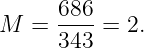
M  = 343-=  2.
(2)

Answer: (C).

Solution 2

       1-
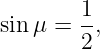
sin μ = 2 ,
(3)

so

      ∘
μ = 30 .
(4)

Answer: (B).

Solution 3

Since sin μ = 1∕M, increasing M decreases μ. Answer: (D).

Solution 4

A compressive normal shock raises pressure and density and increases entropy. Answer: (C).

Solution 5

From

ρ1u1 = ρ2u2,
(5)

and ρ2 > ρ1, it follows that u2 < u1. Answer: (C).

Solution 6

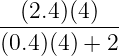
ρ2
---
ρ1 =   (2.4)(4)
------------
(0.4)(4) + 2 (6)
= 9.6
3.6 (7)
≈ 2.67. (8)

Answer: (C).

Solution 7

p2-
p
 1 = 1 + 2(1.4)
 2.4(4 − 1) (9)
= 4.50. (10)

Answer: (D).

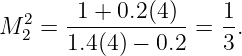
Solution 8

  2   -1-+-0.2(4)-   1-
M 2 = 1.4(4) − 0.2 = 3 .
(11)

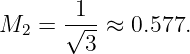
Therefore

        1
M2  =  √---≈ 0.577.
         3
(12)

Answer: (B).

Solution 9

A physical shock is irreversible:

s2 > s1.
(13)

Answer: (C).

Solution 10

At M = 2,

μ = 30∘.
(14)

Thus

x = h cotμ = 10.0 cot30∘ ≈ 17.3 km.
(15)

Answer: (C).

Solution 11

A supersonic aircraft continuously carries a shock system. The boom is heard when that shock structure passes the observer. Answer: (D).

Solution 12

The normal component is

M   =  M  sinβ.
  n1     1
(16)

Answer: (B).

2 GRE checklist

  1. Compute Mach number before selecting a supersonic relation.
  2. Use sin μ = 1∕M.
  3. Distinguish small-disturbance Mach waves from finite shocks.
  4. For a normal shock, expect compression, heating, deceleration, and entropy increase.
  5. Use the shock-fixed frame for jump conditions.
  6. Do not conserve stagnation pressure through an irreversible shock.
  7. Sonic-boom timing comes from cone geometry.
  8. For oblique shocks, apply normal-shock relations to the normal Mach component.

References

References

[1]   PhysicsLibrary, M06-14, Doppler Effect and Moving Sources and Observers.

[2]   J. D. Anderson, Modern Compressible Flow: With Historical Perspective, 3rd ed., McGraw-Hill, 2003.

[3]   H. W. Liepmann and A. Roshko, Elements of Gasdynamics, Wiley, 1957.


"GRE Physics Companion: Supersonic Motion, Mach Cones, and Shock Waves" is owned by bloftin.
(view preamble)
View style:
Other names:  M06-15G
Keywords:  GRE physics, Mach number, Mach cone, shock wave, normal shock, sonic boom, compressible flow

This object's parent.

Cross-references: shock-fixed frame, mass, Mach angle, system, sonic boom, temperature, speed, Normal, Mach wave, Mach cone, Mach number, entropy, normal shock, relations

This is version 1 of GRE Physics Companion: Supersonic Motion, Mach Cones, and Shock Waves, born on 2026-10-24.
Object id is 1532, canonical name is GREPhysicsCompanionSupersonicMotionMachConesAndShockWaves.
Accessed 9 times total.

Classification:
Physics Classification: 45.50.-j (Dynamics and kinematics of a particle and a system of particles)
 45.05.+x (General theory of classical mechanics of discrete systems)

Pending Errata and Addenda

None.

Discussion

No messages.

Interact