GRE Physics Companion: Friction
Timed Friction problems are usually won or lost before the algebra begins. The key questions are:
Is there relative sliding? What is the Normal force? Which way would the surfaces tend to slip? If
the contact is static, what friction force is actually required?
1 Fast friction triage
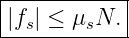
For static contact,
Do not automatically set fs = μsN. Solve for the friction required by the no-slip assumption, then
check whether the required value is available.
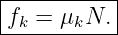
For sliding contact,
The friction direction is opposite relative sliding at the contact.
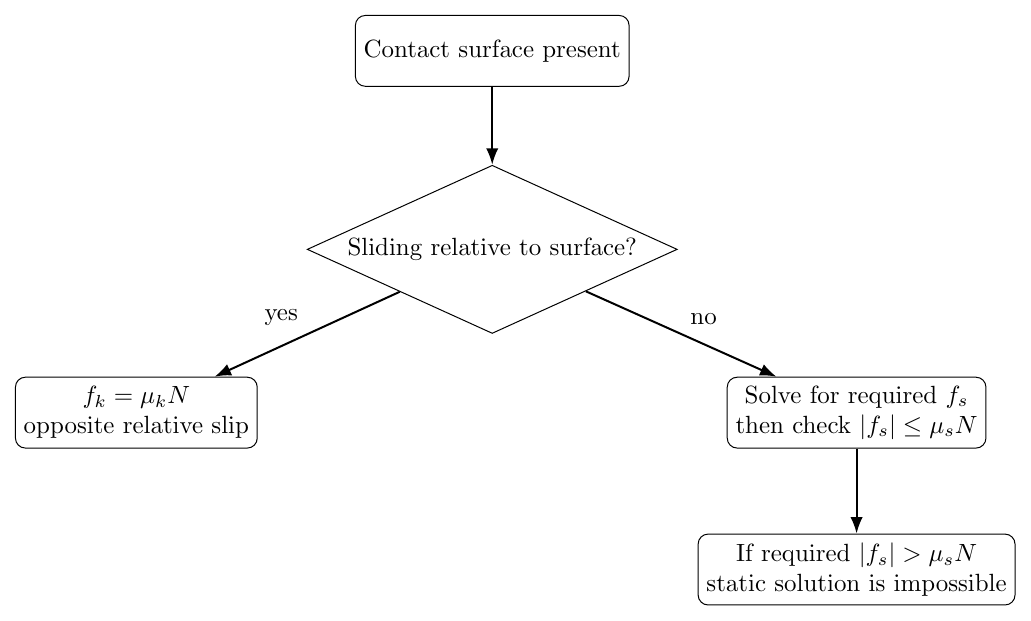
Figure 1. GRE friction triage. Static friction is solved as an unknown and checked against μsN;
kinetic friction is used only when sliding occurs.
2 The graph to recognize
For a horizontal block subject to an increasing horizontal force, static friction tracks the applied
force while the block remains at rest. At impending slip,
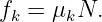
After sliding begins, the elementary model uses
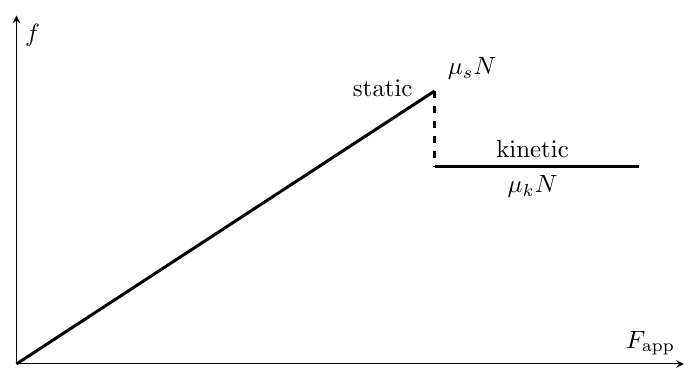
Figure 2. Schematic static-to-kinetic friction transition. The static force is not constant; it adjusts
up to its maximum value.
3 Useful incline results
For a simple block on an incline,
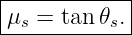
The threshold for impending downhill slip is
so
If the block slides downhill,
4 Worked GRE example 1: is the block actually moving?
A 10.0 kg block rests on a horizontal floor with μs = 0.30 and μk = 0.20. A horizontal force of 25.0
N is applied. Find the friction force and acceleration.
The maximum static friction is
Only 25.0 N is required to maintain equilibrium, so
The kinetic coefficient is irrelevant because the block never starts sliding.
5 Worked GRE example 2: angle of repose shortcut
A block just begins to slide when a board is tilted to 30.0∘. Estimate the coefficient of static
friction.
At impending slip,
Therefore
No mass information is needed.
6 GRE speed questions
- A block is at rest on a horizontal surface. A 12 N horizontal force is applied, and the
block remains at rest. The static friction magnitude is (A) 0 (B) less than 12 N (C) 12
N (D) μsN regardless of μs.
- A 4.00 kg block slides on a horizontal surface with μk = 0.25. The kinetic friction
magnitude is closest to (A) 1.0 N (B) 4.0 N (C) 9.8 N (D) 39 N.
- A horizontal block is pulled upward at an angle while maintaining contact with the
floor. Compared with a purely horizontal pull of the same magnitude, the normal force
is (A) larger (B) smaller (C) unchanged (D) zero.
- A block just begins to slide down an incline at angle 𝜃. In the elementary dry friction
model, μs equals (A) sin 𝜃 (B) cos 𝜃 (C) tan 𝜃 (D) 1∕ tan 𝜃.
- Two blocks of masses m and 2m slide down the same incline with the same μk. Their
accelerations are (A) equal (B) in the ratio 1 : 2 (C) in the ratio 2 : 1 (D) impossible
to compare.
- A box initially at rest is placed on a conveyor belt moving right. While the belt slips
under the box, friction on the box points (A) left (B) right (C) upward (D) zero.
- A block on an incline is held at rest by a strong force directed uphill. Static friction
(A) must always point uphill (B) can point downhill (C) must be zero (D) must equal
μsN.
7 Answers and rationales
- C. Static friction supplies exactly the 12 N needed for equilibrium, provided this is
below its maximum value.
- C. fk = μkmg = (0.25)(4.00)(9.81) = 9.81 N.
- B. The upward component of the pull reduces the normal force.
- C. At impending downhill slip, mg sin 𝜃 = μsmg cos 𝜃.
- A. The mass cancels from a = g(sin 𝜃 − μk cos 𝜃).
- B. The belt slips right relative to the box, so friction on the box acts right and
accelerates it.
- B. Static friction opposes the tendency to slip, which can be uphill if the external force
is sufficiently strong.
References
[1] PhysicsLibrary, M02-07, Friction.
[2] PhysicsLibrary, M02-02, Free Body Diagrams.
[3] J. Moore et al., Mechanics Map, CC BY-SA 4.0.

![[parent]](https://images.physicslibrary.org/images/uparrow.png)