GRE Physics Companion: Cylindrical and Spherical Particle Kinematics
This companion focuses on fast recognition rather than full derivation. For most test problems,
first identify the geometry and then use the physically scaled velocity components rather than the
raw coordinate rates.
1 Fast coordinate triage
For cylindrical coordinates,
For the spherical convention used in M01-11,
The scale factors ρ, r, and r sin 𝜃 are the main quantities students most often omit under time
pressure.
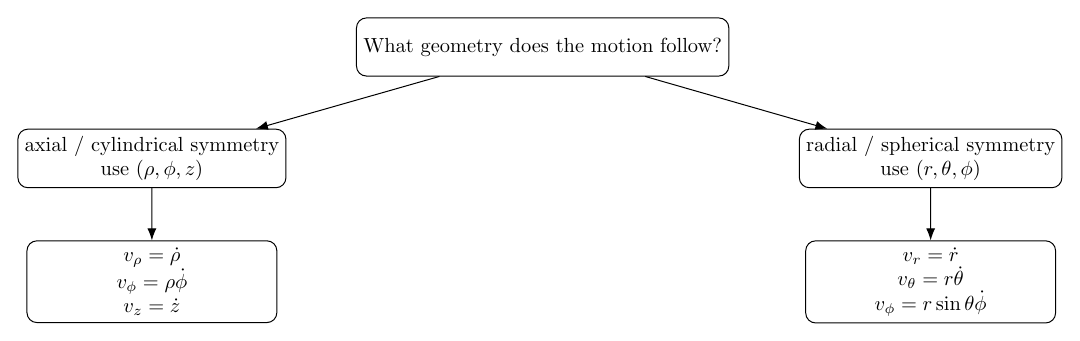
Figure 1. Fast coordinate selection and velocity-component recall for cylindrical and spherical
kinematics.
2 Common traps
Cylindrical and spherical basis vectors are not generally fixed. Angular motion rotates them even
when the coordinate magnitudes are constant.
In spherical coordinates, always confirm the angle convention. Here 𝜃 is measured from +z and ϕ is
the azimuth.
The raw rate dϕ∕dt has units of inverse time; the physical azimuthal speed is ρ(dϕ∕dt) in
cylindrical coordinates and r sin 𝜃(dϕ∕dt) in spherical coordinates.
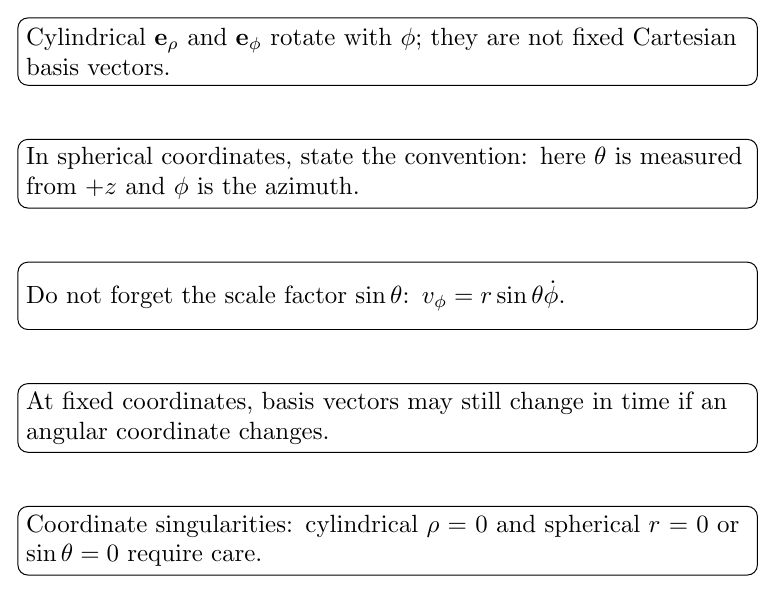
Figure 2. Common coordinate-kinematics traps: rotating bases, angle conventions, missing scale
factors, and coordinate singularities.
3 Worked GRE example 1: cylindrical circular motion
A particle moves with constant cylindrical coordinates
while
is constant. Find its speed and acceleration magnitude.
The speed is
The only nonzero acceleration component is
Therefore
This is ordinary uniform circular motion written in cylindrical coordinates.
4 Worked GRE example 2: spherical equatorial motion
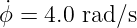
A particle has
with all other coordinate rates zero.
Because sin 90∘ = 1,
The radial acceleration is
and a𝜃 = aϕ = 0. The motion is a circle of radius 3.0 m in the equatorial plane.
5 GRE-speed questions
- In cylindrical coordinates a particle has ρ = 4 m and dϕ∕dt = 3 rad/s with
dρ∕dt = dz∕dt = 0. Its speed is (A) 3 (B) 4 (C) 7 (D) 12 m/s.
- In spherical coordinates using the convention of M01-11, the physical azimuthal speed
is (A) dϕ∕dt (B) r(dϕ∕dt) (C) r sin 𝜃(dϕ∕dt) (D) r cos 𝜃(dϕ∕dt).
- A particle has fixed ρ and fixed z with constant dϕ∕dt = ω. Its radial acceleration is
(A) 0 (B) +ρω2 (C) −ρω2 (D) 2ρω.
- Which statement is true? (A) eρ is fixed in an inertial Cartesian frame. (B) eϕ changes
whenever ϕ changes. (C) ez rotates with ϕ. (D) Spherical er is independent of angle.
6 Answers and rationales
- D. vϕ = ρ(dϕ∕dt) = (4)(3) = 12 m/s.
- C. The radius of the azimuthal circle is r sin 𝜃.
- C. Constant-radius circular motion has inward acceleration −ρω2e
ρ.
- B. The cylindrical radial and azimuthal unit vectors rotate with the azimuthal
coordinate.
References
[1] PhysicsLibrary, M01-11, Cylindrical and Spherical Particle Kinematics.
[2] PhysicsLibrary, M01-10, Polar-Coordinate Particle Kinematics.

![[parent]](https://images.physicslibrary.org/images/uparrow.png)