
|
|
|
|||||||
The antiderivative is −1∕ Check. The near-side field is positive and the far-side result contains the total disk charge. Reflection reverses Ez below the disk.
3 Practice variationAt what positive z is the field half its immediate above-surface value? Solution.
Set the bracket to 1∕2. This gives z∕
4 Track the annulus measure and both limitsThe surface charge density σ is signed charge per unit area. For a uniformly charged disk the
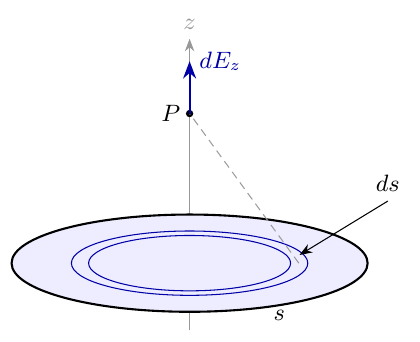
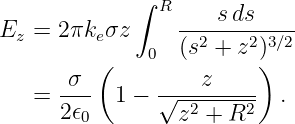
annulus measure gives dq = 2πσsds. In the field integral put u = s2 + z2, so sds = du∕2 and the
new limits are z2 and R2 + z2. Its primitive is − The infinite-sheet limit takes R →∞ while holding z≠0 and σ fixed. It holds charge per area fixed, so total charge diverges. By contrast, the distant-point limit keeps R and total charge fixed. For x = R2∕z2 ≪ 1 on the positive side, the expansion is
The first relative correction to the point-charge field is −3R2∕(4z2).
5 Worked example 2: derive the potentialFor a finite disk choose zero potential at infinity. The ring potential contributes dV = ke dq∕
The potential is continuous at zero. Its derivative away from zero reproduces the signed field. At fixed z, the potential itself diverges in the infinite-sheet limit with this reference. Differences between finite heights remain finite after the common leading 2πkeσR cancels.
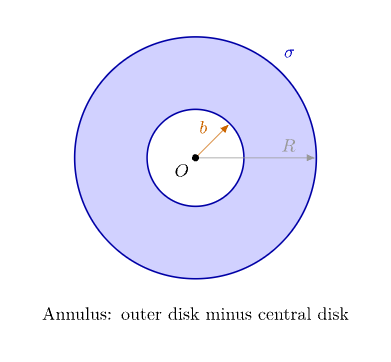
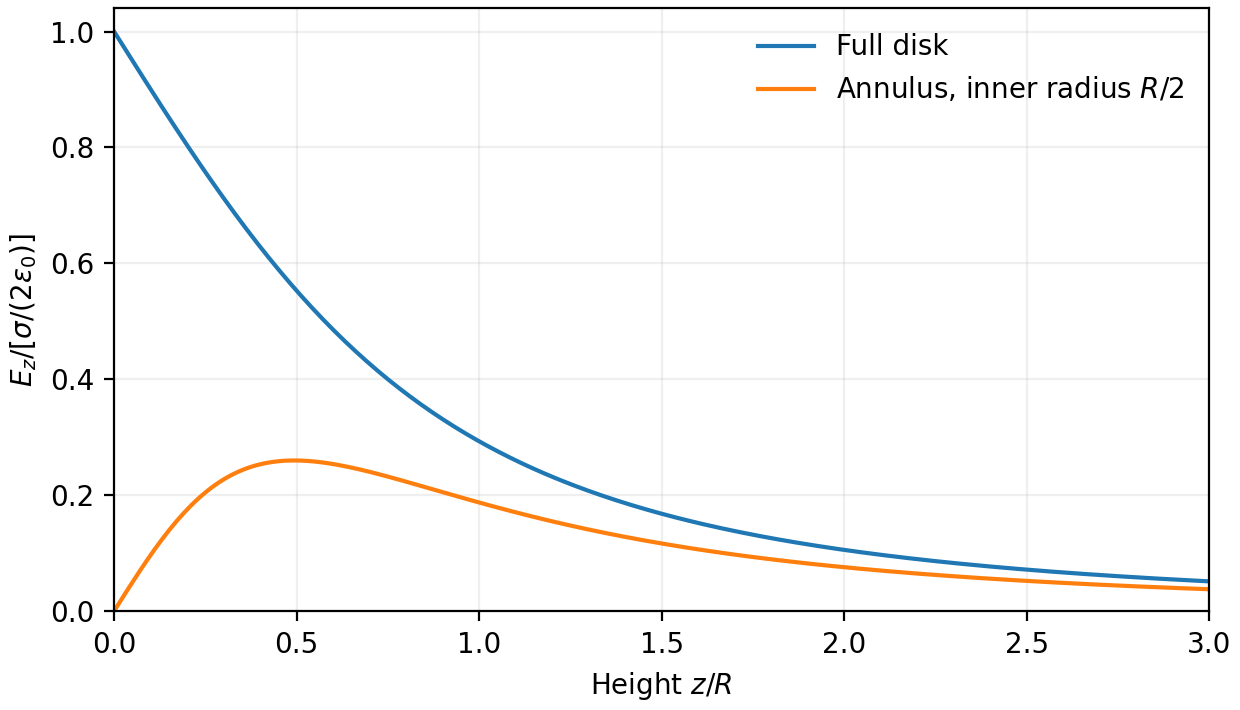
Figure 2. A uniform annulus is represented by subtracting a smaller disk from a larger disk with the same positive surface charge density.
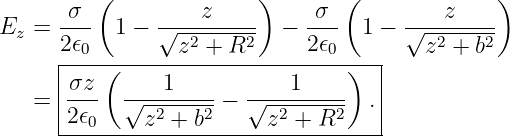
6 Worked example 3: a uniformly charged annulusA disk with a circular hole of radius b and outer radius R (0 < b < R) has uniform density σ > 0. Regard it as a positive disk of radius R minus a positive disk of radius b. For z > 0, superposition yields
The field vanishes at the center of the hole, z = 0, because the charged material never approaches the axis closer than b. For positive z it points upward. Far from the annulus, the total charge is Q = πσ(R2 − b2), so E z ≃ keQ∕z2.
7 Worked example 4: disk with charge increasing radiallyLet the surface charge density vary as
where s is the source-ring radius. The total charge is
For an axial observer at z > 0, the ring contribution gives
Write s2 = (s2 + z2) − z2. The integral becomes
Both terms vanish at s = 0, so the final field is
At z ≫ R, the bracket is R3∕(3z3) +
Figure 3. Normalized fields of a full disk and an annulus with inner radius R∕2. The annular field vanishes at the center of its hole, while the full disk has a nonzero one-sided field there.
8 Worked example 5: compare two different infinite-radius limitsThere are two physically distinct ways to let the disk radius R grow. In the first, hold σ fixed. Total charge Q = πR2σ then grows without bound, and the fixed-height field approaches σ∕(2𝜖0). In the second, hold the total charge Q fixed. Then σ = Q∕(πR2) falls as R−2, so
The geometry is similar, but the amount of charge in the limiting process is not. A physically meaningful limit must specify which parameters remain fixed.
9 ExercisesExercise 1. Take the field immediately below the disk center and compare to the field immediately above. Solution. The one-sided values are −σ∕(2𝜖0) and +σ∕(2𝜖0), respectively. Their difference in the +z Normal direction is σ∕𝜖0. Exercise 2. Take R →∞ while holding total charge Q fixed at positive z. Solution. Now σ = Q∕(πR2) falls to zero. The parenthetical factor tends to one, so the field tends to zero, unlike the fixed-density limit.
10 Further exercises and complete solutions
References
References
"From a Charged Disk to an Infinite Sheet" is owned by bloftin.
This object's parent. Cross-references: Normal, parameters, superposition, unit, charge, surface charge density This is version 1 of From a Charged Disk to an Infinite Sheet, born on 2026-11-27. Object id is 1615, canonical name is FromAChargedDiskToAnInfiniteSheet. Accessed 9 times total. Classification:
|
|
|
|
Pending Errata and AddendaNone.
|
DiscussionNo messages.
|
Interact |

 , and the lower limit gives 1

 = 1
 .
 (2)

 .
Using the same substitution but exponent






 ; therefore

 . After multiplying
by