We can use Bohr’s model of the atom to understand how spectral lines are formed. The concept of
energy levels for the electron orbits in an atom leads naturally to an explanation of why atoms
absorb or emit only specific energies or wavelengths of light.
The Hydrogen Spectrum
Let’s look at the hydrogen atom from the perspective of the Bohr model. Suppose a beam of white
light (which consists of photons of all visible wavelengths) shines through a gas of atomic
hydrogen. A photon of wavelength 656 nanometers has just the right energy to raise an electron in
a hydrogen atom from the second to the third orbit. Thus, as all the photons of different energies
(or wavelengths or colors) stream by the hydrogen atoms, photons with this particular wavelength
can be absorbed by those atoms whose electrons are orbiting on the second level. When they are
absorbed, the electrons on the second level will move to the third level, and a number of the
photons of this wavelength and energy will be missing from the general stream of white
light.
Other photons will have the right energies to raise electrons from the second to the fourth orbit, or
from the first to the fifth orbit, and so on. Only photons with these exact energies can be absorbed.
All of the other photons will stream past the atoms untouched. Thus, hydrogen atoms absorb light
at only certain wavelengths and produce dark lines at those wavelengths in the spectrum we
see.
Suppose we have a container of hydrogen gas through which a whole series of photons is passing,
allowing many electrons to move up to higher levels. When we turn off the light source, these
electrons “fall” back down from larger to smaller orbits and emit photons of light—but, again, only
light of those energies or wavelengths that correspond to the energy difference between permissible
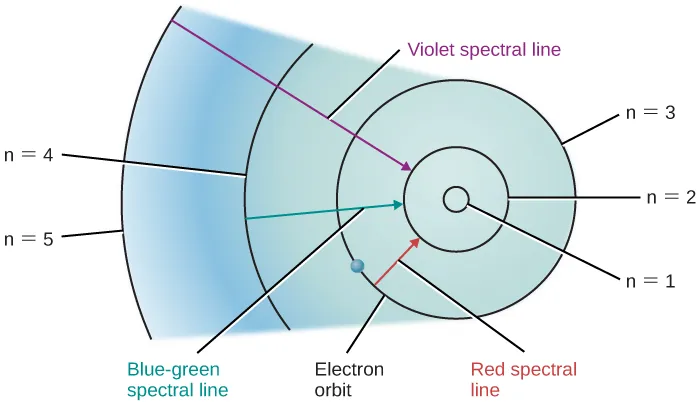
orbits. The orbital changes of hydrogen electrons that give rise to some spectral lines are shown in
Figure 5.19.
Figure 5.19 Bohr Model for Hydrogen. In this simplified model of a hydrogen atom, the concentric
circles shown represent permitted orbits or energy levels. An electron in a hydrogen atom can only
exist in one of these energy levels (or states). The closer the electron is to the nucleus, the
more tightly bound the electron is to the nucleus. By absorbing energy, the electron can
move to energy levels farther from the nucleus (and even escape if enough energy is
absorbed).
Similar pictures can be drawn for atoms other than hydrogen. However, because these other
atoms ordinarily have more than one electron each, the orbits of their electrons are much
more complicated, and the spectra are more complex as well. For our purposes, the key
conclusion is this: each type of atom has its own unique pattern of electron orbits, and no
two sets of orbits are exactly alike. This means that each type of atom shows its own
unique set of spectral lines, produced by electrons moving between its unique set of
orbits.
Astronomers and physicists have worked hard to learn the lines that go with each element by
studying the way atoms absorb and emit light in laboratories here on Earth. Then they can use
this knowledge to identify the elements in celestial bodies. In this way, we now know the chemical
makeup of not just any star, but even galaxies of stars so distant that their light started on its way
to us long before Earth had even formed.
Energy Levels and Excitation
Bohr’s model of the hydrogen atom was a great step forward in our understanding of the atom.
However, we know today that atoms cannot be represented by quite so simple a picture. For
example, the concept of sharply defined electron orbits is not really correct; however, at the level of
this introductory course, the notion that only certain discrete energies are allowable for an
atom is very useful. The energy levels we have been discussing can be thought of as
representing certain average distances of the electron’s possible orbits from the atomic
nucleus.
Ordinarily, an atom is in the state of lowest possible energy, its ground state. In the Bohr
model of the hydrogen atom, the ground state corresponds to the electron being in the
innermost orbit. An atom can absorb energy, which raises it to a higher energy level
(corresponding, in the simple Bohr picture, to an electron’s movement to a larger orbit)—this is
referred to as excitation. The atom is then said to be in an excited state. Generally,
an atom remains excited for only a very brief time. After a short interval, typically a
hundred-millionth of a second or so, it drops back spontaneously to its ground state, with the
simultaneous emission of light. The atom may return to its lowest state in one jump, or
it may make the transition in steps of two or more jumps, stopping at intermediate
levels on the way down. With each jump, it emits a photon of the wavelength that
corresponds to the energy difference between the levels at the beginning and end of that
jump.
An energy-level diagram for a hydrogen atom and several possible atomic transitions are shown in
Figure 5.20. When we measure the energies involved as the atom jumps between levels, we find
that the transitions to or from the ground state, called the Lyman series of lines, result in the
emission or absorption of ultraviolet photons. But the transitions to or from the first excited state
(labeled n = 2 in part (a) of Figure 5.20), called the Balmer series, produce emission or absorption
in visible light. In fact, it was to explain this Balmer series that Bohr first suggested his model of
the atom.
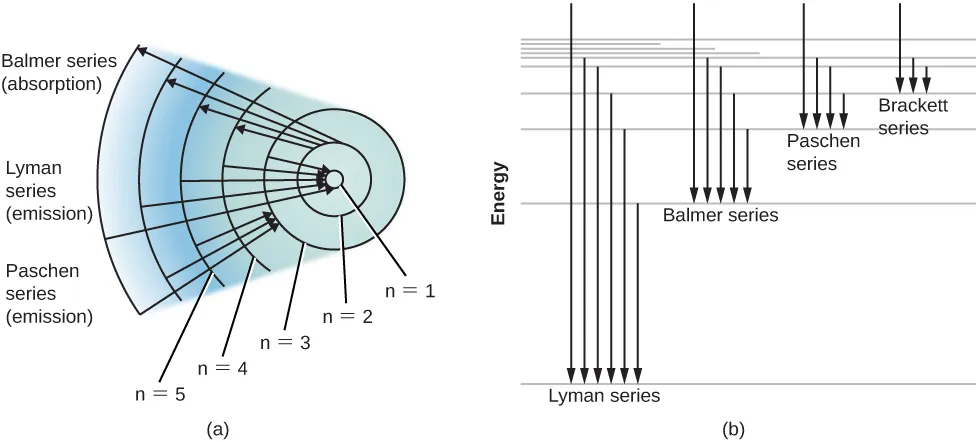
Figure 5.20 Energy-Level Diagrams for Hydrogen. (a) Here we follow the emission or absorption of
photons by a hydrogen atom according to the Bohr model. Several different series of spectral lines
are shown, corresponding to transitions of electrons from or to certain allowed orbits. Each series of
lines that terminates on a specific inner orbit is named for the physicist who studied it. At the top,
for example, you see the Balmer series, and arrows show electrons jumping from the second orbit
(n = 2) to the third, fourth, fifth, and sixth orbits. Each time a “poor” electron from a lower level
wants to rise to a higher position in life, it must absorb energy to do so. It can absorb
the energy it needs from passing waves (or photons) of light. The next set of arrows
(Lyman series) show electrons falling down to the first orbit from different (higher)
levels. Each time a “rich” electron goes downward toward the nucleus, it can afford to
give off (emit) some energy it no longer needs. (In this idealized diagram, the energy
levels are shown equally spaced; in real life, they are not.) (b) At higher and higher
energy levels, the levels become more and more crowded together, approaching a limit.
The region above the top line represents energies at which the atom is ionized (the
electron is no longer attached to the atom). Each series of arrows represents electrons
falling from higher levels to lower ones, releasing photons or waves of energy in the
process.
Atoms that have absorbed specific photons from a passing beam of white light and
have thus become excited generally de-excite themselves and emit that light again in a
very short time. You might wonder, then, why dark spectral lines are ever produced. In
other words, why doesn’t this reemitted light quickly “fill in” the darker absorption
lines?
Imagine a beam of white light coming toward you through some cooler gas. Some of the
reemitted light is actually returned to the beam of white light you see, but this fills in the
absorption lines only to a slight extent. The reason is that the atoms in the gas reemit light
in all directions, and only a small fraction of the reemitted light is in the direction of
the original beam (toward you). In a star, much of the reemitted light actually goes in
directions leading back into the star, which does observers outside the star no good
whatsoever.
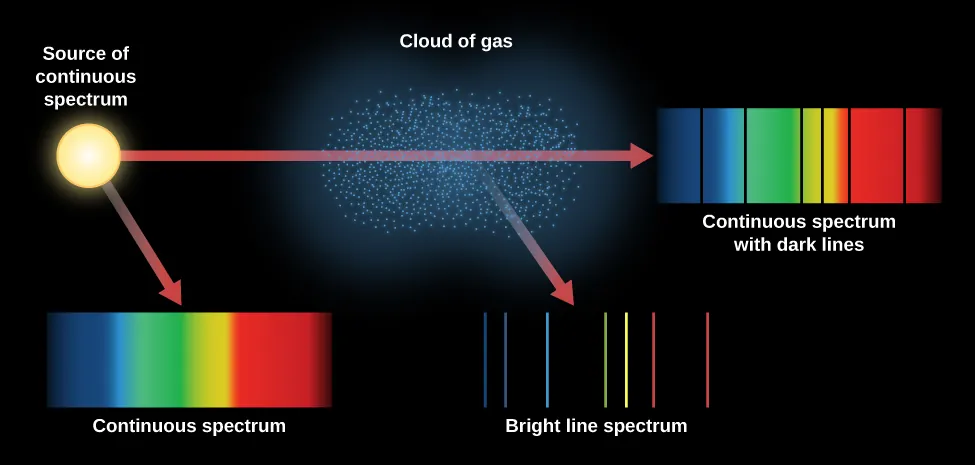
Figure 5.21 summarizes the different kinds of spectra we have discussed. An incandescent
lightbulb produces a continuous spectrum. When that continuous spectrum is viewed
through a thinner cloud of gas, an absorption line spectrum can be seen superimposed
on the continuous spectrum. If we look only at a cloud of excited gas atoms (with no
continuous source seen behind it), we see that the excited atoms give off an emission line
spectrum.
Figure 5.21 Three Kinds of Spectra. When we see a lightbulb or other source of continuous
radiation, all the colors are present. When the continuous spectrum is seen through a thinner gas
cloud, the cloud’s atoms produce absorption lines in the continuous spectrum. When the excited
cloud is seen without the continuous source behind it, its atoms produce emission lines. We can
learn which types of atoms are in the gas cloud from the pattern of absorption or emission
lines.
Atoms in a hot gas are moving at high speeds and continually colliding with one another and with
any loose electrons. They can be excited (electrons moving to a higher level) and de-excited
(electrons moving to a lower level) by these collisions as well as by absorbing and emitting light.
The speed of atoms in a gas depends on the temperature. When the temperature is higher, so are
the speed and energy of the collisions. The hotter the gas, therefore, the more likely
that electrons will occupy the outermost orbits, which correspond to the highest energy
levels. This means that the level where electrons start their upward jumps in a gas
can serve as an indicator of how hot that gas is. In this way, the absorption lines in a
spectrum give astronomers information about the temperature of the regions where the lines
originate.
Link to Learning
Use this simulation to play with a hydrogen atom and see what happens when electrons move to
higher levels and then give off photons as they go to a lower level.
https://openstax.org/l/30Hatom
Ionization
We have described how certain discrete amounts of energy can be absorbed by an atom, raising it
to an excited state and moving one of its electrons farther from its nucleus. If enough
energy is absorbed, the electron can be completely removed from the atom—this is
called ionization. The atom is then said to be ionized. The minimum amount of energy
required to remove one electron from an atom in its ground state is called its ionization
energy.
Still-greater amounts of energy must be absorbed by the now-ionized atom (called an ion) to
remove an additional electron deeper in the structure of the atom. Successively greater energies are
needed to remove the third, fourth, fifth—and so on—electrons from the atom. If enough
energy is available, an atom can become completely ionized, losing all of its electrons. A
hydrogen atom, having only one electron to lose, can be ionized only once; a helium
atom can be ionized twice; and an oxygen atom up to eight times. When we examine
regions of the cosmos where there is a great deal of energetic radiation, such as the
neighborhoods where hot young stars have recently formed, we see a lot of ionization going
on.
An atom that has become positively ionized has lost a negative charge—the missing electron—and
thus is left with a net positive charge. It therefore exerts a strong attraction on any free electron.
Eventually, one or more electrons will be captured and the atom will become neutral (or ionized to
one less degree) again. During the electron-capture process, the atom emits one or more photons.
Which photons are emitted depends on whether the electron is captured at once to the lowest
energy level of the atom or stops at one or more intermediate levels on its way to the lowest
available level.
Just as the excitation of an atom can result from a collision with another atom, ion, or
electron (collisions with electrons are usually most important), so can ionization. The rate
at which such collisional ionizations occur depends on the speeds of the atoms and
hence on the temperature of the gas—the hotter the gas, the more of its atoms will be
ionized.
The rate at which ions and electrons recombine also depends on their relative speeds—that is, on
the temperature. In addition, it depends on the density of the gas: the higher the density, the
greater the chance for recapture, because the different kinds of particles are crowded more closely
together. From a knowledge of the temperature and density of a gas, it is possible to calculate the
fraction of atoms that have been ionized once, twice, and so on. In the Sun, for example,
we find that most of the hydrogen and helium atoms in its atmosphere are neutral,
whereas most of the calcium atoms, as well as many other heavier atoms, are ionized
once.
The energy levels of an ionized atom are entirely different from those of the same atom when it is
neutral. Each time an electron is removed from the atom, the energy levels of the ion, and thus the
wavelengths of the spectral lines it can produce, change. This helps astronomers differentiate the
ions of a given element. Ionized hydrogen, having no electron, can produce no absorption
lines.
Bibliography
This article is a derivative work of the Creative Commons source in [1].
[1] Andrew Fraknoi, David Morrison, and Sidney Wolff, “5.5 Formation of Spectral Lines,” in
Astronomy 2e. Houston, Texas: OpenStax, 2022. Licensed CC BY 4.0 in the original 2022 release
(https://creativecommons.org/licenses/by/4.0/). Changes: converted to LaTeX for PhysicsLibrary.
Access for free at https://openstax.org/books/astronomy-2e/pages/1-introduction. Section source:
https://openstax.org/books/astronomy-2e/pages/5-5-formation-of-spectral-lines.