Physics Library
 An open source physics library
Encyclopedia | Forums | Docs | Random |  
Login
create new user
Username:
Password:
forget your password?
Main Menu
Sections

Meta

Talkback

Downloads

Information
[parent] example of Wave Mechanics: Average Power of a Sinusoidal Wave (Example)
Wave Mechanics Examples: Average Power of a Sinusoidal Wave

This companion article provides exercises for WM20, wave mechanics: Average power of a Sinusoidal Wave. All exercises are stated first. Complete worked solutions follow in Part II.

For a right-moving sinusoidal transverse wave

u(x,t) = A cos(kx − ωt + ϕ),
(1)

WM20 obtained the instantaneous power

P(x, t) = T A2k ω sin2(kx − ωt + ϕ )
(2)

and the cycle average

|------------------------------------------|
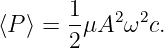
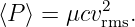
|⟨P ⟩ = 1T A2k ω = 1-μA2 ω2c = 2π2μA2f  2c.|
--------2----------2-----------------------|
(3)

The same lesson also established

|------------|
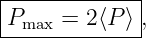
P    =  2⟨P ⟩,
--max---------
(4)

|-----------|
|       A ω |
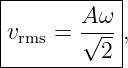
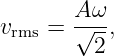
|vrms = √---,
----------2-
(5)

|-------------|
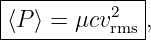
|⟨P ⟩ = μcv2rms,
--------------
(6)

and

|------------|
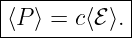
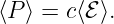
|⟨P ⟩ = c⟨ℰ ⟩.
-------------
(7)

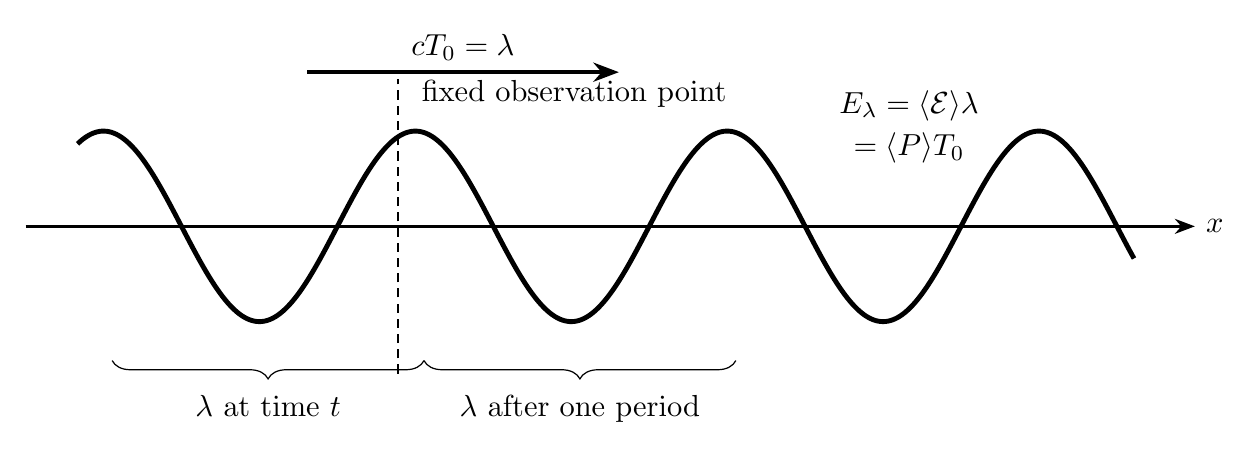
For a steady sinusoidal traveling wave, the energy in one wavelength satisfies

|------------|
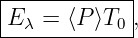
|Eλ = ⟨P ⟩T0 ,
-------------
(8)

because one wavelength passes a fixed point in one period [123].

How to use this problem set

Attempt all exercises in Part I before consulting Part II. Keep the following distinctions explicit:

  • instantaneous power versus cycle-averaged power,
  • peak power versus average power,
  • signed power versus the positive magnitude commonly called “power carried,”
  • scaling at fixed string properties versus changing the string itself.

Part I: Exercises

Exercise 1: Derive the one-half factor

Starting from

         ∫
      -1-  t0+T0    2     2
⟨P ⟩ = T0        T A  kω sin (kx − ωt + ϕ )dt,
          t0
(9)

show that

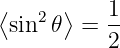
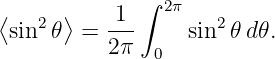
⟨     ⟩   1
 sin2 𝜃  = --
          2
(10)

over one complete cycle, and hence derive

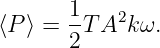
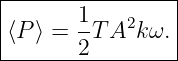
⟨P⟩ =  1T A2kω.
       2
(11)

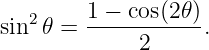
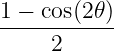
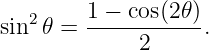
Use

        1 − cos(2𝜃)
sin2 𝜃 = -----------.
             2
(12)

The following figure gives a geometric interpretation of the same average.

PIC

Figure. The mean value of sin 2𝜃 over one full phase cycle is 12.

Exercise 2: Average and peak power from string data

A right-moving sinusoidal wave has

A =  5.0 mm,      f = 18 Hz,
(13)

on a string with

μ = 0.015kg/m,      T =  54N.
(14)

Find:

  1. the wave speed c,
  2. the angular frequency ω,
  3. the average power,
  4. the peak instantaneous power.

Exercise 3: Use the TA2form

A right-moving sinusoidal wave has

A  = 2.5mm,       k = 6.0rad/m,      ω = 180 rad/s,
(15)

and the string Tension is

T = 72 N.
(16)

Find the average power and the peak instantaneous power.

Exercise 4: Square-law scaling

For a fixed string, a sinusoidal wave initially carries average power P0. The amplitude changes from A0 to 1.40A0 and the frequency changes from f0 to 0.75f0.

  1. Find Pnew∕P0.
  2. Does the average power increase or decrease?
  3. By what factor would the power change if both amplitude and frequency doubled instead?

Use the figure below as a reminder of the square-law dependence.

PIC

Figure. At fixed string properties, average power is quadratic in both amplitude and frequency.

Exercise 5: Required amplitude

A string has

μ = 0.010 kg/m,     c = 90 m/s.
(17)

A sinusoidal wave of frequency

f = 30 Hz
(18)

must carry an average power of

⟨P ⟩ = 2.0W.
(19)

Find the required displacement amplitude A.

Exercise 6: Infer frequency from measured average power

A traveling sinusoidal wave has

A  = 3.0mm,      μ =  0.020 kg/m,      c = 60 m/s,
(20)

and carries average power

⟨P⟩ = 0.96 W.
(21)

Find its ordinary frequency f.

Exercise 7: RMS transverse velocity

At a fixed point on a sinusoidal traveling wave, the RMS transverse material velocity is

vrms =  0.42 m/s.
(22)

The string has

μ = 0.018 kg/m,     c = 75 m/s.
(23)

  1. Find the average power.
  2. If the ordinary frequency is 22 Hz, find the displacement amplitude A.

Exercise 8: Average energy density and energy per wavelength

A sinusoidal traveling wave has

⟨ℰ⟩ = 0.24 J/m,     c = 50 m/s,     λ = 1.25 m.
(24)

Find:

  1. the average power,
  2. the period,
  3. the energy in one wavelength,
  4. the energy crossing a fixed point during one period.

PIC

Figure. One wavelength moves a distance λ = cT0 in one period, so the energy in one wavelength crosses a fixed point in one period.

Exercise 9: Spatial average versus temporal average

At a fixed time, the power of a right-moving sinusoidal wave is

P (x) = Pmax sin2(kx +  δ).
(25)

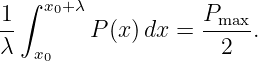
Show directly that averaging over one wavelength gives

  ∫
1-   x0+λ            Pmax-
λ        P (x)dx =   2   .
    x0
(26)

Explain why this is equal to the time average over one period.

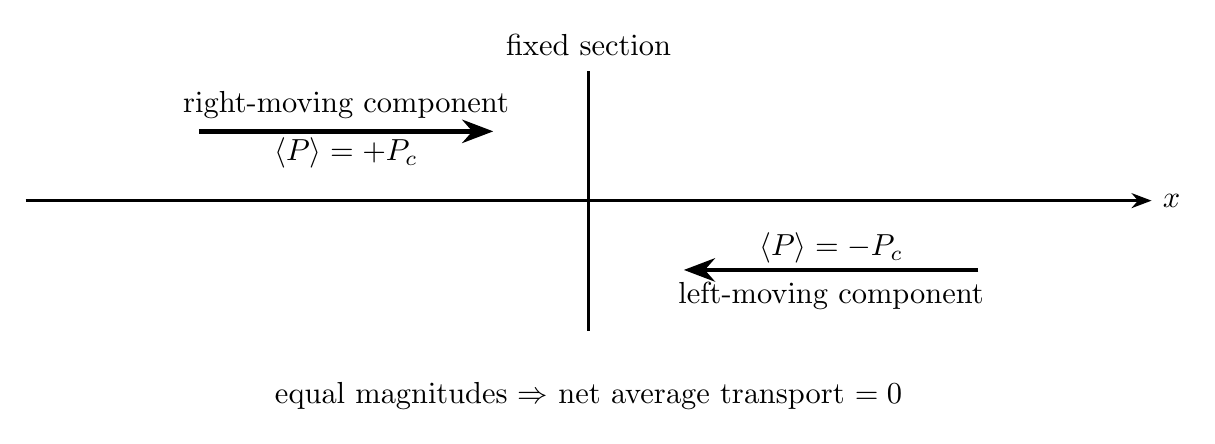
Exercise 10: Signed average power

Two otherwise identical sinusoidal waves have the same A, f, μ, and c. One travels right and the other travels left. The magnitude of the average power carried by each is

1.8 W.
(27)

Using the WM19 sign convention:

  1. state the signed average power of the right-moving wave,
  2. state the signed average power of the left-moving wave,
  3. find the net average power if both are present simultaneously with equal amplitudes and frequencies.

PIC

Figure. Equal right- and left-moving sinusoidal waves carry equal-magnitude average powers with opposite signs.

Exercise 11: Perfect standing wave

A Standing Wave is formed from two equal sinusoidal waves traveling in opposite directions. Each component separately carries average power magnitude

Pc.
(28)

  1. What is the net time-averaged power through any fixed point?
  2. Does this imply that the standing wave has zero energy?
  3. Explain the physical difference between zero average transport and zero stored energy.

Exercise 12: Changing the tension changes the medium

A sinusoidal wave is maintained at fixed displacement amplitude A and fixed ordinary frequency f on a string whose linear density μ is unchanged. The tension is increased from T0 to 4T0.

  1. By what factor does the wave speed change?
  2. By what factor does the average power change?
  3. Explain why the simple scaling P⟩ ∝ A2f2 is not by itself enough to answer this problem.

Exercise 13: Diagnose conceptual statements

For each statement, decide whether it is correct. If it is incorrect, rewrite it accurately.

  1. “Because a sinusoidal displacement averages to zero, its average power is zero.”
  2. “For a sinusoidal traveling wave, peak instantaneous power is twice the average power.”
  3. “Doubling amplitude doubles average power.”
  4. “A left-moving wave can be represented by a negative signed average power.”
  5. “The relation P= c⟨ℰ⟩ says that energy density multiplied by propagation speed gives energy per unit time.”

Exercise 14: Full synthesis

A right-moving sinusoidal wave travels on a string with

T =  100N,      μ = 0.025kg/m,
(29)

and has

A =  4.0 mm,      λ = 2.0 m.
(30)

Find:

  1. c,
  2. k,
  3. f,
  4. ω,
  5. vrms,
  6. ⟨ℰ⟩,
  7. P,
  8. Pmax,
  9. Eλ.

Then verify numerically that

Eλ = ⟨P ⟩T0.
(31)

Part II: Complete Worked Solutions

Solution 1: Derive the one-half factor

At fixed x, define

𝜃 =  kx − ωt + ϕ.
(32)

Then

d𝜃 = − ω dt.
(33)

Over one complete period, the phase changes by 2π, so

              ∫
⟨   2  ⟩   -1-  2π   2
 sin 𝜃  =  2π     sin  𝜃d𝜃.
               0
(34)

Use

        1 − cos(2𝜃)
sin2 𝜃 = -----------.
             2
(35)

Therefore

⟨   2  ⟩
 sin 𝜃 = -1-
2 π 02π1-−-cos(2𝜃)
     2 d𝜃 (36)
= -1-
2 π[π ] (37)
= 1-
2 . (38)

Since

P = T A2k ω sin2 𝜃,
(39)

the average is

|-------1--------|
|⟨P⟩ =  -T A2kω. |
--------2--------|
(40)

Solution 2: Average and peak power from string data

Given

A = 0.0050 m,     f =  18Hz,     μ =  0.015kg/m,      T =  54N,
(41)

first compute

c = ∘  ---
   T
   μ- (42)
= ∘  ------
    54
   ------
   0.015 (43)
= 60 m/s . (44)

The angular frequency is

ω = 2 πf = 36 π ≃ 113.1rad/s.
(45)

Now

P = 1-
2μA2ω2c (46)
= 1
2-(0.015)(0.0050)2(113.1)2(60) (47)
0.144 W . (48)

For a sinusoidal traveling wave,

P    =  2⟨P ⟩,
  max
(49)

so

|----------------|
-Pmax-≃-0.288-W--.
(50)

Solution 3: Use the TA2form

Convert the amplitude:

A = 0.0025 m.
(51)

Then

P = 1-
2TA2 (52)
= 1
--
2(72)(0.0025)2(6.0)(180) (53)
= 0.243 W . (54)

Therefore

|----------------|
-Pmax-=-0.486-W--.
(55)

Solution 4: Square-law scaling

For fixed string properties,

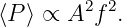
⟨P ⟩ ∝ A2f 2.
(56)

Hence

Pnew
-----
 P0 = (1.40)2(0.75)2 (57)
= 1.96(0.5625) (58)
= 1.1025 . (59)

Thus the power increases by about 10.3%.

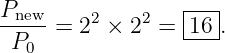
If both amplitude and frequency double,

Pnew     2   2   |---|
-P---=  2 × 2  = -16-.
  0
(60)

Solution 5: Required amplitude

Use

⟨P ⟩ = 1-μA2 ω2c.
      2
(61)

Solve for A:

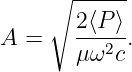
     ∘ ------
       2 ⟨P ⟩
A  =   -----.
       μ ω2c
(62)

The angular frequency is

ω = 2 π(30) = 188.5rad/s.
(63)

Therefore

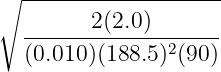
A = ∘  --------------------
         2(2.0)
   (0.010)(188.5)2(90-) (64)
0.0112 m. (65)

Thus

|-------------|
-A-≃--11.2-mm--.
(66)

Solution 6: Infer frequency from measured average power

Start from

⟨P⟩ = 2π2 μA2f 2c.
(67)

Solve for f:

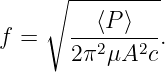
    ∘ ---------
      ---⟨P⟩---
f =   2 π2μA2c .
(68)

Substitute

A = 0.0030 m.
(69)

Then

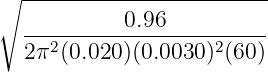
f = ∘ ------------------------
            0.96
  ---2---------------2----
  2 π (0.020 )(0.0030 ) (60 ) (70)
67.1 Hz . (71)

Solution 7: RMS transverse velocity

Use

⟨P ⟩ = μcv2rms.
(72)

Thus

P = (0.018)(75)(0.42)2 (73)
0.238 W . (74)

For part (b),

       A ω
vrms = √---,
         2
(75)

so

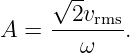
     √ --
     --2vrms
A  =    ω   .
(76)

With

ω = 2 π(22) = 138.2rad/s,
(77)

we obtain

A  ≃ 4.30 × 10⁻³ m.
(78)

Therefore

|-------------|
|A ≃  4.30 mm  .
---------------
(79)

Solution 8: Average energy density and energy per wavelength

Use

⟨P ⟩ = c⟨ℰ ⟩.
(80)

Hence

                   |-------|
⟨P⟩ = (50)(0.24) = -12.0-W--.
(81)

The period is

T  =  λ-= 1.25 =  0.0250-s.
  0   c    50     ---------
(82)

The energy in one wavelength is

                           |-------|
Eλ = ⟨ℰ ⟩λ =  (0.24 )(1.25) = -0.300J-.
(83)

The energy crossing a point in one period is

                         |-------|
⟨P⟩T  = (12.0)(0.0250) = |0.300 J .
    0                    --------
(84)

The two values agree, as they must.

Solution 9: Spatial average versus temporal average

The spatial average is

             ∫
        Pmax-  x0+λ    2
⟨P ⟩x =   λ         sin (kx +  δ)dx.
              x0
(85)

Let

𝜃 = kx + δ,     d𝜃 = kdx.
(86)

Over one wavelength,

k λ = 2π,
(87)

so the phase spans one complete cycle. Therefore

                       |-----|
            ⟨     ⟩    Pmax  |
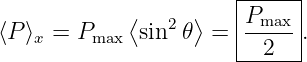
⟨P⟩x = Pmax  sin2𝜃  =  ----- .
                       --2----
(88)

The temporal average is identical because at a fixed position the phase also spans exactly 2π during one period. Both averages therefore sample one complete phase cycle.

Solution 10: Signed average power

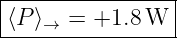
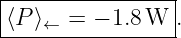
Under the WM19 sign convention, rightward energy flow is positive and leftward flow is negative.

Thus

|----------------|
|⟨P⟩   = +1.8 W  |
----→------------
(89)

and

|----------------|
|⟨P ⟩← =  − 1.8 W  .
-----------------
(90)

If both equal components are present,

                    |--|
⟨P ⟩net = 1.8 − 1.8 =-0-.
(91)

Solution 11: Perfect standing wave

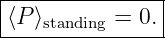
  1. Equal counter-propagating components contribute equal and opposite average powers, so
    |--------------|
⟨P-⟩standing-=-0.-
    (92)

  2. No. A standing wave can contain substantial kinetic and elastic potential energy.
  3. Zero average transport means that there is no net energy crossing a fixed point over a complete cycle. Stored energy refers to energy present in the oscillating medium. A standing wave can exchange energy locally between kinetic and elastic forms while carrying no net time-averaged energy in either direction.

Solution 12: Changing the tension changes the medium

The wave speed is

    ∘ ---
       T
c =    -.
       μ
(93)

If

T →  4T0,
(94)

then

    √ --     |---|
c →   4 c0 = 2c0-.
(95)

At fixed A, f, and μ,

         2   2 2
⟨P⟩ = 2π  μA  f c.
(96)

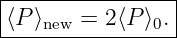
Therefore doubling c doubles the average power:

|----------------|
-⟨P⟩new-=-2⟨P-⟩0.|
(97)

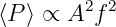
The simple statement

        2 2
⟨P ⟩ ∝ A f
(98)

assumes the medium properties remain fixed. Here the tension changes, so the propagation speed also changes and must be included.

Solution 13: Diagnose conceptual statements

  1. Incorrect. Sinusoidal displacement averages to zero, but power is quadratic in the wave derivatives and has a positive cycle average for a right-moving wave.
  2. Correct. For P = Pmax sin 2𝜃, the mean of sin 2𝜃 is 12, so P max = 2P.
  3. Incorrect. At fixed medium properties and frequency, doubling amplitude multiplies average power by four.
  4. Correct. Under the WM19 convention, a left-moving wave has negative signed average power.
  5. Correct. Energy density has units of joules per meter, and multiplying by meters per second gives joules per second, which is power.

Solution 14: Full synthesis

Given

T =  100 N,     μ = 0.025 kg/m,     A  = 0.0040 m,     λ = 2.0 m,
(99)

first find the wave speed:

c = ∘  ---
   T
   --
   μ (100)
= ∘  ------
    100
   ------
   0.025 (101)
= 63.25 m/s . (102)

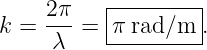
The Wavenumber is

          |--------|
k = 2π-=  π rad/m  .
     λ    ----------
(103)

The frequency is

                 |---------|
f = c-=  63.25-= |31.62 Hz .
    λ     2.0    ----------
(104)

The angular frequency is

           -------------
           |           |
ω = 2πf  ≃ -198.7rad/s-.
(105)

The RMS transverse velocity is

vrms = Aω
√---
  2 (106)
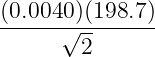
= (0.0040-)(198.7)
      √2-- (107)
0.562 m/s . (108)

The average energy density is

⟨ℰ⟩ = 1-
2μA2ω2 (109)
7.90 × 10³ J/m . (110)

The average power is

P = c⟨ℰ⟩ (111)
(63.25)(7.90 × 10³) (112)
0.500 W . (113)

The peak instantaneous power is

|--------------|
Pmax-=--1.00-W--.
(114)

The energy in one wavelength is

                                  |-------------|
E λ = ⟨ℰ⟩λ ≃  (7.90 × 10 −3)(2.0) = |1.58 × 10⁻²J .
                                  ---------------
(115)

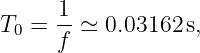
Finally,

     -1
T0 = f  ≃ 0.03162 s,
(116)

so

PT0 (0.500)(0.03162) (117)
1.58 × 10² J. (118)

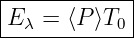
Thus

|------------|
|E λ = ⟨P ⟩T0 |
-------------
(119)

is verified numerically.

Common mistakes

  • Mistake: forgetting the factor 12 from the cycle average of sin 2.
  • Mistake: confusing peak power with average power.
  • Mistake: applying P⟩∝ A2f2 while changing the string tension or density.
  • Mistake: treating signed left-moving average power as a negative amount of energy. The negative sign indicates direction of flow.
  • Mistake: assuming zero average standing-wave power means zero stored energy.
  • Mistake: mixing displacement amplitude A with RMS transverse velocity.

What WM20E1 reinforces

These exercises reinforce the central WM20 result

|------------------------------------------|
|       1    2     1    2 2      2   2  2  |
|⟨P ⟩ = -T A k ω = --μA  ω c = 2π μA  f  c.|
--------2----------2-----------------------
(120)

They also connect average power to RMS velocity, average energy density, signed propagation direction, and energy transport over one wavelength and one period. These ideas prepare directly for later discussions of intensity, flux, impedance, and reflection/transmission.

References

References

[1]   A. P. French, Vibrations and Waves, M.I.T. Introductory Physics Series, W. W. Norton & Company, 1971.

[2]   Frank S. Crawford, Jr., Waves, Berkeley Physics Course, Volume 3, McGraw-Hill, 1968.

[3]   William Moebs, Samuel J. Ling, and Jeff Sanny, University Physics, Volume 1, OpenStax, 2016, Section 16.4, “Energy and Power of a Wave.”

[4]   Howard Georgi, The Physics of Waves, Prentice Hall, 1993.

[5]   Massachusetts Institute of Technology, 8.03SC Physics III: Vibrations and Waves, MIT OpenCourseWare, Fall 2016.

[6]   Richard P. Feynman, Robert B. Leighton, and Matthew Sands, The Feynman Lectures on Physics, Volume I, Chapter 47, “Sound. The Wave Equation.”


"example of Wave Mechanics: Average Power of a Sinusoidal Wave" is owned by bloftin.
(view preamble)
View style:
Other names:  WM20E1
Keywords:  wave mechanics, average power, sinusoidal wave, stretched string, cycle average, RMS velocity, energy density, power scaling, wave energy, exercises, worked solutions

This object's parent.

Cross-references: impedance, flux, Wavenumber, position, Standing Wave, WM19, velocity, Tension, speed, magnitude, energy, power, mechanics, wave, WM20

This is version 1 of example of Wave Mechanics: Average Power of a Sinusoidal Wave, born on 2026-09-12.
Object id is 1188, canonical name is ExampleOfWaveMechanicsAveragePowerOfASinusoidalWave.
Accessed 2 times total.

Classification:
Physics Classification46.40.Cd (Mechanical wave propagation (including diffraction, scattering, and)
 46.40.-f (Vibrations and mechanical waves )
Pending Errata and Addenda
None.
Discussion
Style: Expand: Order:

No messages.

Interact
rate | post | correct | update request | add example | add (any)