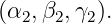
Euler Angles: 3-1-3 Proper Euler Sequence
The intrinsic 3-1-3 sequence is the flagship proper Euler sequence in this PhysicsLibrary
series.
Its chronological frame rotations are
- rotate through α about axis 3 of the initial frame;
- rotate through β about axis 1 of the first intermediate frame;
- rotate through γ about axis 3 of the second intermediate frame.
The resulting passive coordinate transformation is
The sequence is called a proper Euler sequence because the first and third axis labels are the same
while the middle axis is different.
This article develops the moving-axis geometry, full direction cosine matrix, inverse extraction
formulas, singularity structure, quaternion equivalent, angular-velocity relationship, and numerical
checks for intrinsic 3-1-3.
The separate Euler 313 sequence entry remains the compact sequence reference. EA08 is the
deeper derivation and engineering treatment.
1 Frame and transformation convention
Let A be the reference frame and B the final oriented frame.
PhysicsLibrary uses the passive coordinate map
The physical vector is unchanged. Only its coordinate representation changes.
Positive frame rotation follows the right hand rule. Passive does not mean that the physical frame
rotation is reversed. The opposite sign appears when the same transformation is interpreted as an
active rotation of a vector.
For intrinsic Euler rotations, every later rotation axis belongs to the current intermediate
frame.
2 Intrinsic 3-1-3 frame construction
Define
After the first rotation, call the intermediate frame A1. After the second rotation, call the next
frame A2. After the third rotation,
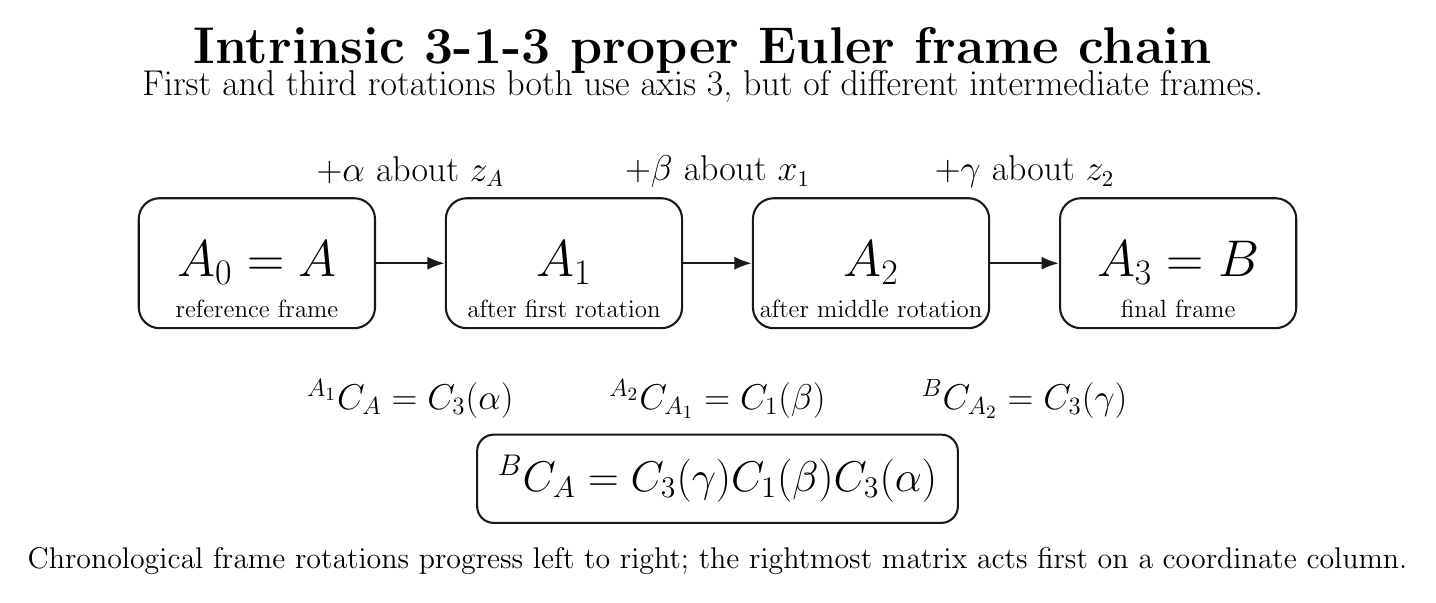
Figure. Intrinsic 3-1-3 frame chain. The first rotation is about zA, the middle rotation is
about the moved axis x1, and the final rotation is about the moved axis z2.
The three intermediate passive coordinate maps are
and
Matching adjacent frame labels gives
so
The chronological frame rotations progress from left to right through the intermediate frames,
while the rightmost matrix acts first on a coordinate column.
3 Why the repeated axis label does not mean the same physical axis
The defining feature of a proper Euler sequence can be misleading at first. The sequence is 3-1-3,
but the two axis-3 rotations are generally not about the same physical line.
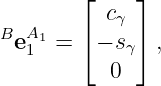
The first rotation uses
The middle rotation is about x1. Because a nonzero rotation about x1 changes the directions of y1
and z1, the new axis z2 is generally tilted away from zA.
The third rotation is about this new axis z2.
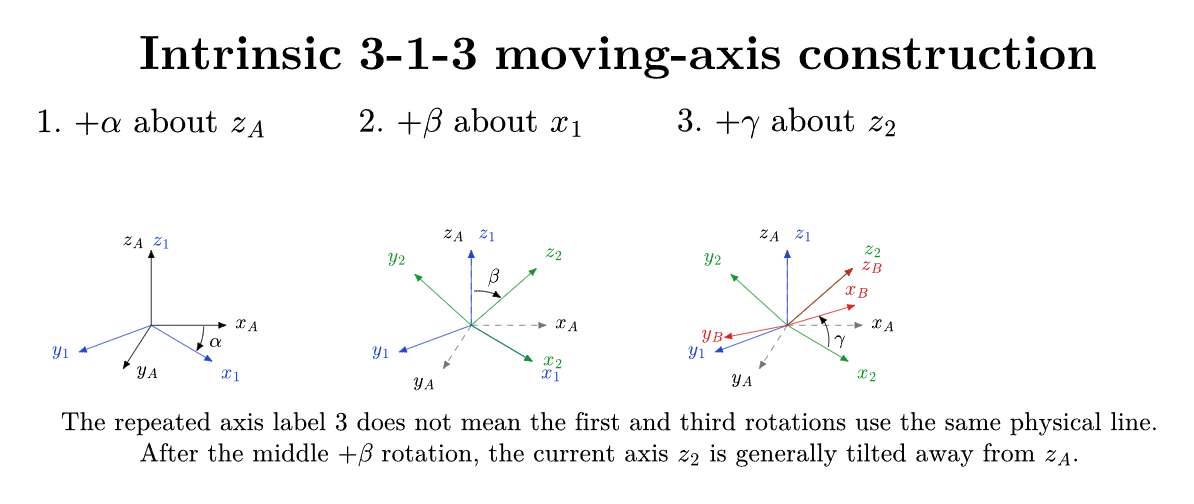
Figure. Moving-axis interpretation of intrinsic 3-1-3. The middle rotation changes the
direction of the current axis 3, so the final +γ rotation is generally not about the original
zA line.
This distinction is the reason the first and third rotations cannot normally be combined into one
rotation.
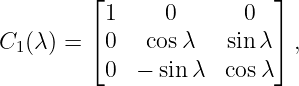
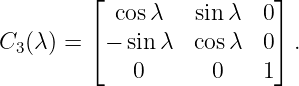
4 Elementary passive matrices
The passive axis-1 and axis-3 matrices used by the sequence are
and
Each matrix maps coordinates from the old frame into coordinates of the new frame after a
positive physical frame rotation.
5 Derivation of the full 3-1-3 DCM
Introduce the abbreviations
and
First multiply the middle and first transformations:
Premultiplying by C3(γ) gives
This is the canonical PhysicsLibrary passive intrinsic 3-1-3 DCM.
6 Single-angle reductions
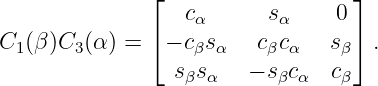
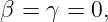
The full matrix should reduce to the elementary transformations when two angles vanish.
If
then
If
then
If
then
These three tests are among the fastest ways to detect sign or multiplication order errors in an
implementation.
7 Meaning of the DCM rows and columns
For
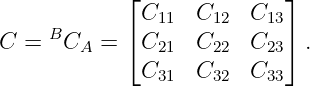
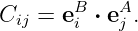
the matrix elements satisfy
Thus row i is the ith basis vector of frame B expressed in frame A, while column j is the jth basis
vector of frame A expressed in frame B.
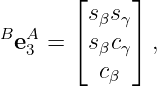
In particular, the third row is
The angle between zA and zB is therefore controlled directly by β, because
For this reason the middle angle is often interpreted as a nutation or tilt angle in Classical
Mechanics applications.
8 Line of nodes interpretation
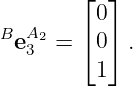
After the first rotation about zA, the axis x1 lies in the plane perpendicular to zA.
The middle rotation is performed about x1. Since x1 is unchanged by that middle rotation,
Geometrically, this axis is the line about which the original zA direction is tilted into the new z2
direction.
In many classical rigid-body treatments it is called the line of nodes. The terminology is useful, but
the frame labels remain the more reliable way to specify the convention.
9 Principal angle ranges
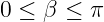
A common principal branch for proper Euler Angles is
and
On this branch,
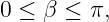
The end points β = 0 and β = π are precisely the singular configurations of the coordinate
chart.
10 Inverse extraction from the DCM
Let
Away from the singularity, the principal middle angle follows from
Because
we obtain
Likewise,
so
The two-argument function atan2 is essential because it retains the correct quadrant of each outer
angle.
11 Numerically useful atan2 form for the middle angle
Since
and sin β ≥ 0 on the principal branch, one may compute
The same result follows from
This form can be preferable in software because it uses both sine-like and cosine-like
information.
12 The 3-1-3 singularity
The inverse formulas for the outer angles require
Therefore intrinsic 3-1-3 becomes singular when
On the standard principal branch,
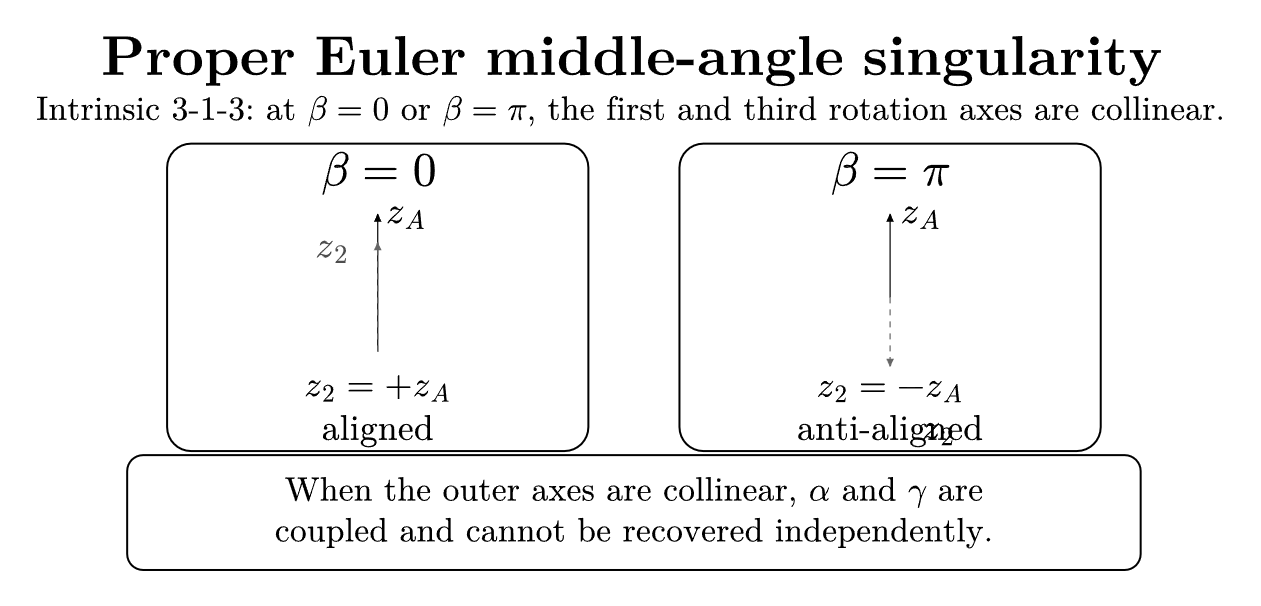
Figure. Proper Euler middle-angle singularity. At β = 0, the first and third axis-3
directions are aligned. At β = π, they are anti-aligned.
The physical orientation remains perfectly valid. Only the Euler coordinate chart loses one
independent coordinate direction.
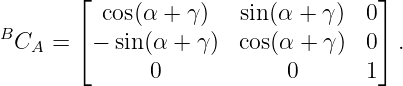
13 Exact outer-angle coupling at beta equal to zero
Set
Then
Rotations about the same axis add, giving
Explicitly,
Only the combination
is observable. The individual outer angles cannot be recovered.
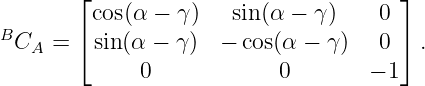
14 Exact outer-angle coupling at beta equal to pi
Set
Substituting into the full matrix gives
Only the difference
is independently observable.
Thus both singular end points collapse the two outer angles into one observable combination, but
the combination changes from a sum to a difference.
15 A practical singular-case extraction policy
A numerical implementation must choose a convention when | sin β| falls below a selected
threshold.
One possible policy is to set
at singularity and assign the entire observable outer-angle combination to α.
At β = 0, define
With γ = 0,
At β = π, define
Again choosing γ = 0 gives
A different implementation may hold α fixed and assign the coupled angle to γ. The important
requirement is an explicit and consistent policy.
16 Alternate Euler branch
Away from singularity, a nonprincipal triple representing the same orientation is
with the outer angles wrapped by integer multiples of 2π as needed.
The principal restriction
selects one representative away from the singular end points.
This is another reminder that Euler triples are coordinates, not unique physical vectors.
17 Equivalent extrinsic description
Intrinsic 3-1-3 with chronological angle list
is equivalent to extrinsic 3-1-3 with the reversed chronological angle list
Therefore
Because the axis sequence is palindromic, the digit string remains 313 even though the chronology
and angle association reverse.
18 Active versus passive 3-1-3 matrices
The PhysicsLibrary matrix is passive:
The corresponding active rotation matrix is the transpose,
Consequently, a matrix found in another reference may appear transposed or may use the opposite
signs in its elementary factors while describing the same physical orientation under an active-vector
convention.
19 Passive quaternion equivalent
For a positive passive frame rotation about axis i,
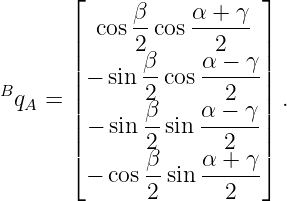
Therefore intrinsic 3-1-3 has quaternion product
Under Hamilton multiplication with scalar-first storage, this product reduces to the compact
form
The quaternion and DCM represent the same passive map:
The sum and difference of the outer angles already appear naturally in this quaternion expression,
foreshadowing the singularity structure of the Euler coordinates.
20 Angular velocity from the Euler angle rates
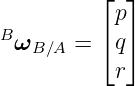
Let
be the angular velocity of frame B relative to frame A, expressed in frame B coordinates.
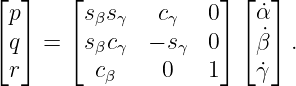
The physical angular velocity is the sum of the three instantaneous frame rotations:
Expressing these axes in frame B gives
and
Therefore
The determinant of this rate matrix is
Thus the rate mapping becomes singular at exactly the same configurations as the Euler
coordinate extraction.
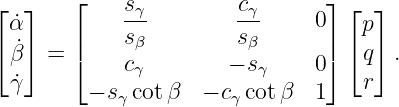
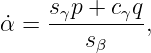
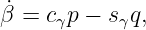
21 Euler rates from body angular velocity
Away from sin β = 0, the inverse relationship is
Equivalently,
and
The blow-up of the coefficients as β approaches 0 or π is a coordinate effect, not a physical
divergence of angular velocity.
22 Classical precession, nutation, and spin language
A common classical-mechanics use of 3-1-3 associates the three angles with
- α: precession about the reference axis zA;
- β: nutation or tilt about the line of nodes x1;
- γ: spin about the current body-related axis z2.
This terminology is useful in rigid-body dynamics, but it is not a substitute for stating the axis
sequence and active/passive convention. Different texts may assign different symbols to precession,
nutation, and spin.
23 Numerical example
Take
Then
becomes approximately
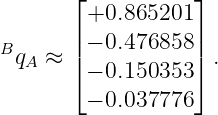
The corresponding passive quaternion is
The matrix satisfies
and
to numerical precision.
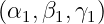
Applying the inverse formulas gives
confirming the principal-branch round trip.
24 Relative attitude is not found by subtracting Euler angles
Suppose two attitudes are represented by 3-1-3 triples
and
The exact relative orientation is not generally obtained by subtracting the three coordinates
component by component.
If
then the exact relative passive DCM is
If a relative 3-1-3 triple is needed, extract it from this relative DCM. Quaternion composition gives
the equivalent exact result.
25 Implementation guidance
A robust software implementation should separate three tasks:
- build a DCM or quaternion from the Euler coordinates;
- propagate orientation with a nonsingular representation when practical;
- extract 3-1-3 angles only when the coordinate representation is actually needed.
Near β = 0 or β = π, the extracted outer angles may change rapidly while the underlying DCM or
quaternion varies smoothly. This is expected behavior for the coordinate chart.
For numerical extraction, clamp roundoff-sensitive values such as C33 to the interval [−1, 1] before
using arccos, and define an explicit singularity threshold for | sin β|.
26 Convention traps in the literature
A statement such as “Euler 313 angles” does not fully determine a matrix. At minimum,
identify:
- intrinsic or extrinsic axes;
- active or passive transformation;
- coordinate-map direction;
- column-vector or row-vector convention;
- positive-angle convention;
- chronological rotation order versus written matrix-factor order;
- the symbol assignment to first, second, and third angles;
- the principal angle ranges used for inverse extraction.
For a palindromic sequence such as 313, intrinsic/extrinsic conversion is especially easy to
misread because the digit string itself does not change. The angle chronology must still
reverse.
27 Verification battery
A correct PhysicsLibrary 3-1-3 implementation should satisfy:
- zero angles give the identity matrix;
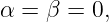
- β = γ = 0 gives C3(α);
- α = γ = 0 gives C1(β);
- α = β = 0 gives C3(γ);
- CCT = I;
- det C = 1;
- the reverse coordinate map is CT ;
- DCM-to-Euler round trips recover the principal branch away from sin β = 0;
- at β = 0, the DCM depends only on α + γ;
- at β = π, the DCM depends only on α − γ;
- the DCM agrees with the passive quaternion product;
- the Euler-rate matrix has determinant − sin β and becomes singular at the same
middle-angle configurations.
28 Summary
The PhysicsLibrary intrinsic 3-1-3 proper Euler sequence is
Its passive coordinate map is
Away from singularity,
and
The singular configurations are
At the first, only α + γ is observable; at the second, only α − γ is observable.
The equivalent passive quaternion is
The 3-1-3 sequence is therefore a useful local coordinate system for classical rigid-body orientation,
while DCMs and quaternions remain preferable for globally nonsingular numerical attitude
propagation.
The next article, Euler angles: DCM to Euler angles, develops systematic inverse extraction across
Euler sequences.
29 References and further reading
Henderson provides the classic NASA engineering development and tabulation of Euler
angle, quaternion, and transformation-matrix relationships across the twelve standard
sequences.
Moore develops reference-frame orientation and body-fixed Euler sequences in a modern mechanics
treatment, including angular-velocity formulas and gimbal-lock considerations.
Diebel gives a compact unified comparison of Euler angles, direction cosine matrices, unit
quaternions, and rotation vectors.
References
[1] D. M. Henderson, Euler Angles, Quaternions, and Transformation Matrices: Working
Relationships, JSC-12960, NASA Johnson Space Center, 1977. NASA Technical Reports
Server
[2] J. K. Moore, Learn Multibody Dynamics, chapters “Orientation of Reference Frames”
and “Angular Kinematics,” 2026 edition. Licensed CC BY 4.0. Learn Multibody
Dynamics
[3] J. Diebel, “Representing Attitude: Euler Angles, Unit Quaternions, and Rotation
Vectors,” Stanford University, 2006. Online PDF
License
Unless otherwise noted, this PhysicsLibrary entry is intended for release under the Creative
Commons Attribution ShareAlike 4.0 International license.




















![A B [ ]
e3 = s αsβ − cαs β cβ .](https://images.physicslibrary.org/cache/objects/1134/make4ht/EulerAngles313ProperEulerSequence25x.png)