Electromagnetic Waves, Antennas, and RF: Magnetic Forces on Charges and Currents
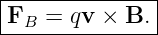
EM09 introduced the magnetic field through the Lorentz force on a moving charge,
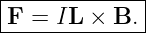
It also stated the corresponding force on a straight current-carrying segment. EM10 now connects
those two descriptions carefully. The main question is:
That bridge is important for motors, coils, transmission structures, and antennas. Later articles
will describe how currents generate magnetic fields; here the magnetic field is treated as externally
specified, and the focus is the mechanical force that field exerts on charges and currents
[1, 2, 3, 5].
1 Review: magnetic force on one moving charge
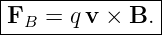
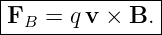
For a particle of charge q and velocity v in a magnetic field B,
The magnitude is
where 𝜃 is the angle between v and B.
For a positive charge, the force direction follows the right-hand rule for v × B. A negative charge
reverses that direction.
Because the cross product is perpendicular to v,
so the magnetic field does no instantaneous work on an isolated point charge:
The force can nevertheless redirect the motion.
2 From many moving charges to electric current
Consider a straight Conductor with cross-sectional area A. Suppose its mobile charge carriers have
number density n, charge q, and drift velocity vd.
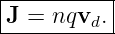
The current density is
For a uniform conductor carrying conventional current I along a unit direction ℓ,
and
The sign of q is already contained in J = nqvd. This is why conventional current points opposite to
electron drift in an ordinary metal.
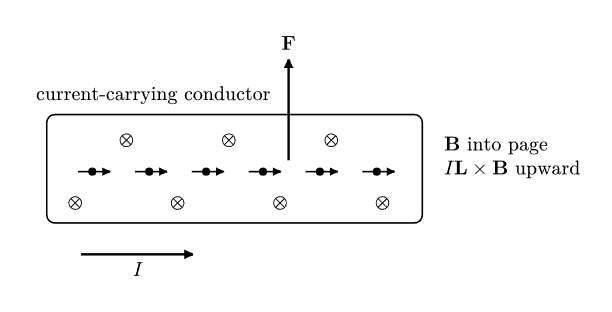
Figure. The magnetic forces on many moving charge carriers add to a macroscopic force
on a current-carrying conductor. Conventional current, not electron drift direction, is used
in the wire-force formula.
3 Deriving the force on a current element
Take a small conductor element of vector length
Its volume is
The number of mobile carriers in this volume is
Each carrier experiences magnetic force
Therefore the total force on the carriers in the small element is
| dF | = dN qvd × B | (14)
|
| = nAdℓqvd × B. | (15) |
Since
and, for a uniform straight conductor,
we obtain
This equation is the differential force law for a thin current-carrying wire.
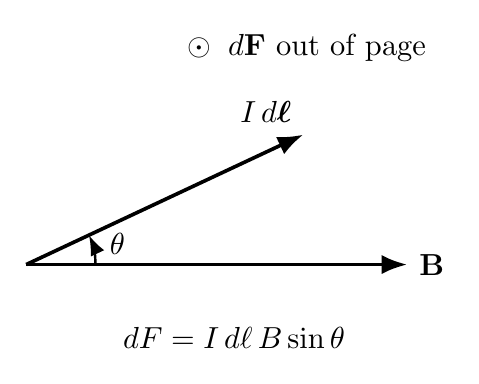
Figure. A current element I dℓ in a magnetic field experiences a force perpendicular to
both the current direction and the field.
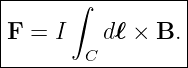
4 Force on a finite wire
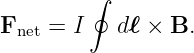
For a wire following a path C,
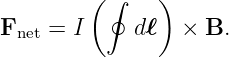
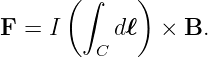
If B is uniform, it can be taken outside the integral:
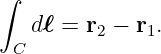
The line integral of dℓ is simply the displacement from the wire’s starting point to its ending
point:
Therefore, for a wire segment in a uniform field,
For a straight segment, define
and obtain the familiar result
Its magnitude is
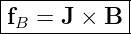
5 Force density in a continuous current distribution
The current-density description is even more general.
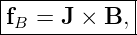
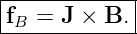
For a small volume dV carrying current density J, the force is
This identifies the magnetic force per unit volume:
Its SI units are
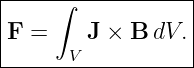
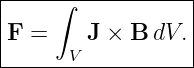
The total magnetic force on a volume V is therefore
This form is especially important later when currents are distributed through conductors, coils,
and antenna structures rather than confined to an ideal filament.
6 A closed current loop in a uniform field
For a closed loop in a uniform magnetic field,
Because B is uniform,
But a closed path returns to its starting point, so
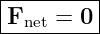
Hence
for a closed current loop in a uniform magnetic field.
Zero net force does not imply zero mechanical effect. Different parts of the loop can experience
opposite forces that form a couple and produce torque.
7 Torque on a rectangular current loop
Consider a rectangular loop carrying current I in a uniform magnetic field. Let the loop have area
A and unit normal n. Let 𝜃 be the angle between n and B.
Opposite sides of the loop experience equal and opposite magnetic forces. The net force is zero, but
the separated forces produce a torque.
For one turn, the torque magnitude is
For N identical turns,
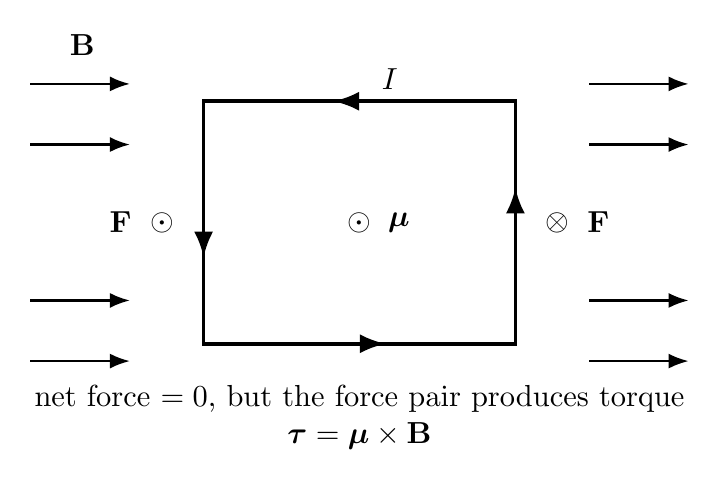
Figure. A current loop in a uniform magnetic field can have zero net force but nonzero
torque. The force pair tends to rotate the loop so that its magnetic moment aligns with the
field.
8 Magnetic dipole moment
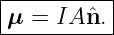
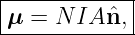
The magnetic dipole moment of a planar current loop is defined as
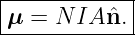
For N turns,
The unit normal is set by a right-hand rule: curl the fingers of the right hand in the direction of
conventional current; the thumb gives n and therefore the direction of μ.
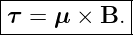
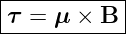
Using μ, the torque law becomes
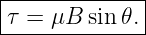
Its magnitude is
The magnetic moment therefore packages the current, loop area, number of turns, and loop
orientation into one vector.
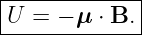
9 Magnetic dipole potential energy
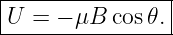
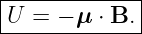
A magnetic dipole in an external magnetic field has orientation-dependent potential
energy
Therefore
The minimum energy occurs at
when μ is aligned with B.
The maximum energy occurs at
when they are antiparallel.
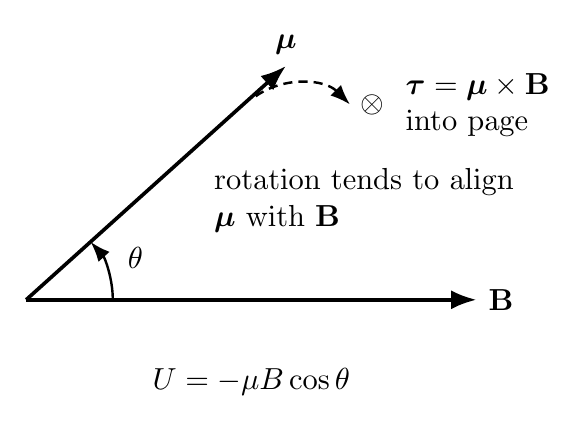
Figure. The torque τ = μ× B tends to rotate a current loop toward the lower-energy
aligned state.
10 Does this contradict the statement that magnetic force does no work?
At first glance, rotational motion of a current loop may seem to contradict the result from EM09
that magnetic force does no work on an individual point charge.
There is no contradiction.
For an isolated charge,
In a conductor, however, mobile charges are constrained by the material, and maintaining a current
generally involves electric fields, lattice forces, and possibly an external source. Mechanical energy
can be exchanged among the field, the conductor, and the source while the magnetic force on each
individual carrier remains perpendicular to that carrier’s instantaneous velocity contribution
associated with the Lorentz force.
For introductory calculations, the potential-energy formula
is therefore used for the mechanical orientation of a current loop in an externally imposed
field.
11 Worked Example 1: vector magnetic force on a charge
A positive charge
moves with
through
Then
| FB | = qv × B | (49)
|
| = (2.0 × 10⁻⁶)(3.0 × 10⁴)(0.20)(x ×z). | (50) |
Since
we obtain
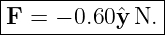
12 Worked Example 2: force on a straight conductor
A wire of length
carries
along +x through a field
The force is
| F | = IL × B | (56)
|
| = (4.0)(0.50)(0.30)(x ×z) | (57)
|
| = −0.60y N. | (58) |
Thus
13 Worked Example 3: force density
Suppose
and
Then
| fB | = J × B | (62)
|
| = (2.5 × 10⁶)(0.040)(x ×z) | (63)
|
| = −1.0 × 10⁵y N/m3. | (64) |
Hence
14 Worked Example 4: curved wire in a uniform field
A wire carries current I = 2.0 A from
to
along an arbitrary curved path. A uniform field is
The net force depends only on the endpoint displacement:
| F | = I(r2 − r1) × B | (69)
|
| = 2.0(0.30x + 0.40y) × (0.50z). | (70) |
Using
we get
15 Worked Example 5: torque on a single current loop
A one-turn loop has
and its normal makes an angle
with a uniform field
The magnetic moment magnitude is
The torque magnitude is
| τ | = μB sin 𝜃 | (77)
|
| = (0.060)(0.40) sin 30∘ | (78)
|
| = 1.2 × 10⁻² N m. | (79) |
Thus
16 Worked Example 6: multiturn coil
A coil has
Its normal is perpendicular to a field
The magnetic moment is
| μ | = NIA | (83)
|
| = 100(0.50)(4.0 × 10⁻⁴) | (84)
|
| = 2.0 × 10⁻² A m2. | (85) |
Since 𝜃 = 90∘,
Therefore
17 Worked Example 7: dipole energy change
A magnetic dipole has
in a field
Compare the potential energy at 𝜃 = 90∘ with the energy at alignment, 𝜃 = 0.
At 90∘,
At 0,
| U0 | = −μB | (91)
|
| = −(0.080)(0.25) | (92)
|
| = −2.0 × 10⁻² J. | (93) |
Therefore the change from 90∘ to alignment is
The aligned state is lower in energy.
18 Common misconceptions
- Current direction is conventional current direction. In a metal, electron drift
is opposite to the direction used for I dℓ.
- The force is not generally parallel to the current. It is proportional to dℓ× B.
- A closed loop can have zero net force and still have nonzero torque.
- The magnetic dipole moment is not the magnetic field. μ characterizes the
loop; B characterizes the applied field.
- A uniform magnetic field produces zero net force on a closed loop, but a
nonuniform field need not.
- J × B is a force density. It must be integrated over volume to obtain total force.
- Magnetic-force zero-work on a point charge does not forbid mechanical
torque on a constrained current loop.
19 Why this matters for antennas and RF structures
An antenna is not just a geometric object. It supports time-varying charge and current
distributions. Later articles will use those currents as sources of electromagnetic fields.
The present article establishes the mechanical side of that current-field interaction. In distributed
form,
shows that a magnetic field acts locally on current density.
This language becomes useful in antenna conductors, inductive structures, motors, coils, and
electromagnetic stress analysis. It also prepares the notation needed in EM11, where the direction
of reasoning is reversed: currents become the source of magnetic fields through the Biot–Savart
law.
20 Summary
The microscopic magnetic-force law is
For a thin current element,
For a current density,
and
A closed loop in a uniform field has zero net force but can experience torque. Defining
we obtain
and
EM11 next asks how moving charge and current generate magnetic fields.
References
[1] David J. Griffiths, Introduction to Electrodynamics, 4th ed., Cambridge University
Press, 2017.
[2] Samuel J. Ling, Jeff Sanny, and William Moebs, University Physics, Volume 2,
OpenStax, 2016, chapters on magnetic force, current loops, and sources of magnetic fields.
[3] Edward M. Purcell and David J. Morin, Electricity and Magnetism, 3rd ed.,
Cambridge University Press, 2013.
[4] Richard P. Feynman, Robert B. Leighton, and Matthew Sands, The Feynman Lectures
on Physics, Volume II, Addison-Wesley, 1964, chapters on magnetic force, currents, and
magnetic moments.
[5] Massachusetts Institute of Technology, 8.02 Physics II: Electricity and Magnetism,
MIT OpenCourseWare, materials on Lorentz force, current-carrying conductors, torque,
and magnetic dipoles.
















![[fB] = N/m3.](https://images.physicslibrary.org/cache/objects/1227/make4ht/ElectromagneticWavesMagneticForcesOnChargesAndCurrents25x.png)