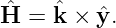
Electromagnetic Waves, Antennas, and RF: Vector Fields for Wave Mechanics - Exercises and
Complete Worked Solutions
This companion article provides self-study exercises for EM02, vector fields for wave mechanics. All
exercises are stated first. Complete worked solutions follow in Part II.
The problems remain intentionally within the EM02 mathematical foundation. They practice
vector components, magnitude, unit vectors, dot products, projections, wave vectors,
three-dimensional plane-wave phase, cross products, and the geometric relation among electric
field, magnetic field, and propagation direction. Gradient, divergence, curl, and Maxwell’s
equations are deferred to EM03 and later articles.
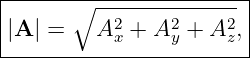
The central formulas used throughout are
with magnitude
the dot product
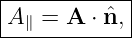
the scalar projection onto a unit direction n,
the cross product magnitude
and the three-dimensional plane-wave phase
These are the same definitions and conventions used in EM02 [1, 2, 3, 4].
How to use this problem set
Attempt all exercises in Part I before reading Part II. For every vector calculation, keep three
questions separate:
- What are the scalar components?
- What is the vector direction?
- What physical or geometric meaning does the result have?
A correct numerical result with the wrong direction is not a correct vector answer.
Part I: Exercises
Exercise 1: components, magnitude, and unit vector
Let
Find:
- the three Cartesian components;
- the magnitude |A|;
- the unit vector A;
- a numerical check that |A| = 1.
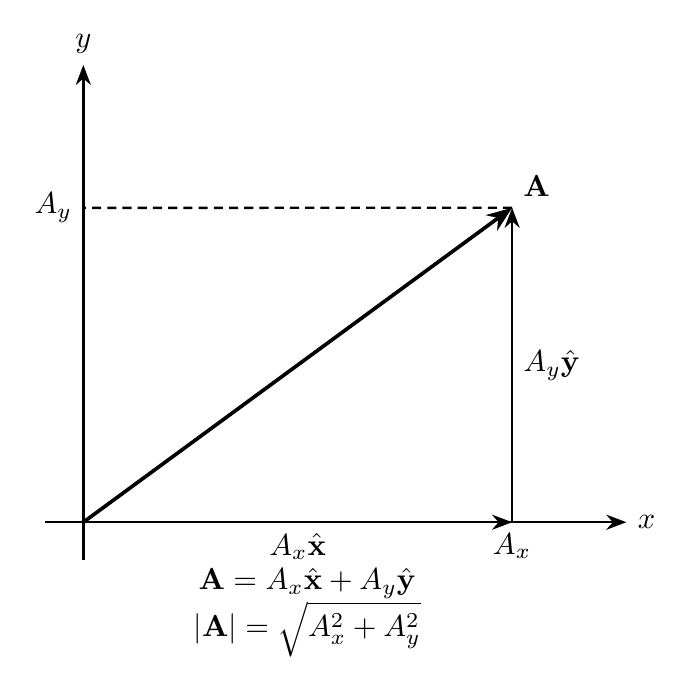
Figure. A vector is reconstructed from its Cartesian component contributions. The figure
is two-dimensional for clarity, but the same component logic extends directly to three
dimensions.
Exercise 2: displacement vector between two points
Two points are
and
Find the displacement vector from P to Q, its magnitude, and the corresponding unit direction
vector.
Exercise 3: use the dot product to test perpendicularity
Let
and
Compute A ⋅ B and determine whether the vectors are perpendicular.
Exercise 4: projection onto a sensor axis
An electric-field vector at one point is
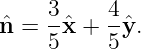
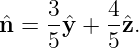
A sensor responds only along the unit direction
Find:
- the scalar component E∥ = E ⋅n;
- the vector projection E∥;
- the perpendicular remainder E⊥;
- the magnitude |E⊥|.
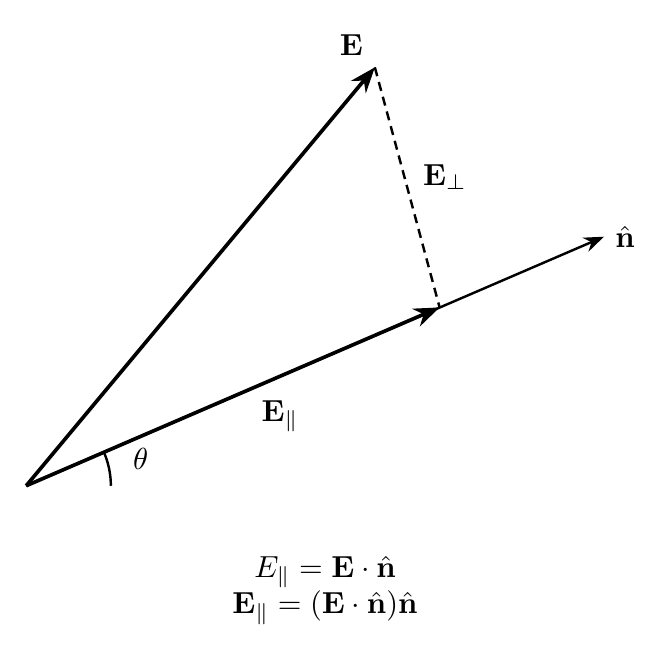
Figure. A field can be decomposed into a component along a measurement direction and a
component perpendicular to that direction.
Exercise 5: find the angle from a dot product
Let
and
Find the angle between the vectors in degrees.
Exercise 6: construct a wave vector from wavelength and direction
A plane wave has wavelength
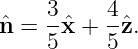
and propagates in the unit direction
Find:
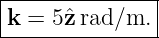
- the scalar Wavenumber k;
- the wave vector k in Cartesian components.
Exercise 7: evaluate a three-dimensional plane-wave phase
Let
Find:
- the spatial phase k ⋅ r;
- the total phase k ⋅ r − ωt.
Exercise 8: constant-phase planes
A plane wave has
At a fixed time, constant-phase surfaces satisfy
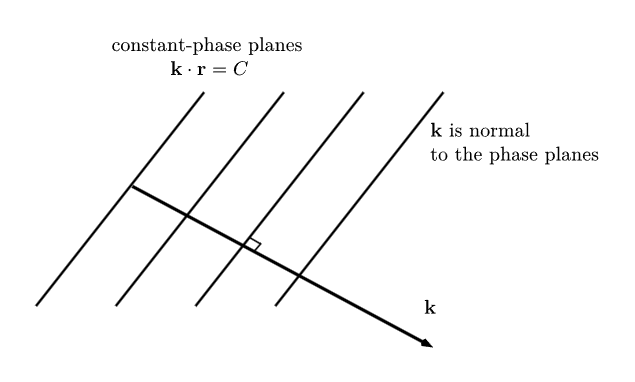
Figure. For a plane wave, k is normal to surfaces of constant phase.
Answer the following:
- Write the constant-phase equation in x and y.
- Show that the points
and
lie on the same constant-phase plane.
- Explain geometrically why k is perpendicular to those planes.
Exercise 9: compute a cross product in Cartesian form
Let
and
Find:
- A × B;
- |A × B|;
- B × A.
Exercise 10: parallel and perpendicular cross-product limits
Without using the component formula, evaluate each expression and explain the geometry:
- x ×x;
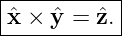
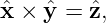
- x ×y;
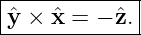
- y ×x;
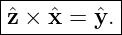
- z ×x.
Exercise 11: field direction versus propagation direction
Consider
Identify:
- the electric-field direction;
- the wave vector k;
- the propagation direction;
- whether the field is transverse to the propagation direction.
Exercise 12: complete a transverse electromagnetic triad
Suppose an ideal plane-wave geometry has
and
Find the direction of H so that
points along +z.
Then verify the three perpendicularity conditions using dot products.
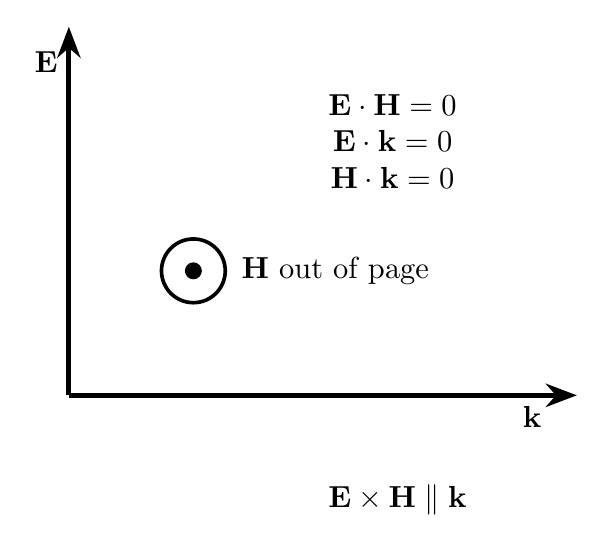
Figure. The ideal transverse triad is right handed: E × H points in the propagation
direction.
Exercise 13: read a wave vector from the phase
Consider
Find:
- the wave vector k;
- the scalar wavenumber k;
- the wavelength λ;
- the propagation unit vector k;
- a dot-product check that the electric field is transverse to k.
Exercise 14: synthesis - vector field, phase, sensor projection, and triad geometry
A plane-wave electric field is
At
and
answer the following:
- Find k and k = |k|.
- Find the wavelength λ.
- Find the propagation unit vector k.
- Evaluate the phase at (r0,t0).
- Evaluate E(r0,t0) as a multiple of E0.
- A sensor responds along
Find the sensor-measured scalar field component as a multiple of E0.
- Determine a unit direction for H such that E × H points along k.
Part II: Complete Worked Solutions
Solution 1: components, magnitude, and unit vector
The vector is
Therefore the scalar components are
Its magnitude is
| |A| | =  | (38)
|
| =  | (39)
|
| =  | (40)
|
| = 7. | (41) |
Hence
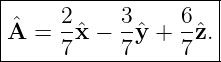
The unit vector is
| A | =  | (43)
|
| =  x − x − y + y +  z. z. | (44) |
Thus
Finally,
| |A| | = 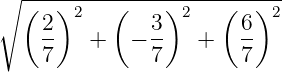 | (46)
|
| = 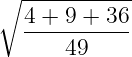 | (47)
|
| = 1. | (48) |
So the normalization check passes.
Solution 2: displacement vector between two points
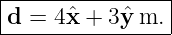
The displacement from P to Q is
Therefore
| d | = (5 − 1)x + (1 − (−2))y + (0 − 0)z | (50)
|
| = 4x + 3y m. | (51) |
Hence
Its magnitude is
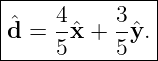
The unit direction is
Solution 3: use the dot product to test perpendicularity
Compute
| A ⋅ B | = (2)(3) + (3)(−2) + (−1)(0) | (55)
|
| = 6 − 6 | (56)
|
| = 0. | (57) |
For nonzero vectors, zero dot product means the vectors are perpendicular. Therefore
Solution 4: projection onto a sensor axis
The scalar component along the sensor axis is
| E∥ | = E ⋅n | (59)
|
| =  ⋅ ⋅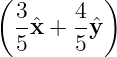 | (60)
|
| =  + +  | (61)
|
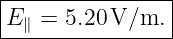
| =  V/m. V/m. | (62) |
Thus
The vector projection is
| E∥ | = (E ⋅n)n | (64)
|
| = 5.20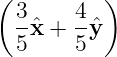 V/m V/m | (65)
|
| = 3.12x + 4.16y V/m. | (66) |
Therefore
The perpendicular part is
| E⊥ | = E − E∥ | (68)
|
| = (6 − 3.12)x + (2 − 4.16)y V/m | (69)
|
| = 2.88x − 2.16y V/m. | (70) |
Hence
Its magnitude is
| |E⊥| | =  | (72)
|
| = 3.60 V/m. | (73) |
Thus
Solution 5: find the angle from a dot product
First compute the dot product:
| A ⋅ B | = (1)(2) + (2)(1) + (2)(2) | (75)
|
| = 8. | (76) |
The magnitudes are
and
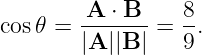
Therefore
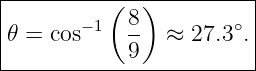
Hence
Solution 6: construct a wave vector from wavelength and direction
The scalar wavenumber is
| k | =  | (81)
|
| =  | (82)
|
| ≈ 10.472 rad/m. | (83) |
Therefore
The wave vector is
| k | = kn | (85)
|
| = 10.472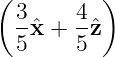 rad/m. rad/m. | (86) |
Thus
Solution 7: evaluate a three-dimensional plane-wave phase
The spatial phase is
| k ⋅ r | = (2)(1) + (3)(2) + (6)(−1) | (88)
|
| = 2 + 6 − 6 | (89)
|
| = 2 rad. | (90) |
Hence
The time-dependent contribution is
Therefore
Solution 8: constant-phase planes
With
the constant-phase condition is
Therefore
For
we obtain
For
we obtain
| k ⋅ r2 | = 3(−1) + 4(1.5) | (100)
|
| = −3 + 6 | (101)
|
| = 3. | (102) |
Thus both points have the same value of k ⋅ r and lie on the same constant-phase plane.
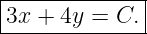
Geometrically, the equation
defines a plane whose normal vector is k. Any displacement Δr lying within the plane
satisfies
so in-plane directions are perpendicular to k.
Solution 9: compute a cross product in Cartesian form
Use
and
The cross product is
| A × B | = (AyBz − AzBy)x + (AzBx − AxBz)y + (AxBy − AyBx)z | (107)
|
| = (2 ⋅ 3 − 0)x + (0 − 1 ⋅ 3)y + (0 − 0)z | (108)
|
| = 6x − 3y. | (109) |
Therefore
Its magnitude is
| |A × B| | = 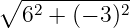 | (111)
|
| =  | (112)
|
| = 3 . . | (113) |
Hence
Reversing the order changes the sign:
Solution 10: parallel and perpendicular cross-product limits
For parallel unit vectors,
This follows from sin 0 = 0.
Using the right-handed Cartesian basis,
Reversing the order reverses the sign:
Finally,
The perpendicular cases all have unit magnitude because both input vectors have unit magnitude
and sin(π∕2) = 1.
Solution 11: field direction versus propagation direction
The field is
The vector prefactor x gives the electric-field direction. Thus
The spatial phase is 5z, so
Because the phase has the form kz − ωt, the pattern propagates toward increasing z:
Finally,
so the electric field is transverse to the propagation direction.
Solution 12: complete a transverse electromagnetic triad
We are given
and
We require
to point along +z.
Since
we choose
The three perpendicularity checks are
and
Thus the triad is mutually perpendicular and right handed.
Solution 13: read a wave vector from the phase
The phase is
Therefore
Its magnitude is
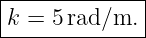
| k | = 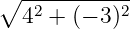 | (135)
|
| = 5 rad/m. | (136) |
Thus
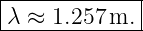
The wavelength is
| λ | =  | (138)
|
| =  m m | (139)
|
| ≈ 1.257 m. | (140) |
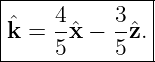
Hence
The propagation unit vector is
The electric-field direction is y. Therefore
| y ⋅k | = y ⋅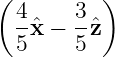 | (143)
|
| = 0. | (144) |
Thus the electric field is transverse to the propagation direction.
Solution 14: synthesis - vector field, phase, sensor projection, and triad geometry
The field is
The spatial phase gives
Its magnitude is
| k | =  | (147)
|
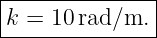
| = 10 rad/m. | (148) |
Thus
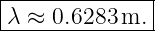
The wavelength is
| λ | =  m m | (150)
|
| ≈ 0.6283 m. | (151) |
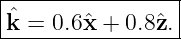
Therefore
The propagation unit vector is
At
the spatial phase is
| k ⋅ r0 | = (6)(0.10) + (8)(0.20) | (155)
|
| = 0.6 + 1.6 | (156)
|
| = 2.2 rad. | (157) |
The temporal term is
Therefore the total phase is
The electric field is
Since
we obtain
The sensor axis is
The measured scalar component is
| Emeas | = E ⋅n | (164)
|
| = 0.3624E0y ⋅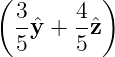 | (165)
|
| = 0.3624E0 | (166)
|
| ≈ 0.2174E0. | (167) |
Thus
Finally, the electric-field direction is y and the propagation direction is
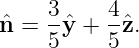
A unit magnetic-field direction that completes the right-handed triad is
Therefore
| H | =  ×y ×y | (171)
|
| = 0.6z − 0.8x. | (172) |
Hence
A check gives
so the orientation is correct.
Common mistakes
- Mistake: treating a scalar component such as Ax as though it were itself a vector.
The vector contribution is Axx.
- Mistake: allowing a vector magnitude to be negative. Component signs encode
direction; magnitude is nonnegative.
- Mistake: using the dot product when a perpendicular vector is required. The dot
product returns a scalar; the cross product returns a vector.
- Mistake: forgetting to normalize a measurement direction before interpreting A⋅n as
a scalar component.
- Mistake: confusing k with k. The scalar k is the magnitude; the vector k also contains
propagation direction.
- Mistake: reading field direction from the phase. The vector prefactor determines field
direction; the spatial phase determines propagation direction.
- Mistake: assuming A × B = B × A. Reversing the order reverses the sign.
- Mistake: applying the ideal plane-wave triad to arbitrary electromagnetic fields. EM02
and EM02E use it only as a preview of the uniform plane-wave geometry derived later.
What EM02E reinforces
The component form
makes vector direction and magnitude explicit.
The dot product provides alignment, projection, and perpendicularity tests:
The cross product provides a perpendicular direction with right-handed orientation:
For wave mechanics, the vector phase
contains the propagation geometry, while the vector field prefactor contains the field
direction.
The electromagnetic geometry that later follows from Maxwell’s equations is previewed
by
EM03 next introduces spatial derivatives of fields: gradient, divergence, and curl.
References
[1] David J. Griffiths, Introduction to Electrodynamics, 4th ed., Cambridge University
Press, 2017.
[2] Samuel J. Ling, Jeff Sanny, and William Moebs, University Physics, Volume 2,
OpenStax, 2016, chapters on electric and magnetic fields and electromagnetic waves.
[3] Richard P. Feynman, Robert B. Leighton, and Matthew Sands, The Feynman
Lectures on Physics, Volume II, Addison-Wesley, 1964, chapters introducing vector
electromagnetic fields.
[4] Massachusetts Institute of Technology, 8.02 Physics II: Electricity and Magnetism,
MIT OpenCourseWare, materials on vector fields and electromagnetic phenomena.
[5] H. M. Schey, Div, Grad, Curl, and All That, 4th ed., W. W. Norton & Company,
2005.
[6] Frank S. Crawford, Jr., Waves, Berkeley Physics Course, Volume 3, McGraw-Hill,
1968.

![[parent]](https://images.physicslibrary.org/images/uparrow.png)