This is a contributed entry
1 Potential Energy and Force acting on a Particle
Let us asssume from the start that the field’s force F is irrotational, i.e. ∇× F = 0, that is,
∇× F = 0 ↔ F = −∇U. In another words, the field’s force is conservative if and only if it is
irrotational. So the conseravation of mechanical energy dE∕dt = d(T + U)∕dt = 0 is a consequence
of that theorem. Once one imposes ∇× F = 0, then one is proving that the necessary condition is:
F = −∇U. Another consequence about the theorem is that the “work” of the field’s force is
independent of the path described by the particle in its motion. That is, if Γ1 and Γ2 are two
different paths, described by the particle, and joininig its initial and end position on the time
interval [t1,t2], then the line integrals ∫
Γ1F ⋅ dr = ∫
Γ2F ⋅ dr must be equal and hence
the work of the field’s force, as the particle describes a closed path, must be zero, i.e.
∮
F ⋅ dr = 0.
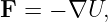
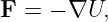
The relation between the force, F, acting on a particle, and the potential energy, U of that particle
is:
where ∇ is the gradient operator.
1.1 Derivation
The above relationship can be derived from the conservation of energy. Let T denote the
kinetic energy of a particle, and U its potential energy, with E the total energy, given by
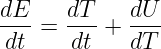
E = T + U.
Take the total time derivative of E, giving
The kinetic energy of a particle is expressed as T =  mv2, where m is the mass of the particle, and
v is the magnitude of the particle’s velocity. Recall that by Newton’s second law, F = mdv∕dt,
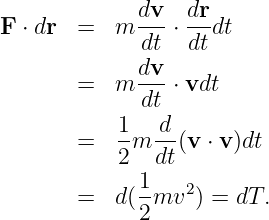
where v is the velocity vector. Consider, next, the quantity F ⋅ dr, where r is the position
vector of the particle. Expanding F in terms of Newton’s second law, it is seen that
mv2, where m is the mass of the particle, and
v is the magnitude of the particle’s velocity. Recall that by Newton’s second law, F = mdv∕dt,
where v is the velocity vector. Consider, next, the quantity F ⋅ dr, where r is the position
vector of the particle. Expanding F in terms of Newton’s second law, it is seen that
Therefore, dT∕dt = F ⋅ dr∕dt.
It is assumed that the potential energy is a function of time and space i.e. U = U(x1,x2,x3,t).
The time derivative of the potential energy can be expanded through the chain rule
as
Notice that
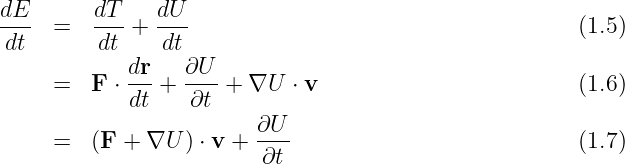
and substitute this result, as well as the expression for the time derivative of kinetic energy back
into the original equation for the time derivative of the total energy,
If the potential has no explicity time dependence i.e. it is dependent upon position, which is
dependent on time, then dU∕dt = 0, and the above becomes
where dE∕dt = 0 arises because of the conservation of energy within a closed system i.e. energy
does not enter or leave the system. Therefore, it follows that under the conservation of energy,
and the time independence of potential energy, F + ∇U = 0, which can be rewritten
as
which is the desired relation between the force acting on a particle and the the particle’s potential
energy in the presence of the force acting upon it.