This is a contributed topic on probability distribution functions and their applications in physics,
mostly in spectroscopy, quantum mechanics, statistical mechanics and the theory of extended QFT
operator algebras (extended symmetry, quantum groupoids with Haar measure and quantum
algebroids).
0.1 Probability Distribution Functions in Physics
0.1.1 Physical Examples
Example 0.2. A classical example of a continuous probability distribution function on ℝ is
the Gaussian distribution, or normal distribution
where σ2 is a parameter related to the width of the distribution (measured for example at
half-heigth).
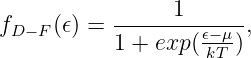
In high-resolution spectroscopy, however, similar but much narrower continuous distribution
functions called Lorentzians are more common; for example, high-resolution 1H NMR absorption
spectra of neat liquids consist of such Lorentzians whereas rigid solids exhibit often only
Gaussian peaks resulting from both the overlap as well as the marked broadening of
Lorentzians.
0.2 General definitions of probability distribution functions
Definition 0.1. One needs to introduce first a Borel space 𝔅, then consider a measure space
SM := (Ω,𝔅,μ), and finally define a real function that is measurable ‘almost everywhere’ on its
domain Ω and is also normalized to unity. Thus, consider (Ω,𝔅,μ) to be a measure space SM. A
probability distribution function (pdf) on (the domain) Ω is a function fp : Ω→ℝ such
that:
-
1.
- fp is μ-measurable
-
2.
- fp is nonnegative μ-measurable-almost everywhere.
-
3.
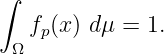
- fp satisfies the equation
Thus, a probability distribution function fp induces a probability measure MP on the measure
space (Ω,𝔅), given by
for all x ∈ 𝔅. The measure MP is called the associated probability measure of fp. MP and
μ are different measures although both have the same underlying measurable space
SM := (Ω,𝔅).
Definition 0.2. The discrete distribution (dpdf)
Consider a countable set I with a counting measure imposed on I, such that μ(A) := |A|, is
the cardinality of A, for any subset A ⊂ I. A discrete probability distribution function (dpdf)
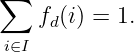
fd on I can be then defined as a nonnegative function fd : I→ℝ satisfying the equation
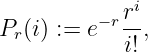
A simple example of a dpdf is any Poisson distribution Pr on ℕ (for any real number r), given by
the formula
for any i ∈ ℕ.
Taking any probability (or measure) space SM defined by the triplet (Ω,𝔅,μ) and a random
variable X : Ω→I, one can construct a distribution function on I by defining
The resulting Δ function is called the distribution of X on I.
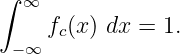
Definition 0.3. The continuous distribution (cpdf)
Consider a measure space SM specified as the triplet (ℝ,𝔅λ,λ), that is, the set of real
numbers equipped with a Lebesgue measure. Then, one can define a continuous probability
distribution function (cpdf) fc : ℝ→ℝ is simply a measurable, nonnegative almost everywhere
function such that
The associated measure has a Radon–Nikodym derivative with respect to λ equal to
fc:
Definition 0.4. One defines the cummulative distribution function, or cdf, F of fc by the
formula
for all x ∈ ℝ.
References
[1] B. Aniszczyk. 1991. A rigid Borel space., Proceed. AMS., 113 (4):1013-1015., available
online.
[2] A. Connes.1979. Sur la théorie noncommutative de l’ integration, Lecture Notes in
Math., Springer-Verlag, Berlin, 725: 19-14.