We start with a system of N particles. The kth particle is subject to the following forces: A
number of external forces which we replace by their resultant Fk; further, the force F1k due to the
presence of the of the first particle, F2k from the second and in general, Fik from the ith particle.
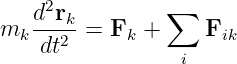
The equation of motion for the kth particle is thus
There are N such equations, one for each particle. Imagine them all written down and added
together:
Since the internal forces having both subscripts alike do not exist, according to our notation, the
combinations k = i are to be excluded from the double sum. Now for every force Fjk, the force
exerted by the jth particle on the kth, there corresponds a force Fkj that exerted by the kth
particle on the jth and these two forces are equal and opposite. Hence the double sum vanishes,
and the internal forces of the system cancel out in the summation. There remains in the
right member only the vector sum of the external forces acting on the individual particles. We now
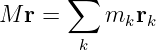
define the center of mass of a system to be a point whose radius vector r(referred to an arbitrary
center) multiplied by the total mass of the system is equal to the vector sum of the
products of individual radius vectors of the separate particles with the corresponding
masses:
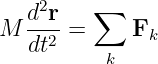
If we substitute this expression in equation (2), we have the theorem
The center of mass of a system moves as if the entire mass of the system were
concentrated there, with the resultant of the externally applied forces acting at that
point. In particular, if there are no external forces, the center of mass remains at rest or in a state
of uniform rectilinear motion. As is well known, this theorem is the basis of the explanation of
recoil phenomena. For example, if a shot is fired from a cannon standing upon a smooth horizontal
plane, then the gun must spring back with a velocity such that the common center of mass of
cannon and projectile remains in the vertical line through the point of firing for, neglecting friction
of the gun with the ground, the only external force is gravity, which has no horizontal
component.
Since the most universal external force is that of gravity, the center of mass is commonly
referred to as the center of gravity. Another name for it in equally general use is the
center of inertia. The following elementary considerations are useful in determining
this point: If r is the radius vector of the center of gravity of two particles m1 and m2,
then
or
this means that the vectors r − r1 and r2 − r are parallel. But since they have the terminus of r in
common, the three points m1, m2 and the center of gravity are collinear. The position of the center
of gravity is determined by
We thus have the rule: The center of gravity of two particles m1 and m2 divides the distance
between the particles in the ratio of the two masses, the center fo gravity being nearer the larger
masss. If, now, a third particle be added to the system, the center of gravity of the set will be the
center of gravity of m3 and the original ceter of gravity, where both m1 and m2 may be considered
concentrated. It is readily seen that the center of gravity, found in this way, is independent
of the order in which the particles are taken. The procedure is similar for additional
particles.
0.1 References
[1] Joos, Georg. ”Theoretical physics” 3rd Edition, Hafner Publishing Company; New York,
1954.
This entry is a derivative of the Public domain work [1].